
Over the course of 2026 a growing number of headlines have invited the public to panic about cychlorphine, a relatively recent addition to the drug supply that’s been implicated in overdose deaths across the country. Some of the claims are due to conflating cychlorphine and a different substance with a similar-sounding name, and most of them are due to the media industry’s perpetual unwillingness to explain that a substance being “involved in” or “linked to” overdose deaths is not the same thing as being the cause of those deaths. This isn’t to say cychlorphine isn’t causing harm, but the way we’re responding to it is going to cause a whole lot more.
Orphines are a class of synthetic opioid, like fentanyls or nitazenes. (They are separate from morphine, which is a plant-based substance derived from opium poppy, as well as from buprenorphine, which is semi-synthetic.) The first orphine identified in the United States drug supply was brorphine in 2020. But cychlorphine was the first to really attract media attention, after it began showing up in overdose toxicology around mid-2025. The Center for Forensic Science Research & Education (CFSRE) attributes this directly to China’s July 2025 crackdown on nitazenes.
Like with fentanyl analogs, nitazenes and whatever novel synthetic opioid will be discovered in the drug supply next, media has claimed that orphines are many times more potent than fentanyl even though their potency is largely unknown, and can also be less than that of fentanyl. For example, CFSRE characterizes 5,6-Dichloro Desmethylchlorphine as much less potent than fentanyl—about on par with morphine, and associated with “less respiratory depression compared to other opioid agonists.”
The commonly cited claim that cychlorphine is 10 times more potent comes from petri-dish data, not real-world overdose data involving humans, though of course that doesn’t mean it’s wrong. It’s reasonable to assume that cychlorphine is more potent than fentanyl. But it’s not driving or escalating the overdose crisis so much as it’s just the latest manifestation of an increasingly harsh drug war, one that continues to move the unregulated supply beyond just fentanyl.
ONDCP DRUG THREAT NOTICE: Cychlorphine, a synthetic opioid involved in at least 55 deaths, has potential to spread across Nation. Read more pic.twitter.com/1fVxMLppYP
— ONDCP (@ONDCP) April 30, 2026
None of the headlines and law enforcement bulletins urging the public to watch out for cychlorphine actually give people any information they can use. The ones that say cychlorphine does respond to Narcan are a little better than the ones that say its high potency makes it “Narcan-resistant,” but it’s not like anyone responding to an overdose in real life knows whether cychlorphine is involved—or needs to, in that moment. The fixation with cychlorphine and with novel synthetic opioids in general has nothing to do with public health. It exists entirely because anything that can be described as “more dangerous than fentanyl” is a huge asset in headlines and reelection campaigns.
“I think my biggest concern with this is we might be seeing the early stages of what might become the next opioid epidemic,” Dr. Timlin Glaser with Arkansas Poison Center told KATV, speculating that cychlorphine may replace fentanyl the way fentanyl has replaced heroin. There is no particular reason to be concerned with this.
In April, South Carolina Attorney General Alan Wilson wrote to the Food and Drug Administration urging the agency to review cychlorphine for placement under Schedule I in order to stave off “another wave of avoidable loss.” Brorphine, which was temporarily scheduled in the Controlled Substances Act in 2021 and permanently scheduled in 2023, is so far the only orphine in the CSA. But it probably won’t be for long.
The Oklahoma Bureau of Narcotics is pushing for a state-level ban, claiming that cychlorphine is often pressed into counterfeit MDMA pills, in addition to pharmaceuticals. Cychlorphine has been suggested for expedited scheduling in Virginia. In March, Kentucky introduced legislation that would not only ban cychlorphine and establish first-degree manslaughter charges for distribution cases linked to overdose deaths, but disqualify defendants from pretrial diversion and make them ineligible for parole or other forms of early release until they’d served 85 percent of their sentence. Currently these terms only apply to fentanyl-related cases.
The Kentucky Department of Corrections projected that bill would result in county jails filling up with more overflow from the prison population, because longer sentences “ultimately decrease prison bed space.”
🚨 #AnalysisAlert: New orphine detected! DEA found 5-chloro desmethyl chlorphine in a Knoxville, TN seizure—never before seen in NFLIS. Sample was 34% pure. Watch for this emerging synthetic opioid in the illicit supply. @TheJusticeDept #DEAForensicshttps://t.co/Jq4YxdRxmo pic.twitter.com/f7J0DRjhGv
— DEA HQ (@DEAHQ) May 27, 2026
Recently the Knoxville Police Department seized a sample of white powder that the DEA has identified as an even newer orphine, 5-chloro desmethyl chlorphine (not to be confused with 5,6-Dichloro Desmethylchlorphine).
“An unknown material was submitted to the DEA Special Testing and Research Laboratory through the DEA Overdose Surveillance Exchange (DOSE) program,” the agency stated in a public alert. “It was found to contain 5-chloro desmethyl chlorphine with an estimated 34% purity. This is the first time 5-chloro desmethyl chlorphine has been identified by DEA and it has not been previously reported in the National Forensic Laboratory Information System (NFLIS).”
At publication time NFLIS hadn’t been updated since April, so 5-chloro desmethyl chlorphine has not yet been added to the reference library. Nothing is yet known about its potency, but it’ll inevitably be used in service of the same larger narrative around orphines.
The more panic there is around cychlorphine, the more medical examiners and county coroners will pursue lab testing to identify it, and the more jurisdictions will report a rising number of cychlorphine-involved deaths. The DEA and local law enforcement will comb through the cell phones of the people who died, and throw a huge amount of money into surveillance and undercover operations so that street-level sellers who don’t know any more about cychlorphine than the people they sold it to can be prosecuted for manslaughter. Legislators will introduce proposals for mandatory life sentences—maybe the death penalty—Congress will propose federal scheduling, a dozen states will place cychlorphine under Schedule I of their own CSA and the DEA will at some point issue a temporary scheduling order while the White House vows to eradicate cychlorphine-associated supply chains. After a few more international crackdowns on a few more precursor chemicals, while harm reduction groups adjust their overdose response to whatever new large animal sedative has replaced medetomidine by then, some even newer kind of synthetic opioid will show up. Definitely way more potent and scary than fentanyl.
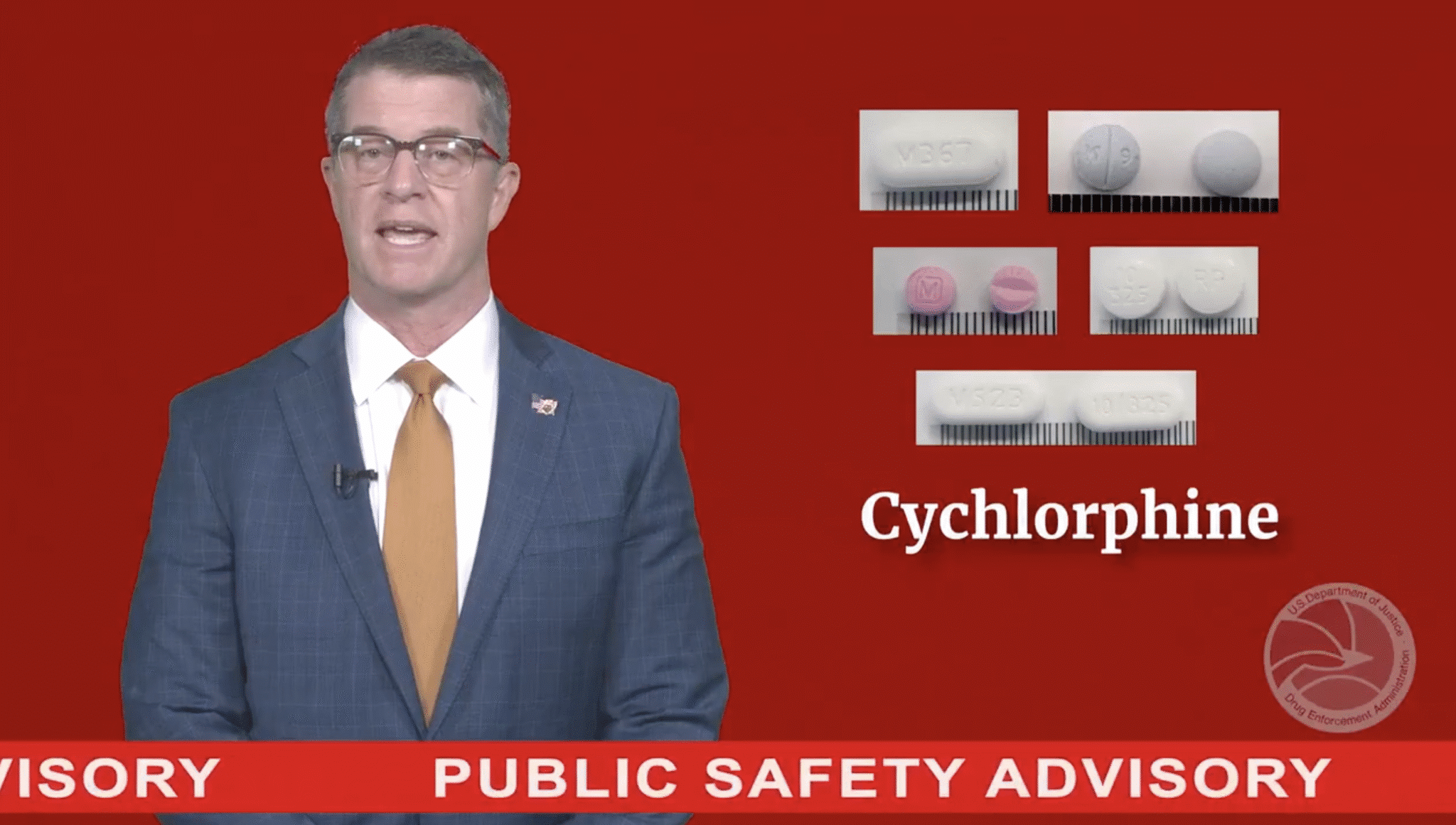
Image (cropped) via Drug Enforcement Administration/Twitter