
The Department of Homeland Security (DHS) has released new guidance on synthetic opioids, intended for first responders and government agents who might encounter them in the field. The Master Question List (MQL) for Synthetic Opioids, announced May 14 by the DHS Science and Technology Directorate, purports to have the latest “scientifically vetted” exposure and decontamination protocols. DHS stated in its announcement that the MQL is supported by President Donald Trump’s December 2025 executive order designating fentanyl a weapon of mass destruction, though the MQL itself does not reference this.
“Synthetic opioids pose serious risks for federal agents and first responders,” DHS stated in its announcement. “The risks include inhalation exposure to lingering toxic aerosols of fentanyl and ultra-potent opioids like nitazenes, which are up to ten times stronger than fentanyl.”
This is the third edition of the MQL, and the first to include nitazenes. Despite the announcement’s misleading characterization of their potency, the MQL itself doesn’t spend that much time on nitazenes.
Historically, law enforcement has been preoccupied with two main routes of so-called passive exposure: skin contact and inhalation. The MQL gets one of these more or less right, noting that skin contact with fentanyl is unlikely to lead to any adverse effects. Fentanyl is really not conducive to absorption through the skin membrane, which is why prescribed transdermal fentanyl patches have to be worn for such a long time.
“Synthetic opioid exposure can occur via several different routes; however, inhalation is the exposure route of greatest concern for emergency responders,” the guidance states. “While synthetic opioids can penetrate the skin, they do so slowly as compared to inhalation and injection routes.”
This, however, is a pretty egregious mischaracterization. DHS is conflating passive, accidental exposure with methods of direct consumption. First responders are not accidentally injecting themselves with fentanyl, nor are people deliberately using fentanyl by rubbing it onto their skin. Despite what DHS is implying, breathing air while standing somewhere in the vicinity of fentanyl is not the same thing as snorting a bag of fentanyl, which is why one of these will introduce fentanyl into your bloodstream and one will not.
Inevitably, DHS does endorse nalmefene-based products.
Though local law enforcement across the country rely heavily on colorimetric field tests that are notorious for false positives, DHS does correctly note that these aren’t reliable without confirmatory testing.
“Colorimetric test kits for opioids may give false positive results in the presence of common interferants, such as sugar and Excedrin,” the MQL states. “The use of a more definitive test, such as IR or mass spectrometry (MS) to verify the identity of a drug is recommended.”
In addition to being highly subjective and readily misinterpreted, the tests tend to identify opioids more accurately when they’re not mixed with other substances, which is almost never how they’re found in street-level samples. Not that this guidance will make highway patrol any more inclined to send their seized drug samples out for expensive mass spectrometry testing at a lab.
The MLQ correctly notes that naloxone is the standard antidote medication for synthetic opioid overdose, which is something; it’s become a common law enforcement refrain that naloxone doesn’t work on fentanyl, nitazenes and such. Inevitably, DHS also endorses nalmefene-based products, which have recently emerged as alternatives despite the fact that they offer no established benefits compared to naloxone and substantial risk of harm.
“Intranasal nalmefene is a competitive, reversible opioid receptor antagonist with a longer duration of action than naloxone,” the MQL states. “Nalmefene nasal spray was approved for use by the FDA in reversing opioid overdoses in 2023 … and an autoinjector of nalmefene was approved in 2024.”
The danger posed by Indivior’s nasal spray Opvee and Purdue Pharma’s autoinjector Zurnai is that they can induce unnecessarily long precipitated withdrawal in people with a physical dependence on opioids; for everyone else, the experience of being administered nalmefene versus naloxone is probably about the same. While nalmefene’s continued existence in overdose-response products is detrimental to public health education, if those products have to go somewhere it might as well be to the federal agents who want something to self-administer whenever they think they’ve been exposed to fentanyl floating around in the air.
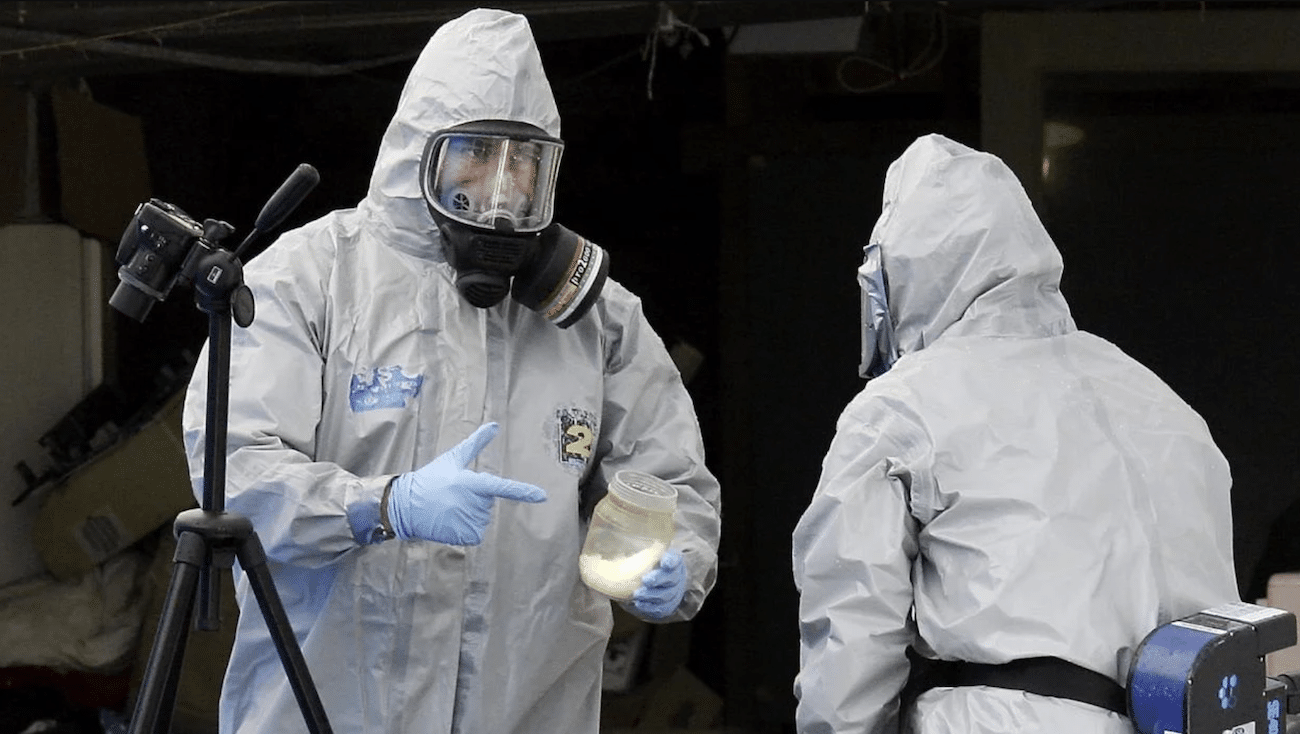
Image (cropped) via Indiana Department of Health