
A decade ago when I transferred to South Central Correctional Facility, a medium-security Tennessee prison privately operated by CoreCivic, there were usually only one or two people on suicide watch at a time. Now on any given day there are up to 14. Most of them aren’t suicidal—they’re supposed to be in protective custody (PC), but there was nowhere else to put them.
South Central has dozens of cells reserved for PC, which prisoners can request when someone in general population is after them and they need to be housed somewhere that’s physically separated. PC is mainly full of people who are fleeing drug debt or are otherwise being victimized by gang-affiliated prisoners who would harm them if they could reach them. In recent years, as South Central has descended into out-of-control gang violence, it’s become commonplace for people who request PC to be turned away. Sometimes they’re simply left to their fate, but sometimes staff tries to find other places to put them. So now there’s no more room in suicide watch, even for people who are suicidal.
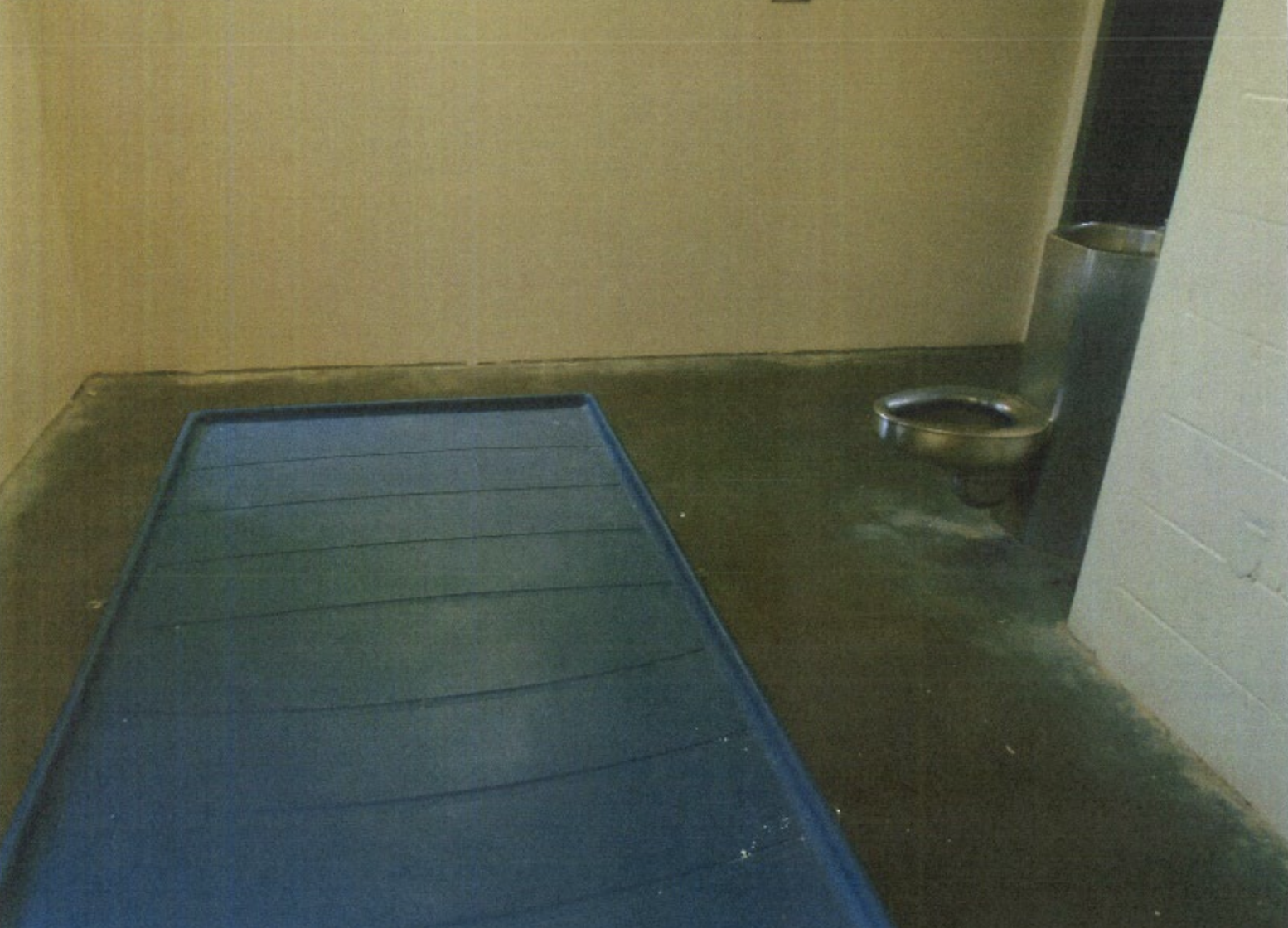
Prisoners on suicide watch are supposed to be kept in one of four highly restricted, specially designed cells where they can be closely monitored by prisoners who are paid 85 cents an hour as trained observers. But because all the suicide watch cells are full, the overflow of prisoners has spilled into the medical examination rooms. Those rooms don’t even have doors that lock; they just shut. Every single exam room has been converted into a makeshift suicide watch cell by ripping out the tables, sinks and electrical outlets, and removing everything else that used to be in them like wastepaper baskets. So now there’s no longer anywhere to do our medical exams, except for the emergency room, which as one medical staff member noted, “needs to be reserved for actual emergencies.”
Even the medical waiting room has been converted into a suicide watch cell.
Even the medical waiting room has been converted into a suicide watch cell. That room does have an electrical door that locks, but it’s also directly visible from the pill line window. Every day when general-population prisoners line up to receive their medications, everybody can look straight into the room and see the person being kept there.
“Medical has become the dumping ground for security problems,” said one medical staff member.
Filter spoke to five staff members who work in medical and mental health, and all of them expressed enormous distress about the situation. The influx of people on suicide watch, most of whom they feel weren’t screened appropriately, has completely disrupted their ability to provide care for the rest of us.
Some of them resent that medical resources have been taken over because no one’s addressing the problems with gang violence, and they feel that security officers are taking advantage of the suicide watch program as a way to avoid paperwork. Before someone can go to PC, they have to wait in the segregation unit for 10 days while security conducts an investigation to determine whether the threats against them are legitimate and then submits a report about the findings. The minute someone goes on suicide watch, they’re no longer the security staff’s problem.
But for the most part, the medical and mental health staff recognize that the security officers are just doing their best and that the prisoners in fear for their lives have nowhere else to go. None of them sees any sign that administration is going to address the situation. One said that the medical staff feel as desperate as the prisoners.
“I don’t feel most days that I ‘do no harm,’” they said, pressing their hand over their heart. “That hurts me deeply.”
TDOC and CoreCivic did not respond to Filter‘s request for comment.
Holding cells down at intake also been converted into suicide watch cells.
There are three holding cells down at intake where new prisoners are processed into the facility. They have also been converted into suicide watch cells. These are the old-school kind with bars you can stick your arm through. The actual suicide watch cells have electronically operated doors with food flaps so that no contact can be made with the person inside.
South Central has a mental health pod with 128 beds. Often, when a bed opens up, staff will take someone off suicide watch and put them there, if they think the person should really have been in PC all along. So this also disrupts the mental health pod, which is supposed to be for people whose mental state is too precarious to expose them to general population.
This still isn’t enough room for all the people on suicide watch, so sometimes they’re housed in the segregation unit. This means that observers have to monitor the people on suicide watch over the commotion of everyone else screaming at each other or at them.
“Sometimes guys in segregation will yell out trying to annoy guys we are watching,” one observer told Filter. “Stuff like, Do it! Do it!”
Three people in custody who have been placed on suicide watch within the past six months told Filter that they weren’t suicidal. They were being victimized by gang-affiliated prisoners in their living unit. Each of them had tried requesting PC by reporting the assaults or extortion they’d already experienced. They’d been taken back to their assigned unit, two of them in handcuffs.
In all three cases, when they eventually ended up on suicide watch it was due to an officer “prompting” them to say they were thinking about harming themselves, which are the words that compel staff to place you on suicide watch. They understood that suicide watch was their best option, so they said what they needed to say.
Filter also spoke to four security officers, who described the situation similarly.
“I have told them, ‘There’s no cell available [but] if you feel like you could harm yourself, I can get you on suicide watch,’” one said. “I don’t know what to do when there’s no space to put someone who really needs PC.”
The observers noted that staff seem to do their best to put the people really at risk for suicide in the actual suicide watch cells, and put the “frequent fliers” who need PC in the makeshift spaces. But it’s difficult to assess people properly under these conditions. And of course, there are still only four cells intended for suicide watch. These days, on average there’s a suicide attempt that results in someone from general population being transported to an outside hospital at least twice a month.
Read Part 2 of this story here
Image (cropped) via Nebraska Unicameral Legislature