
In 2020, Brazil’s then-president Jair Bolsonaro criticized grade-school didactic books for having “too much written in them.” Apparently the Left, influenced by the late educator Paulo Freire, had planted ideological content in them. He wanted to see the Brazilian flag and the national anthem lyrics in each and every book—because, of course, flags and anthems are not ideological.
In 2021, three years into his tenure, his administration’s Minister of Economy Paulo Guedes filed a bill that aimed to tax books, which have been exempt from taxation since the 1946 constitution. Had the bill passed, books would have been slapped with a 12-percent tax rate. When the bill was filed, the National Revenue Authority sought to justify taxing books by claiming that only wealthy people read them in Brazil—a claim that is not supported by evidence.
That same year Bolsonaro confessed that he hadn’t opened a book since taking office; he’d had no time to read due to his presidential commitments. While running for reelection in 2022, he attempted to scare his constituents by claiming that if Workers’ Party candidate Lula (who has been president since 2023) were elected, gun-owners would be at risk of seeing shooting clubs turned into libraries.
So it’s ironic that earlier in 2026, Bolsonaro—who is currently serving a sentence of more than 27 years in prison for plotting a coup d’etat following his 2022 election loss—attracted attention for requesting to join Brazil’s pioneering program Remission Through Reading, in which for each book prisoners read and write a report about, they can shave four days from their sentence. The report is submitted to a committee or to a judge, who must deem it acceptable.
The initiative was first piloted in 2009, in the maximum-security Federal Penitentiary of Catanduvas in the State of Paraná. It was subsequently expanded to other prisons and became a national policy in 2012. The number of books is capped at 12 per year, which can reduce 48 days from a person’s sentence.
Bolsonaro would be one of countless people incarcerated in Brazil to spend more time with books while in prison, but of course not due to any shared background. Bolsonaro was very busy passing two bills passed in 27 years as a congressman, as well as chatting on WhatsApp and insulting women. Of course he had no time to read.
People must have access to books before they are dragged into the criminal-legal system.
Though it is not true that only the wealthy read books, it is the case that almost half of Brazil’s incarcerated population has not completed elementary school. More than one in four—close to 182,000 people—are incarcerated for drug-trafficking convictions, and the majority of them have no prior record and should be resentenced under recent changes to the law.
A 2025 study found that 58 percent of people associated with drug trafficking would prefer not to engage in criminalized activity if they had another way to guarantee enough income. Research shows that many people initially drop out of school because they can’t afford to spend that time not earning money.
People must have access to books—along with housing, food and other basic needs—before they are dragged into the criminal-legal system. Yet the latest data available on the School Census 2025 show that 63 percent of state schools in Brazil do not have a library. This is despite a 15-year-old piece of legislation, enacted by Lula in his second term, that makes it mandatory for every school to have a library.
The sad reality is that while each year federal and state governments waste over $1 billion—money that would be better invested in education budget—on the Sisyphean task of combating drug use and supply, a huge part of the Brazilian population will only have access to books and time to read once they are in prison.
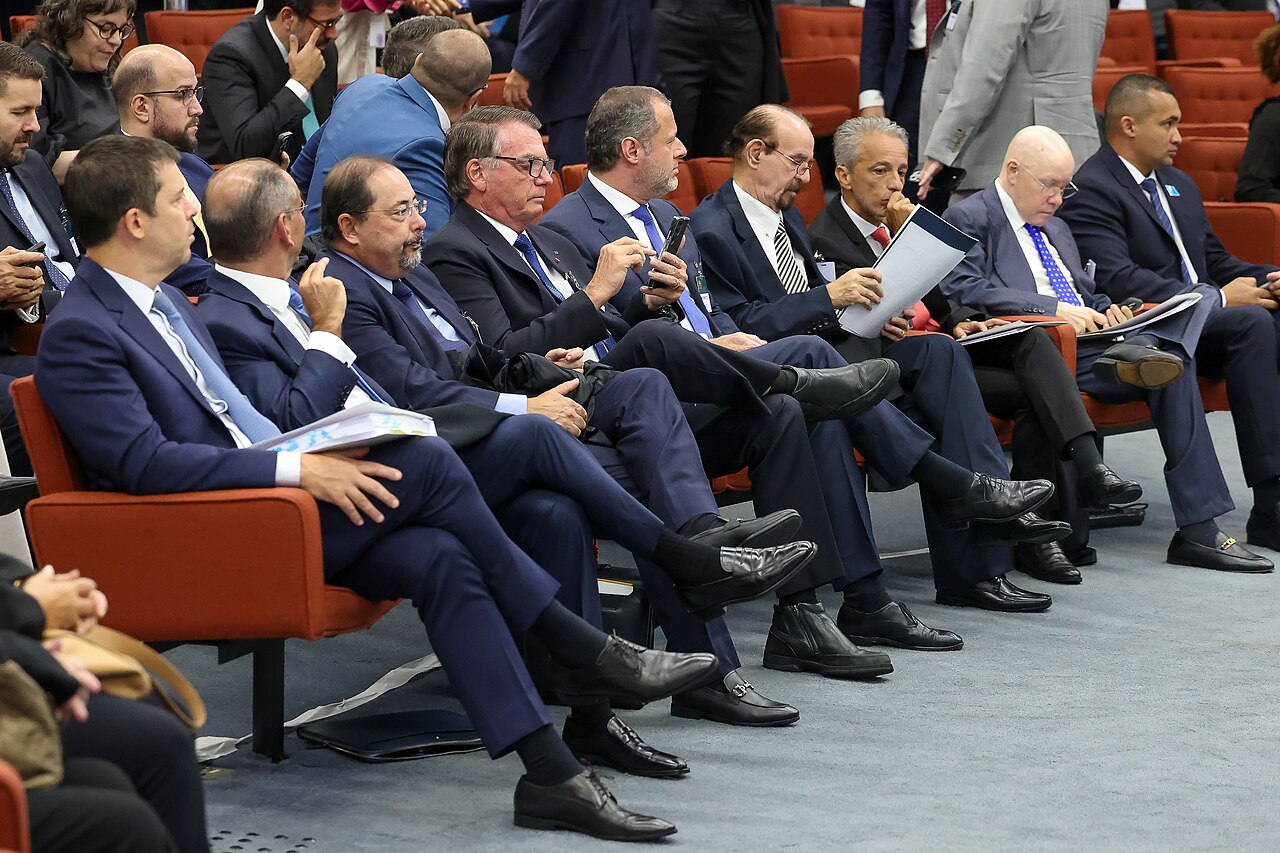
Image of Jair Bolsonaro (fourth from left) during March 2025 Supreme Federal Court trial, via Wikipedia/Gustavo Moreno