
The United States overdose crisis appears to be separating into regional crises on different trajectories, as a wave of fentanyl-involved deaths continues to move up the West.
On June 17 the Centers for Disease Control and Prevention released its latest monthly provisional overdose death count report, which covers the 12-month period ending in January 2026. During that time the US has so far recorded 67,895 overdose deaths, a number that’s predicted to rise to 69,147 once the remaining available data have been added. Because death records are updated and submitted unevenly, the predicted number is considered the more accurate one.
After overdose surged during the early COVID-19, the 12-month death count peaked at 112,996 between August 2022 and August 2023. Then the trajectory reversed, and the national overdose rate has decreased continuously month after month. Between 2023 and 2024, the data showed fatal overdose decreasing by nearly 27 percent. But in 2025 the decrease slowed to about half-speed. The latest CDC report shows it decreasing 13.2 percent, compared to the 12-month period ending in January 2025.
Nationally, the rate of overdose is back down to approximately where it was in September 2019. But over the course of the past few monthly reports, it’s become clear that overdose is going back up in the West even as it continues to go down—at half-speed, on average—almost everywhere else.
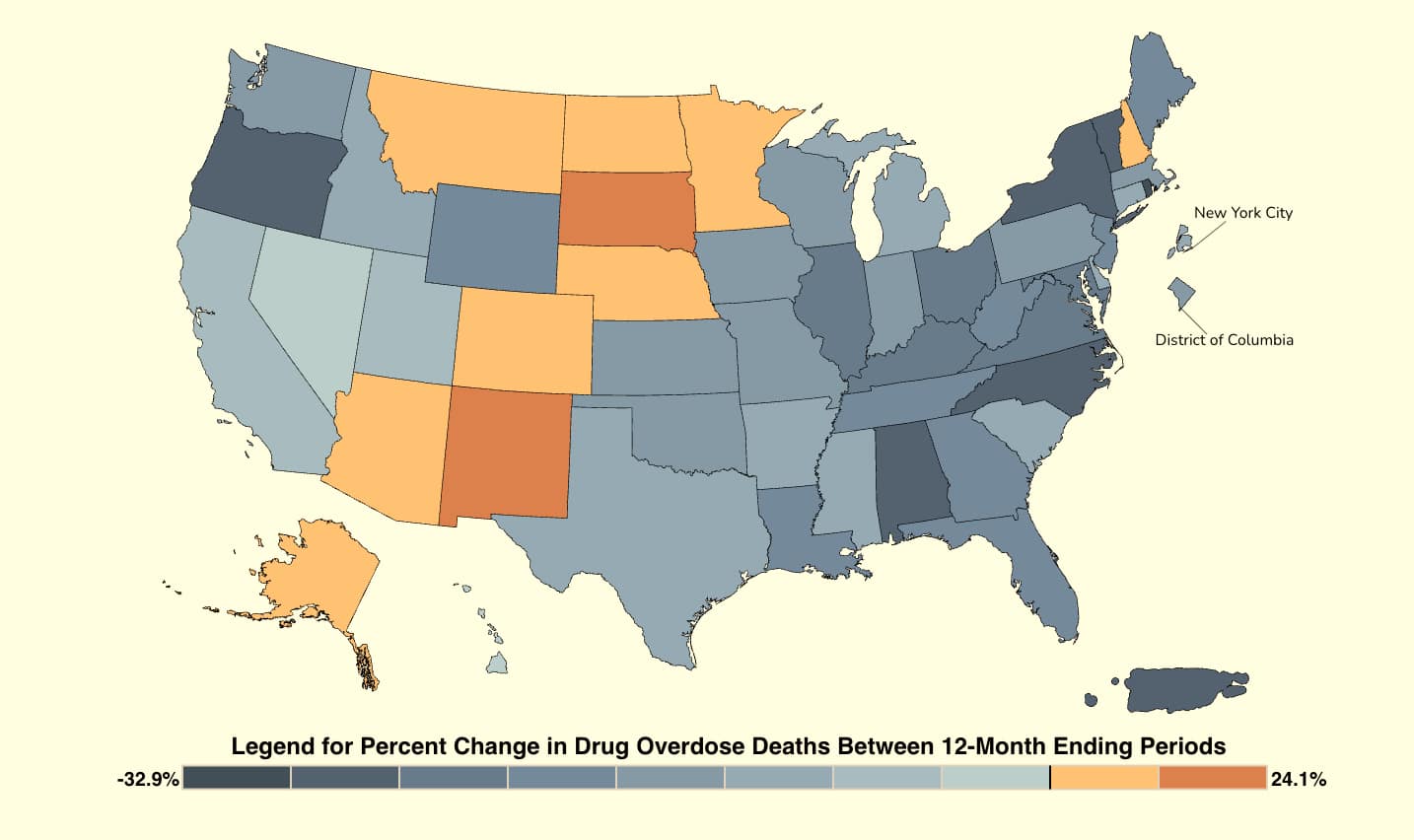
Though their rates have varied from month to month, the two states where overdose has been rising the most are Arizona and New Mexico. The latest report shows New Mexico with 1,010 deaths predicted, a 24.1-percent increase compared to the same 12-month period a year earlier. In Arizona, the predicted death count is 2,932, an increase of 11.5 percent.
In November 2024, fentanyl-involved deaths suddenly began to climb even faster than they’d been falling.
The other states where overdose deaths have increased compared to a year earlier are South Dakota, with 96 predicted deaths (+14.3 percent); Colorado, with 1,819 predicted deaths (+11.3 percent); Nebraska, with 155 predicted deaths (+6.9 percent); Montana, with 174 predicted deaths (+4.2 percent); Minnesota, with 1,017 predicted deaths (+3.9 percent); North Dakota, with 125 predicted deaths (+2.5 percent); Alaska, with 329 predicted deaths (+1.23 percent); and lastly New Hampshire, with 266 predicted deaths (+0.4 percent). This is the first 12-month period in which Alaska and New Hampshire have joined that list.
For most of 2024, fentanyl-involved deaths in Arizona declined rapidly. But that November the data show a sudden, sharp turnaround as fentanyl-involved deaths began to climb even faster than they’d been falling. Methamphetamine-involved deaths, which for years had been increasing at a steady-ish pace, jumped up sharply and rose in tandem through May 2025.
Between November 2024 and January 2025, fentanyl-involved deaths took a similar trajectory in New Mexico, Colorado and Minnesota. Patterns in less-populous states aren’t as readily apparent, not just because of the smaller numbers but because these states tend to have more gaps in their reporting. Nebraska didn’t report any overdose deaths between April 2024 and May 2025, and North Dakota didn’t report any for about half the months from the same time period. Death investigations are such a skewed and unstandardized business from one jurisdiction to the next that this could mean a few different things, but probably does not mean that no one died of overdose in those states during those months.
Though overdose deaths in Arizona still increased compared to the previous 12-month period, in October 2025 they began to slowly drop back down. The latest data show deaths in Arizona continuing to go down through January 2026. New Mexico and the other western states with rising overdose deaths haven’t yet followed suit.
Image (cropped) via Centers for Disease Control and Prevention