
On April 15, the Centers for Disease Control and Prevention published its most recent monthly provisional drug overdose death count, which covers the 12-month period leading up to November 2025. While the decrease in overdose mortality has continued month after month uninterrupted, the data show a significant change in pace in 2025 compared to 2024.
Between November 2024 and November 2025, the United States has recorded 68,372 overdose deaths—a figure the CDC projects will rise to 70,231 as more data are submitted. On average, the death count across the country is 15.9 percent lower than it was in the 12-month period leading up to November 2024.
Between 2023 and 2024, the death rate fell by more than 26 percent. This was unprecedented—since the CDC began tracking overdose mortality in 1999, the only other time the death count wasn’t going up was a very slight decrease in 2018. In 2019, the rate began to climb more quickly, and then much more quickly once the COVID-19 pandemic arrived. In late 2023 it finally turned around, and for the past two-and-a-half years the national average has continued to drop each month.
Though the rate decreased fairly steadily, around March 2025 the pace became slower.
Over the course of 2024 the death count for each month was, on average, 2,221 lower than it had been the month before (using the predicted values, which are always slightly higher than the reported values but follow the same rate of change). The steepest decrease was 3,057 fewer predicted deaths in August than in July (for the number of actual deaths reported, the decrease was 3,091).
But over the course of 2025, on average the death count each month was only 1,007 lower than it had been the month before (data from November to December have not yet been published).
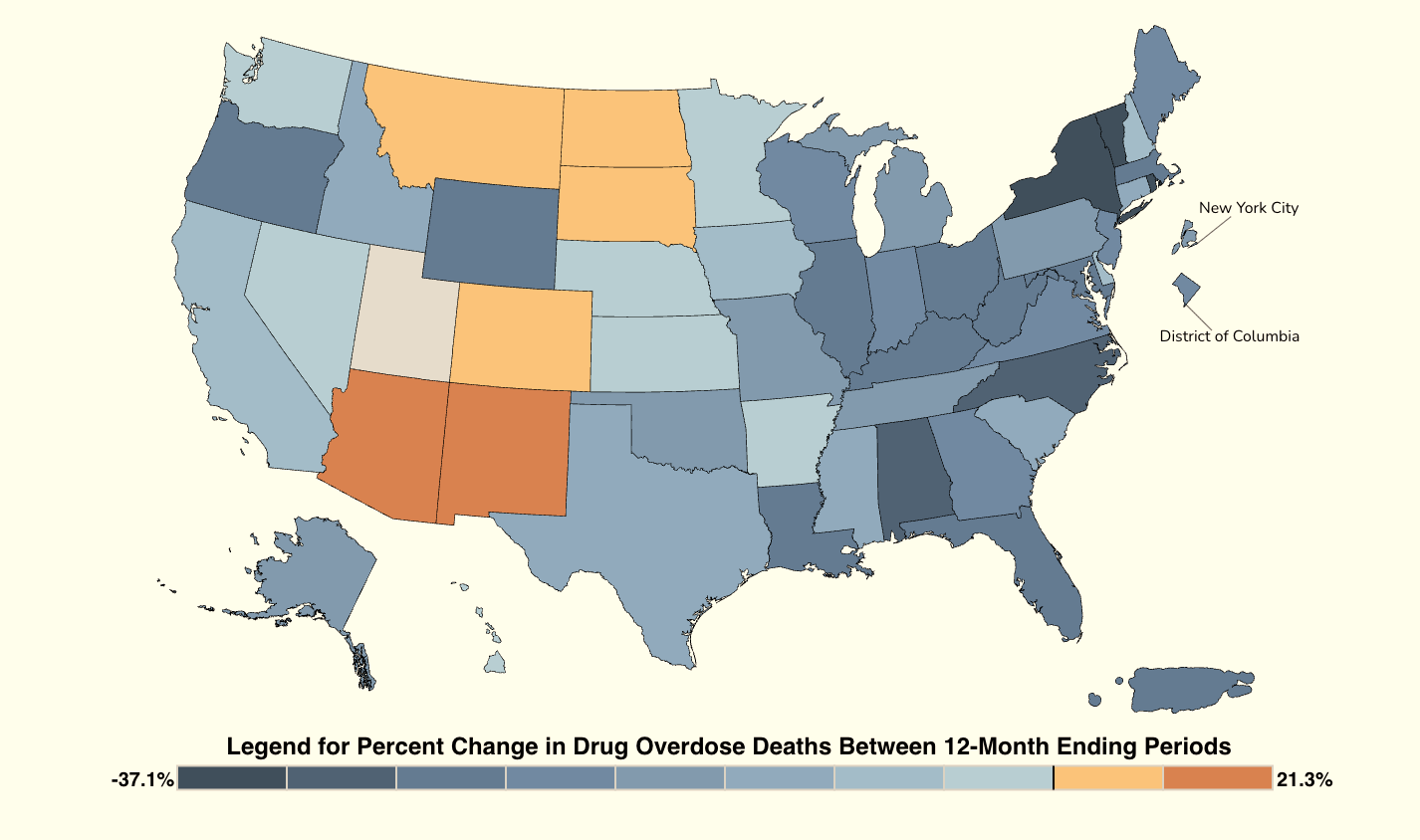
In New York, the rate fell more than 37 percent. In Arizona, it increased more than 21 percent.
National averages have never closely reflected what’s happening on the ground in different parts of the country. Even back when the CDC announced the historic drop from 2023 to 2024, South Dakota and Nevada had both seen slight increases.
The CDC’s most recent data show the national death rate 15.9 percent lower than it was compared to the previous 12-month period, but in New York the rate fell more than 37 percent. Vermont and Rhode Island are in a similar range.
Deaths in Arizona, meanwhile, are predicted to increase by over 21 percent. This is by far the largest increase; the next-closest is New Mexico, with deaths predicted to increase by over 16 percent compared to where they were a year earlier.
In Colorado the predicted death rate is up 10.3 percent. In North Dakota, 8.4 percent. South Dakota, Montana and Utah are all predicted to be within a single death of what was recorded for the previous 12-month period.
Wyoming, geographically right in the middle of all the states going against the national trajectory, is still predicted to have deaths decrease by nearly 25.5 percent. But in many states, the percentages aren’t necessarily useful for understanding the scale or rate of change because the actual number of overdose deaths reported is very low—partly because of population size, but sometimes because of inconsistent data collection or simply underreported data. The 25.5-percent decrease in Wyoming represents the difference between 110 deaths and 82 deaths. In California, on the other hand, a 9.9 percent decrease represents 10,085 predicted deaths dropping to 9,158.
Image (cropped) via Centers for Disease Control and Prevention