

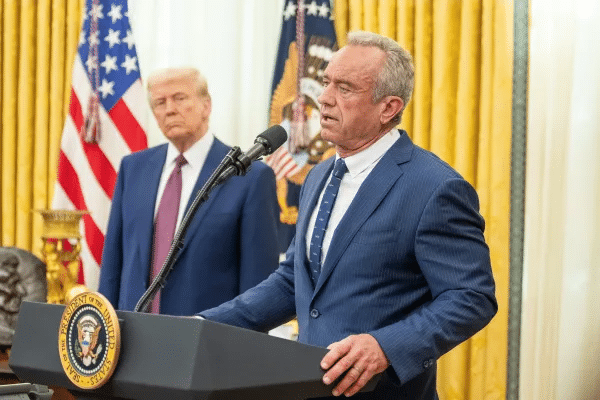
The Department of Health and Human Services is asking the public to weigh in on where it should invest funding for substance use disorder (SUD) and mental illness. In a Federal Register Notice of Request for Information (RFI) published June 10, HHS Secretary Robert F. Kennedy Jr. requested examples of “programs or interventions that have rigorous, empirical evidence of effectiveness,” provided they fit within agency guidelines emphasizing faith-based providers, civil commitment and “ending support for harm reduction.”
Comment is due July 5. HHS appears to only be accepting submissions by email.
“HHS invites public comment in response to this RFI on the research, development, programs, and policies that have been most successful in improving availability of and access to effective prevention, treatment, and recovery interventions for addiction, mental illness, and co-occurring substance use and mental disorders,” the RFI states. “The purpose of this RFI is to identify research, programs, and policies that have been successful and recommend novel policy ideas and gaps in research that could be addressed and implemented to further the Great American Recovery using existing funding.”
President Donald Trump launched the Great American Recovery Initiative, which promotes the brain disease model of addiction, in January via executive order. It dovetails with the other executive order that HHS cites as the basis for its new RFI, which in 2025 escalated the use of civil commitment targeting unhoused people who use drugs.
In the wake of the 2025 executive order, the Substance Abuse and Mental Health Services rejected harm reduction, cutting grant support for what the RFI describes as “counterproductive harm reduction efforts that facilitate illegal drug use and its deadly consequences.” It reiterates that “safe use efforts and the provision of materials and drug paraphernalia, like syringes for illegal drug use, are not allowed with SAMHSA funding.” That ban is well established and isn’t going away anytime soon, but sterile syringe access would fit squarely within one of the SAMHSA funding streams highlighted in the RFI—the Hep C Free initiative designed to mitigate transmission and harms of hepatitis C.
Also highlighted is RFK Jr.’s STREETS Initiative, which will disappear unhoused people into coercive treatment programs.
Along with ending support for harm reduction, the agency’s guidance includes “development of non-opioid options” for pain relief. Two HHS departments—the Food and Drug Administration and the National Institute on Drug Abuse—recently advanced research exploring kratom as a treatment for opioid use disorder. The FDA considers kratom an opioid, but the move still serves the Trump administration’s interest in opioid alternatives, especially following the recent push to reschedule medical marijuana and fast-track psychedelic therapy development. It benefits pain patients, and people who use opioids, for more substances like kratom, marijuana or ibogaine to become regulated and accessible; it does not benefit them for prescription opioids to become less accessible as a result.
Among the funding opportunities highlighted are RFK Jr.’s STREETS Initiative, which will target people who are street-homeless and disappear them into coercive treatment programs. Such as SAMHSA’s assisted outpatient treatment, which is also one of the funding resources described in the RFI.
“An example of comments we are looking for: In the first Trump Administration, HHS helped coordinate take back days which took millions of pills out of homes and helped make the opioid overdose reversal medication naloxone more widely available,” the RFI states. “While these were significant policy wins, HHS can better coordinate with other agencies to achieve the President’s goals by ensuring there is alignment in goals to address addiction.”
It’s a bit bleak that HHS went looking to cite one of its significant policy wins and this was the example it came up with. Tons of policy-level changes have helped make naloxone more widely available over the past few years—over-the-counter products; the arrival of cheaper generics; harm reduction groups getting their own affordable naloxone supply; corrections departments increasing Narcan access for staff, and every once in a while for people in custody; a shelf-life extension; legislation mandating Narcan kits in schools and other public spaces; support for naloxone boxes and vending machines. But what the RFI is referring to is DEA agents handing out Narcan kits at biannual Prescription Drug Take Back Day events, for which various HHS departments contribute misleading promotional materials.
Image via the White House