

Georgia’s public defender shortage was recently of interest to the media when it affected the prosecution of Robert Aaron Long, who is potentially facing the death penalty for charges related to the 2021 Atlanta spa shooting spree that left eight people dead, six of whom were Asian women. Long, who is already serving life without parole, requires two death penalty-qualified public defenders in order for his case in a different county to move forward. As of June 1 a second attorney has been located, and now everyone can go back to ignoring a crisis that costs thousands of people their liberty every day.
The Sixth Amendment guarantees the right to a speedy trial and to an effective public defender for those who can’t afford a private one. In Georgia, those rights have evaporated.
About 85 percent of the state’s criminal cases are handled by the Georgia Public Defender Council (GPDC), the agency created by the Indigent Defense Act of 2003. Nationally, the percentage of defendants in state and federal cases who can’t afford a private attorney is generally in the same ballpark.
Georgia is the eighth most populous state in the country, but GPDC has only around 400 attorneys. It’s routine for public defenders to be juggling 500 active cases at once. Thus being provided with counsel rarely means being provided with effective counsel, as that kind of caseload doesn’t leave attorneys time to learn too many details.
In most states, chief public defenders are elected or otherwise appointed independently. The executive director of GPDC, however, is appointed by the governor. So there’s little incentive to rock the boat.
This is not a system capable of ensuring justice to everyone facing loss of liberty.
Often cases remained stalled even after a conflict attorney was found, because that attorney would subsequently resign.
The first harms come to those who are detained and cannot afford bail, and are therefore sitting in jail watching the slow turning of the judicial machine’s gears. In 2024 Filter reported on a Georgia county jail where people routinely waited over two years for their first hearing, and without talking to their public defender more than once. The man at the center of that story had been waiting for more than three years, while his repeated requests to meet with his assigned public defender all went unanswered. In 2024, Dougherty County released a man who’d been languishing in jail for the longest known pretrial detention in Georgia history, and one of the longest in the nation’s history—nearly 11 years.
But then there are the harms from ineffective counsel. Bad plea deals. Wrongful convictions. Unnecessarily long sentences, though one could argue almost all United States sentences are unnecessarily long.
One big problem stems from the fact that many cases have multiple defendants, but the public defender’s office in the circuit where they’re being tried can only represent one of them; obviously there would be some ethical concerns if two people testifying against each other were represented by the same legal counsel. So for the remaining defendants GPDC must provide “conflict attorneys.” But a 2023 Southern Center for Human Rights investigation found that people routinely waited months just to be assigned one. Often cases remained stalled even after a conflict attorney was found, because that attorney would subsequently resign due to lousy pay and resource support.
In 2022, Georgia passed legislation establishing state funding parity between the district attorneys and public defenders. Has this resulted in actual parity? Of course not, because prosecutors get all kinds of additional support from external victim-advocate grants, county budgets, local law enforcement agencies and the heavily funded Georgia Bureau of Investigation.
In 2025 GPDC got a small budget boost for “conflict cases,” bringing its state funding to a little under $100 million. But this mainly covers its attorneys’ salaries, so the costs of testing evidence or anything else that goes into preparing an adequate defense still falls to the counties. Funding for conflict attorneys and other resources has been coming from federal American Rescue Plan Act funding—a well that will run dry at the end of September.
Similar to how Georgia’s prison overcrowding and understaffing could be resolved through the simple and cost-effective option of parole, there is one obvious way to address the problem of too many indigent defendants and not enough public defenders. In February, Oregon dismissed more than 1,400 cases due to its shortage of public defenders. Georgia has yet to consider this option.
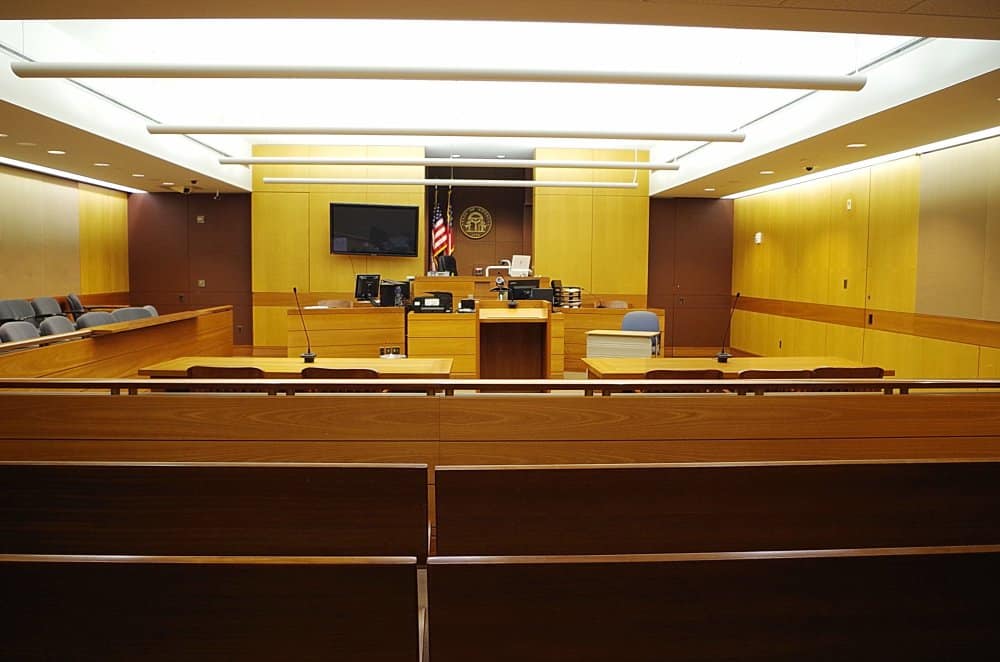
Image via Superior Court of Fulton County, Georgia