


Long vilified by opponents of tobacco harm reduction, fruit-flavored vapes finally got the thumbs up from the FDA in May. The Los Angeles-based company Glas received permission to sell Sapphire (blueberry) and Gold (mango) vapes with age-gating technology—the first non-tobacco, non-menthol vaping products the FDA has authorized.
It was a historic victory to those who support access to a variety of safer nicotine products—including flavors, which research and experience have repeatedly shown to be key to many people’s ability to switch from cigarettes. Access is vital because combustible tobacco use is still the leading cause of preventable disease and death in the United States. Smoking kills more than 480,000 people each year.
“The amount the company had to spend was in the high double-digit millions of dollars … We had numerous meetings with the FDA, navigating the process through substantial scientific review.”
Sean Greenbaum, the founder and president of Glas, explained to Filter how the company got through the FDA’s expensive and legendarily arcane Premarket Tobacco Product Application (PMTA) process.
“We started working on our application in 2019,” he said. “The amount the company had to spend was in the high double-digit millions of dollars. It was a significant investment of time, resources and capital. We had numerous meetings with the FDA, navigating the process through substantial scientific review, various deficiency letters, and we responded to all the questions they had. We conducted scientific, clinical and age restriction studies.”
Not everyone celebrated that blueberry and mango vapes passed FDA muster. The Campaign for Tobacco-Free Kids (CTFK) and Parents Against Vaping Electronic Cigarettes (PAVE) were apoplectic.
CTFK trotted out the old, tired and false narrative that “kid-friendly” flavors’ purpose is to hook youth. “By authorizing fruit flavors and allowing e-cigarette makers to disguise them with names like Gold and Sapphire, the FDA is risking a resurgence of youth e-cigarette use,” President Yolanda C. Richardson said in a press release. “History can’t be allowed to repeat itself; mango was one of the most popular Juul flavors that contributed to a past surge in youth e-cigarette use before it was pulled off the market.”
Their fury flows from a sense of betrayal towards an agency that has generally caved to their demands.
On a PAVE webinar to discuss the FDA decision, cofounder Meredith Berkman was enraged: “It’s a catalytic moment where the FDA has failed us. Has failed American families. Has failed to live up to its regulatory authority to protect public health and the health of our children … It’s shameful that at this moment the FDA has been co-opted by the predatory tobacco industry.” Apparently the mango-hating Manhattanite doesn’t know that Glas is an independent vape business that’s never been affiliated with the tobacco industry.
The apocalyptic language over the sale of two fruit-flavored vapes is ridiculous. Surely CTFK and PAVE are aware that vapes in dozens of fruit flavors are easily purchased on the booming illicit market created by the FDA’s obstructionism? Despite this, there has been no increase in youth vaping for years—in fact, the number has dropped sharply.
Their evidence-free claims that the legal availability of flavored vapes will unleash another teen vaping “epidemic” are an attempt to create another drug panic and to bully the FDA into reversing its decision. Their fury flows from a sense of betrayal towards an agency that has generally caved to their demands.
FDA Commissioner and tobacco control lapdog Marty Makary was toeing that line in April when he issued a memo preventing the authorization of Glas menthol, mango and blueberry vapes, after FDA scientific reviewers green-lit them. Then the Trump Whitehouse got involved and suddenly they were authorized. Weeks later Makary resigned specifically over this issue. Don’t be surprised if he ends up working for CTFK. That’s where Brian King, the former Director of the FDA’s Center for Tobacco Products, is now employed.
PAVE initiated a letter-writing campaign demanding repeal of the authorization. Joining the attack are 21 state attorneys general who wrote a letter to the FDA urging it to “reverse guidance easing sales of flavored e-cigarettes.”
“DARS are an information-gathering device masquerading as a youth prevention.”
Tobacco control organizations and other groups have another bone to pick with Glas. They have denounced the “device access restrictions” (DARS) technology, arguing it won’t stop tech-savvy youth and deploys Big Brother spying software.
“DARS are an information-gathering device masquerading as a youth prevention,” stated Willow Najjar Anderson, an attorney at the Public Health Law Center. “They give the industry a socially responsible gloss while doing little to stop youth from seeing, wanting or accessing flavored vapes. Moreover, privacy concerns with DARS remain real, especially when access to an addictive product is conditioned on surveillance, biometric check-ins, and data collection.”
Anderson makes an important point about the monitoring features embedded in the Glas app. Where do the information and photos collected by the company go, and who has access to them? In an era of powerful hacking groups, rampant identity theft and massive data breaches, this might be a deal-breaker.
I asked Greenbaum why Glas did this. “We wanted to take a very conservative approach that presented zero risk in regards to any form of appealing to youth, and we combined that with our extensive and robust age-restrictive technology,” he said. “We conducted two age restriction studies. The first study didn’t expose youth to the brand or the physical product. We put the technology in their hands and provided them the opportunity to game the system. They couldn’t. Then the FDA told us to put the actual vape in the hands of young people, and we conducted the same set of tests where they tried to game or break the system. Zero youth were able to.”
That’s a lot of steps to puff on a vape. Compare that to how fast and easy it is for anyone—of any age—to pick up and smoke a cigarette.
Here are the steps to activate a Glas flavored vape. Before it can be unlocked, the device has to be paired with a smartphone app, so the first step is to download the app. The next step is uploading a government-issued ID and a real-time selfie, which the software analyzes to confirm legal age. Once verified, a digital certificate is sent to the vape, allowing the heating coil to be activated. Sensors in the vape actively monitor the connection to the smartphone, and if the phone is moved out of close range of the vape, or if it is turned off, the vape automatically deactivates.
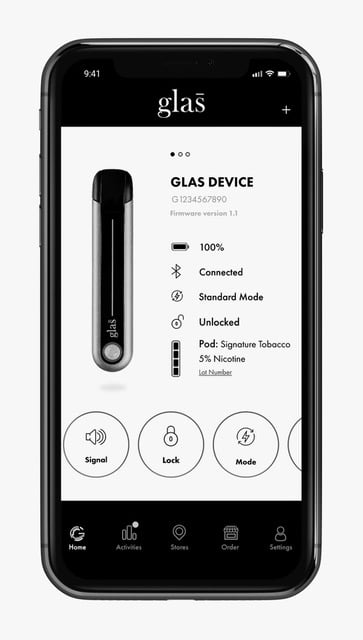 That’s a lot of steps to puff on a vape. Compare that to how fast and easy it is for anyone—of any age—to pick up and smoke a cigarette. Or use an unauthorized, non-age-gated vape, for that matter.
“Every new technology product has a little bit of a hurdle in the beginning, but our process is seamless and efficient,” Greenbaum said. “From the perspective of thinking about all of the products that we use as consumers in today’s world, everything for the most part is connected and you have some form of a mobile app. The process that we have for verifying a user, it occurs in under three minutes. It’s similar to a mobile banking app. In our studies we pulled from a demographic of heavy smokers of all ages and demographics, and the ease of use on the technology side was not a concern for them.”
To be sure, some people will be able to activate the device, but seriously, in under three minutes and nothing will ever go wrong?
It’s a feature that is the opposite of user-friendly—but this is where the FDA, and the manufactured outcry at “kid-friendly” flavors, have gotten us.
What Greenbaum isn’t taking into account is the digital divide that is a reality for low-income, vulnerable populations, especially in rural areas, that have the highest rates of smoking. People who are street-homeless often don’t have consistent access to wifi, often don’t have government-issued ID, and cell phones get lost, stolen or are shut off for nonpayment. People with serious mental health diagnoses might have cognitive or functional impairments that limit their ability to follow directions to activate the vape.
Another problem is that the pleasure of inhaling nicotine could be lost because the freedom to move around while vaping is compromised by the technology. I envision people forgetting that they have to keep their cell phone and vape in close proximity and the device abruptly deactivating. Annoying! It’s a feature that is the opposite of user-friendly—but this is where the FDA and the manufactured outcry at “kid-friendly” flavors have gotten us.
It was a seven-year battle to get FDA authorization of flavored vapes. But if age-gating surveillance technology becomes the norm and makes vapes too difficult, frustrating, time-consuming or invasive to use, then tobacco control zealots will have found yet another way to block the use of safer nicotine products.
Photographs courtesy of Glas
Correction, July 24: A previous version of this article incorrectly stated that the FDA did not issue a press release about the Glas authorizations. In fact, the agency did issue a press release on May 5.
The Influence Foundation, which operates Filter, has received unrestricted grants from Juul Labs, Inc. Filter‘s Editorial Independence Policy applies.