

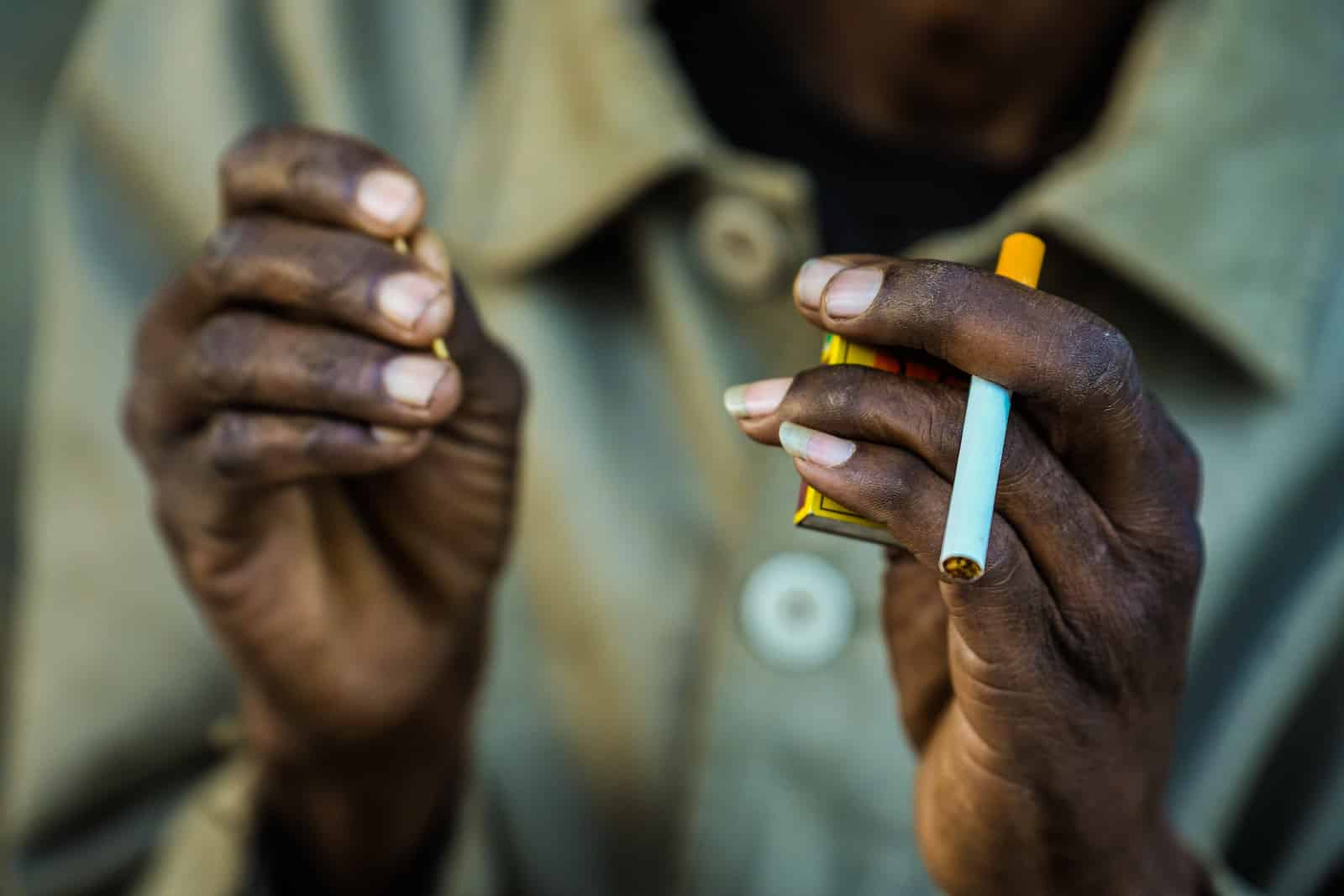
Globally, around 41 million people are living with HIV. And just about everywhere, smoking rates for this population are far higher—anywhere up to four times higher—than national averages.
In Australia, for instance, 21 percent of people with HIV smoke, compared to 11 percent of the general population. In countries such as Austria, Germany and Italy, around half of people with HIV smoke. In South Africa, which has the world’s highest HIV rate, general rates of smoking are 32 percent for men and 7 percent for women; for people with HIV, those rates are 52 percent and 13 percent, respectively.
In the United States meanwhile, estimates of the smoking rate for people living with HIV have ranged from 34-47 percent, against a national rate a little over 12 percent. “Lung cancer is the leading cause of cancer death among people with HIV on antiretroviral therapy,” notes the National Cancer Institute.
A recent briefing paper from Global State of Tobacco Harm Reduction (GSTHR) highlights the acute need to maximize health for people with HIV by helping them quit smoking.
When over 4 million of the 24.5million people on ART are estimated to smoke, the life-extending benefits of this treatment are substantially negated.
Advances in medical care, such as antiretroviral therapy (ART), mean that in many places people with HIV should be able to have the same life expectancy as the general population, the paper notes. But when over 4 million of the 24.5million people on ART are estimated to smoke, the life-extending benefits of this treatment are substantially negated.
“In many populations of people living with HIV who are being treated with ART, those who smoke are more likely to die from smoke-related diseases than HIV,” the briefing paper states.
It goes on to discuss how the reasons for these high smoking rates may be similar to those in other—heavily overlapping—marginalized groups, such as people experiencing poverty, homelessness and incarceration. Smoking is often used as a coping mechanism for stress, anxiety and pain.
For people with HIV in particular, smoking may exacerbate the risk of infections associated with weakened immune systems, such as Pneumocystis pneumonia, according to the US Centers for Disease Control and Prevention, and there may be an increased risk of smoking-related diseases.
“Before effective treatment, smoking cigarettes likely had an adverse impact on many opportunistic infections,” Dr. Mark Tyndall told Filter. “However, even for those with suppressed virus there is some evidence that the incidence of cardiovascular disease may be increased and smoking would make this worse.”
“I think that most doctors focused on HIV treatments and downplayed the impact of smoking.”
Tyndall is a medical doctor and epidemiologist who pioneered an opioid safe supply “vending machine” program in Canada and played a leading role in evaluating Insite, North America’s first sanctioned overdose prevention center. He has spent much of his career working with and for people with HIV around the world.
In his long experience, smoking cessation interventions for people with HIV have not been emphasized enough by medical providers. “I think that most doctors focused on HIV treatments and downplayed the impact of smoking,” he said.
The majority of people with HIV live in low-income countries—over 26 million are in Africa—with limited health care infrastructure and scarce funds. So a question many might ask is, how can we convince authorities that struggle to cover basic HIV treatment to spend money on smoking cessation programs?
Dr. Gerry Stimson, emeritus professor at Imperial College London, and honorary professor at London School of Hygiene and Tropical Medicine, is a public health social scientist and cofounder of Knowledge-Action-Change, the group that publishes GSTHR. In the 1980s he led research supporting the harm reduction response to the HIV crisis.
Smoking cessation can very easily be rolled into existing HIV services, Stimson said.
Tobacco harm reduction, he told Filter, is “low-cost.” It simply does not require governments to spend large amounts of money—if safer nicotine alternatives, like vapes and pouches, are available. What’s more, he added, smoking cessation can very easily be rolled into existing HIV services.
“Health care staff can give very brief advice on quitting smoking and using alternative safer nicotine products in less than one minute,” Stimson said.
However, “The big obstacle for all smokers in poor countries is access to safer nicotine products and their affordability relative to the price of cigarettes,” he continued. “That’s something that needs addressing by governments and manufacturers.”
That case to governments is strengthened when you consider the vast cost to health services from smoking-related illnesses—and the potential to save money and free up valuable resources. Lower-income countries broadly have the highest smoking rates, so the benefits of making tobacco harm reduction available would stretch far beyond populations living with HIV.
But barriers to health care for those populations are not just monetary; they’re also stigma-based.
“HIV-related stigma, smoking-related stigma, and sometimes self-stigma can all affect whether people seek help, whether health care workers prioritize the issue, and whether funders see it as a legitimate area for investment,” Tatsiana Pikirenia, a public health specialist and the scoping, engagement and resource development lead at Knowledge-Action-Change, told Filter.
“Access to services is also shaped by broader structural factors, such as poverty, workforce capacity, competing health priorities, and whether tobacco dependence treatment is available at all,” she continued.
The evidence suggests “that integrating tobacco support into HIV-related services can be effective in practice.”
Pikirenia said Switzerland was a good example of a country that has managed to use smoking cessation programs effectively within HIV care.
“In the Swiss HIV Cohort Study, one HIV outpatient center integrated smoking cessation counselling into routine HIV care by training HIV physicians and using structured follow-up during clinic visits,” she said.
It resulted in patients being more likely to quit smoking and less likely to return to cigarettes, compared to other comparable HIV treatment sites.
“That makes Switzerland a useful example of smoking cessation being embedded directly within HIV services, rather than treated as something separate,” Pikirenia said.
A further example of this, she continued, is how clinical guidance in the US explicitly includes tobacco cessation as part of comprehensive HIV care.
A CDC report looking at a tobacco use reduction program embedded in HIV health services in Michigan recognized an increased rate of quit attempts and a significant reduction in tobacco use.
Pikirenia said this all suggests “that integrating tobacco support into HIV-related services can be effective in practice.”
“That is why safer nicotine products are so well suited to this population.”
The GSTHR paper also notes the willingness among people living with HIV to engage in smoking cessation programs, citing a 2024 review in which “individuals living with HIV whose smoking was assessed by a physician were three more times likely to report a readiness to quit.”
This is something Tyndall has experienced. The attitude of continuing to smoke because of a compromised life expectancy is something that might have existed early in the epidemic, he said, but with most people being treated with ART, “the general motivation is to stay well.”
“That is why safer nicotine products are so well suited to this population,” Tyndall said.
Stimson made a similar point. “Having HIV is no longer a life sentence,” he said, and “fatalism” has been replaced by “optimism.”
“People living with HIV and who smoke do so for all the reasons that others smoke—because they find nicotine helpful,” he concluded. “The simple message is twofold: Don’t let the benefits of HIV treatment be negated by smoking, and that giving up smoking need not mean giving up nicotine.”
Photograph by Emmanuel Mwape/Global State of Tobacco Harm Reduction via Flickr/Creative Commons 2.0
The Influence Foundation, which operates Filter, has received grants and donations from Knowledge-Action-Change. Filter‘s Editorial Independence Policy applies.