
On June 11 the Supreme Court received, and subsequently rejected, a request from the state of Alabama to proceed with the nitrogen gas execution of 49-year-old Jeffrey Lee, which had been scheduled for that same day. Three days earlier, the United States Court of Appeals for the 11th Circuit issued an injunction in Lee’s case barring Alabama from using nitrogen, ruling that it would result in suffering “over and above the mental distress that typically accompanies the knowledge of impending death by execution.”
Eight people in the US have been executed with nitrogen gas—seven in Alabama and one in Louisiana. There is no evidence base supporting nitrogen gas as an execution method. It’s been banned across the US as a euthanasia method for pets.
Had Lee’s execution proceeded, a respirator strapped to his face would have forced him to breathe nitrogen instead of air. The nitrogen itself is not what causes death; it’s the lack of oxygen. Lee, like many others on death row in Alabama, had opted for nitrogen as his method of execution after the state first authorized it in 2018. But it wasn’t used until January 2024, in the Alabama execution of Kenneth Eugene Smith. Though officials had claimed that Smith would lose consciousness when he began to breathe in the gas, and die within minutes, the execution lasted more than half an hour.
Medical experts have testified that dyspnea, or “air hunger,” is thought to be “far worse than pain.”
Witness reports from Smith’s and subsequent nitrogen executions described what appeared to be torturously slow and painful deaths. Medical experts opposed to this method have testified that dyspnea, or “air hunger,” is thought to be “far worse than pain” because it triggers fear and panic, and isn’t localized to any particular part of the body.
In 2025 Lee filed an appeal arguing that nitrogen would represent an Eighth Amendment violation due to unnecessary suffering, and requesting execution by firing squad instead. The appeal was rejected by a US district judge on the grounds that the Constitution doesn’t guarantee the right to a painless execution, and suffering associated with nitrogen hypoxia would not be “well beyond what’s needed to effectuate a death sentence.” That ruling is what the Eleventh Circuit overturned in the days before Lee’s execution date.
Typically juries don’t decide someone’s punishment, just whether they’re legally guilty or not guilty. But in death penalty cases, the jury votes on whether the punishment should be death or life in prison.
In 2000, the jury in Lee’s trial voted for life without parole. The judge then overruled their decision and sentenced Lee to death through judicial override, a legal loophole that Alabama and three other states have used to let judges decide the punishment in death penalty cases unilaterally. Alabama was the last state to allow judicial override before legislators abolished it in 2017. Its abolition does not apply retroactively.
Alabama alone has overseen nine botched executions, most of them within the past decade.
The concern about nitrogen adding mental distress “over and above” the inherent distress of being executed refers to what the condemned person may experience after the execution begins, as opposed to “anticipatory distress” during the prolonged torture of living for decades on death row. But this doesn’t quite seem like it reflects the actual landscape of modern executions. Alabama alone has overseen nine botched executions, most of them within the past decade.
On May 21, 57-year-old Tony Carruthers survived his execution by lethal injection in Tennessee, after officials spent more than an hour poking him with a needle and ultimately weren’t able to insert an IV. His death has now been deferred for a year. That seems like it might also constitute unnecessary distress after the execution has begun.
Kenneth Eugene Smith became the first person in the world to be executed with nitrogen gas in 2024 because he’d survived an attempt by lethal injection in 2022; executioners hadn’t been able to find a vein. Half a dozen other people have survived lethal injection attempts for that same reason.
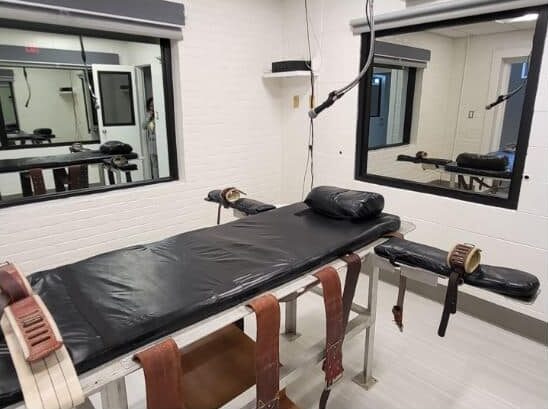
Image (cropped) via Mississippi Department of Corrections