
Louisiana, one of only two states that distributes opioid settlement funding directly to law enforcement, is now trying to bring some oversight to the process. House Concurrent Resolution 50 requests that the Louisiana Opioid Abatement Taskforce (LaOATF) and state attorney general create reporting requirements for the local sheriffs receiving the funds, as well as clarify how the funds can be spent. The resolution passed the Senate on May 26, after advancing from the House on May 11. Both votes were unanimous.
However, concurrent resolutions are not laws. HCR50 doesn’t require the governor’s signature, nor any further approval now that it’s cleared the Senate, but its requests aren’t legally binding even if they are likely to have substantial influence.
HCR50 also requests that the state health department, corrections department and sheriffs’ association jointly report on programs to treat and reduce opioid use in prisons and jails, and that the health department “provide best practices” for correctional treatment programs, including a budget.
The resolution is driven by a widely cited May 2025 report from the Louisiana legislative auditor, which investigated how the state was allocating its opioid settlement payouts. After administrative and legal costs, 80 percent of the remaining funds go to parishes (the equivalent of what most other states refer to as counties) and 20 percent to sheriffs. Louisiana has 64 parishes, each with an elected sheriff.
“No entity has been specifically tasked with enforcing the terms of the opioid settlement agreements in Louisiana [such as] payment amounts and approved uses,” the report stated. “Louisiana’s Memorandum of Understanding (MOU) does not give LaOATF the authority to ensure that parish and sheriff expenditures comply.”

The LaOATF was created in 2021 to oversee the approximately $600 million in opioid settlement payouts expected across Louisiana by 2038. The five-member taskforce distributes the money and advises recipients on how to spend it, but doesn’t have the power to do much more than that.
By late 2024, the LaOATF had disbursed nearly $100 million. But the audit found that only $8.6 million had actually been spent—at least by the parishes and sheriffs that responded, which many of them didn’t.
Parishes are required to submit an annual report on how the funds are used, but at the time of the audit only about two out of three had actually done so. Sheriffs are not subject to any reporting requirements at all, which is one of the points HCR50 “urges and requests” the LaOATF to change by modifying the MOU.
Every state’s system for managing its opioid payouts is a little different. Despite national mandates that at least 70 percent of the funds go to treatment, prevention and harm reduction programs, the whole thing has been rife with unused funds, untracked funds and slush funds that quietly lead back to law enforcement. But only Louisiana and Georgia formally award any funding to local law enforcement. Georgia’s MOU stipulates that “at least” 9.45 percent of the settlement funds disbursed to each county go to the county sheriff.
Expenditures reported as Treatment show that sheriffs and parishes actually “gave the money to their local district attorney.”
The legislative auditor’s office found that for many of the entries parishes and sheriffs had reported as fitting one of the three MOU-approved categories—Treatment, Prevention and Other Strategies—the actual expenditure didn’t quite fit.
For example, two nearly identical expenditures reported by a sheriff and a parish as Treatment state that they gave the money to their local district attorney “to help with their Adult & Juvenile Drug Court Programs.” In another Treatment expenditure, a parish wrote: “Supporting pre-arrest or pre-arraignment diversion by funding diversion officers’ salaries.”
Under the category of Other Strategies, one sheriff reported putting funds toward “law enforcement officers who are operating cameras and solving narcotics crime dealing with the illegal distribution of opioids.” A parish, meanwhile, reported “utilizing the settlement money within our Police Department with working overtime to help get the drugs off the street as well as purchase equipment needed to safely and effectively work on removing the drugs and dealers off the street.”
As for why the bulk of the payouts hadn’t been spent, the most common explanation from parishes and sheriffs was that they weren’t clear on how they were allowed to use them.
Louisiana’s MOU does suggest a very wide range of approved uses for the funds, including medication for opioid use disorder, detox services, housing services, provider training, naloxone distribution and trauma support. There are multiple references to harm reduction, including mobile outreach, testing and treatment for HIV and hep C, and “[s]yringe service programs and other evidence-informed programs to reduce harms associated with intravenous drug use.”
Other approved uses have come from outside the MOU, such as the 2024 law Louisiana helpfully enacted to add pretrial drug-testing to the list.
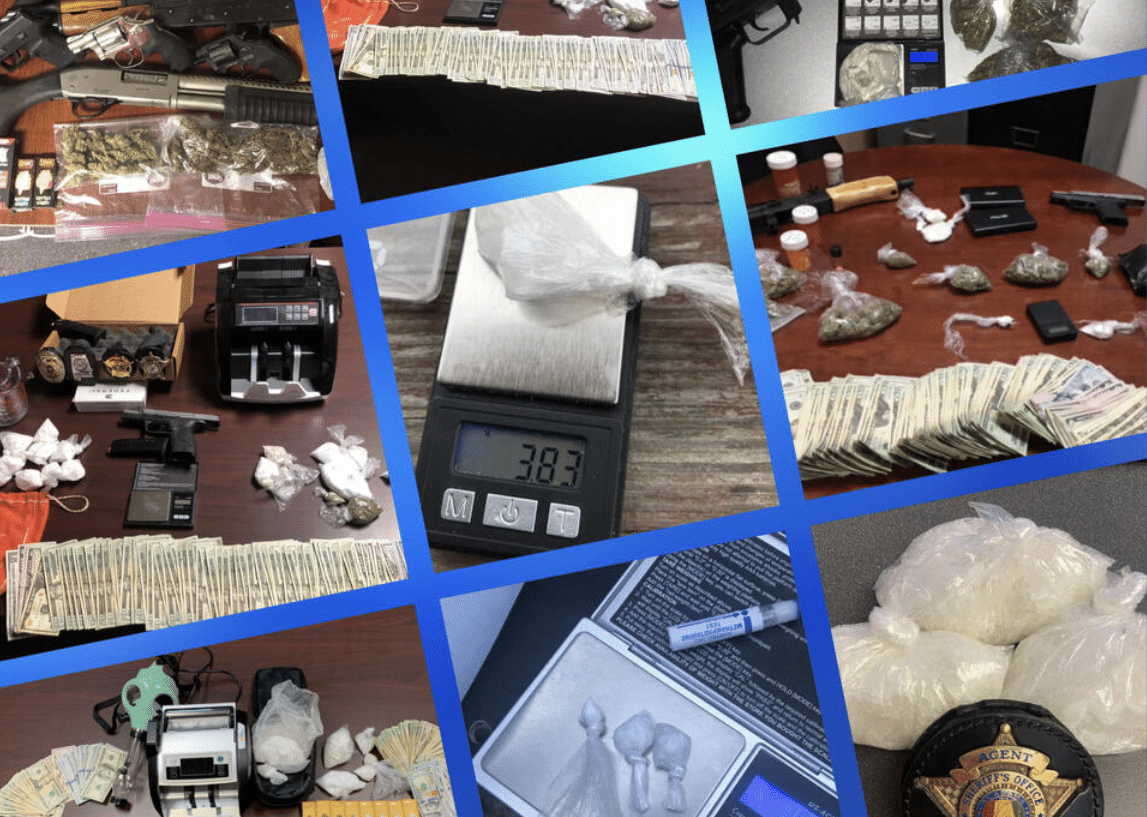
Top image (cropped) via Morgan County Sheriff’s Office. Inset graphic via Louisiana Legislative Auditor.