

On March 2, the Drug Enforcement Administration published a final rule permanently scheduling five benzodiazepines under the Controlled Substances Act. While the CSA already bans dozens of benzos, only these five—clonazolam, diclazepam, etizolam, flualprazolam and flubromazolam—are in Schedule I. The rule will take effect April 1.
In 2020, the United Nations Commission on Narcotic Drugs added etizolam and flualprazolam to the 1971 Convention on Psychotropic Substances, an international treaty that’s the UN equivalent of the CSA. In 2021, the Commission added clonazolam, diclazepam and flubromazolam. This is what prompted the DEA to temporarily schedule the five substances in 2023.
The DEA stated in its new final rule that as a signatory on the 1971 Convention the United States “is required, by scheduling under the CSA, to place appropriate controls on these five ‘designer’ benzodiazepines to meet the requirements of this treaty.” But the UN had placed all five under Schedule IV—the least-restrictive option, as the 1971 Convention only has four schedules—and all the DEA was really obligated to do was make sure any import/export business was properly licensed.
In July 2025, the agency extended its temporary ban by one year and simultaneously declared its intention to schedule all five benzos permanently.
“Clonazolam, diclazepam, etizolam, flualprazolam and flubromazolam have a high potential for abuse,” states the final rule. “These five substances are pharmacologically similar to classical benzodiazepines (e.g., diazepam), which have been shown to produce dependence and are abused by millions of individuals in the United States.”
Diazepam, better known by brand name Valium, is not in Schedule I. It’s in the significantly less restrictive Schedule IV—the category for substances that by the DEA’s definition have “a low potential for abuse.” Other than the five “designer” drugs, and a benzo-anesthetic that’s only approved for veterinary use, every benzo in the CSA is in Schedule IV.
Most of the benzos in Schedule IV have no currently accepted medical use.
Benzos are a class of central nervous system depressants commonly prescribed for anxiety or insomnia, as well as other applications like managing seizures or alcohol withdrawal. With a few exceptions, their generic names almost always end in “-zepam” or “-zolam.” The benzos that are most widely prescribed in the US are alprazolam (Xanax), clonazepam (Klonopin), diazepam (Valium) and lorazepam (Ativan). All of those “classical” benzos are in Schedule IV.
In 2025, the Center for Forensic Science Research and Education reported 37 toxicology specimens for flualprazolam; 37 for flubromazolam; nine for etizolam; seven for clonazolam; and one for diclazepam. Toxicology specimens are separate from seized drug samples, but can represent people who were either living or dead when the specimen was collected.
The DEA claims that the five “designer” benzos belong in Schedule I because, in addition to being just like the classical benzos in Schedule IV, they have no currently accepted medical use (CAMU) in the US. Neither do most of the benzos in Schedule IV. There are 34, of which only 16 (including diazepam and other the “classical” examples) have ever been approved by the Food and Drug Administration. Two of those 16 have been discontinued.
Many of the Schedule IV benzos that haven’t been approved in the US do have therapeutic benefits that are recognized in other markets. This is also true of etizolam, one of the five Schedule I benzos. In North America etizolam is best known in the context of “benzodope” and the unregulated opioid supply, but it’s also approved to treat anxiety and insomnia in India, Italy and Japan.
“Regarding etizolam specifically, [the Department of Health and Human Services] noted in its scientific and medical evaluation that etizolam is used as an approved medical drug in other countries for the treatment of anxiety disorders, insomnia and neurosis,” states the DEA final rule. “Nevertheless, HHS concluded that etizolam lacked a currently accepted medical use in the United States.”
The DEA went on to describe how there’s little available research on etizolam, and the studies that have been conducted haven’t addressed “the human abuse potential” or demonstrated safety or efficacy in any medical context.
The final rule emphasized that Schedule I placement “does not preclude academic research,” which is technically true. But it does heavily restrict it. This makes the CAMU requirement somewhat of a Catch-22, amid the DEA’s escalating abuse of temporary scheduling powers to shove novel synthetic drugs into Schedule I at will. In late 2025, the DEA issued a temporary order placing bromazolam, another novel benzo, under Schedule I.
Alongside their “high potential for abuse” just like benzos in Schedule IV, and their lack of CAMU just like benzos in Schedule IV, the DEA’s final justification for permanent placement of the five benzos in Schedule I was the lack of evidence supporting their safe use under medical supervision—including that “no qualified experts or groups have been identified in the United States who have asserted or supported that etizolam has a currently accepted medical use in treatment in the United States.” It would be confusing if any experts had asserted this, under the circumstances.
“Designer” drugs, a term the DEA uses to build up the mythology of synthetic drugs as unstoppable chemical weapons engineered with a lot more precision than they actually are, don’t tend to show up in the unregulated supply on their own. Like nitazenes and fentanyl analogs, the novel benzos in Schedule I are overwhelmingly found mixed with fentanyl, and their permanent Schedule I status will facilitate longer and longer prison sentences for people who use or sell or share fentanyl without any control over what other substances come into the supply.
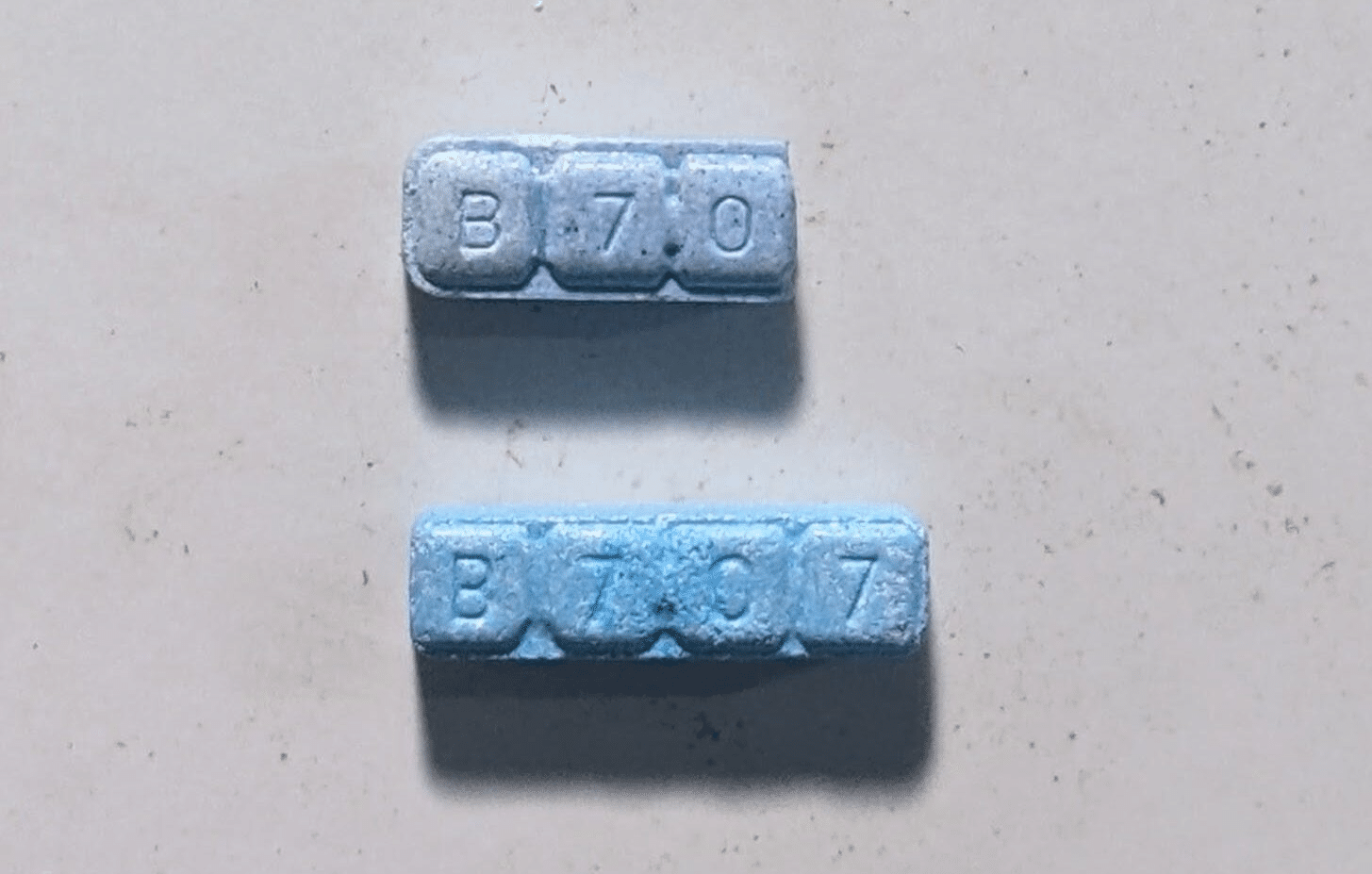
Image of licit (above) and illicit alprazolam courtesy of Anonymous