
DEA Plans Emergency Ban for O-DSMT, Active Compound in Tramadol

    On June 24 the Drug Enforcement Administration announced that it’s preparing to temporarily place synthetic opioid O-desmethyltramadol (O-DSMT) in Schedule I of the Controlled Substances Act. Administrator Terrance C. Cole is expected to issue the temporary order July 24, per the CSA requirement of a 30-day wait from when the notice of intent was published in the Federal Register. The agency claims O-DSMT is a “significant public health concern,” though the evidence for this is limited.

    O-DSMT is the primary active metabolite in tramadol, a synthetic opioid approved by the Food and Drug Administration to treat moderate to moderately severe pain. Tramadol is a prodrug, which in this case means it’s an oral medication that’s essentially inactive until it hits the liver and is metabolized by enzymes that convert it into the O-DSMT. While people who use drugs often crush and inject oral medications to get a stronger and quicker effect by introducing them to the bloodstream directly, that doesn’t necessarily work with a drug that still has to go through the liver first.

    Tramadol has been in Schedule IV of the CSA since 2014. While it’s considered a “weak” opioid receptor agonist, O-DSMT is a more potent agonist. Codeine works similarly—it’s a weak opioid agonist until liver enzymes break it down into morphine, a more potent agonist. The central nervous system stimulant Vyvanse is another common prodrug, with limited effect until red blood cells convert it into dextroamphetamine.

    United States law enforcement first encountered O-DSMT in 2011. In the 15 years since then, it’s been identified a total of 148 times, primarily through seized drug samples rather than through post-mortem toxicology reports.

    “The threat of serious injury to the individual and the imminent threat to public safety following the ingestion of O-DSMT persists,” the notice states. “Because not every forensic laboratory has the capacity to test for O-DSMT, it is likely that encounters of O-DSMT are underreported.”

    This is probably true, but just in the sense that you could say that about any substance. O-DSMT is in the National Institute of Standards and Technology mass spectral reference library, the master list of known chemical substances that forensics labs work off of, but it wouldn’t be detectable through certain basic tests like drug panels that aren’t designed to detect O-DSMT specifically.

    The hard data about fatal overdose comes from a handful of report from Sweden in 2009.

    The DEA stated that law enforcement has encountered O-DSMT “in various forms, including as a solid powder, pressed into pills or tablets, in a capsule, as a semi-solid paste/slurry, and in liquid formulations.” 

    The notice states that O-DSMT was “found as the only drug” in 118 of those encounters, and in the rest was “co-reported with various other substances,” including kratom. The language is similar to how we often describe fatal overdose, in terms of whether post-mortem toxicology identified one substance versus multiple substances, but here the DEA is just referring to seized drug samples.

    It also probably means very little that O-DSMT has been co-reported with other substances, because different labs have different definitions of what that means. A 2019 National Forensic Library Information System report on tramadol explained that, for example, a bag of tramadol found with a bag of heroin could be logged as one item, so a “drug combination” might mean powders found mixed together or it might mean “counts of separate drugs reported together in the same item.”

    The DEA also stated that O-DSMT has been “found to be mixed with the kratom plant as determined by packaging material and the confirmation of both O-DSMT and [active kratom metabolite] mitragynine in toxicology results of individuals.” This is also slightly misleading, because two substances being in someone’s system at the same time doesn’t always mean they’d been consumed together.

    The hard data about fatal overdose that the DEA is using to justify the emergency scheduling order primarily comes from a handful of reports from Sweden in 2009, which is when “Krypton,” a mix of O-DSMT and kratom, was briefly popular. Anything can be an “imminent threat to public safety” if the DEA wants it to be.


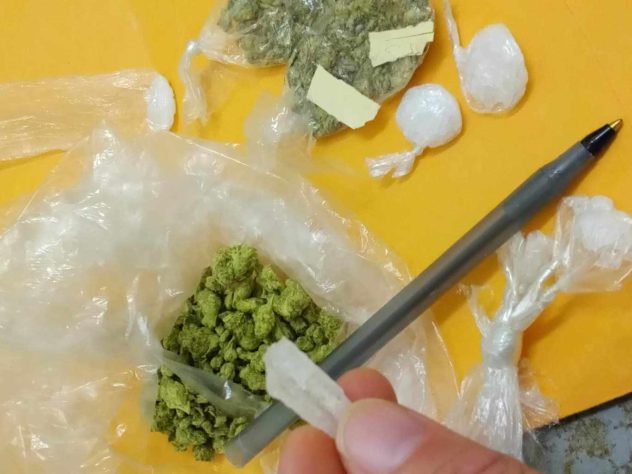
    Image of seized tramadol (cropped) via National Forensic Library Information System

    • Kastalia is Filter‘s deputy editor. She previously worked at half a dozen mainstream digital media outlets and does not recommend the drug war coverage at any of them. For a while she was a syringe program peer worker in NYC, where she did outreach hep C testing and navigated participants through treatment. She also writes with Jon Kirkpatrick.

    You May Also Like