

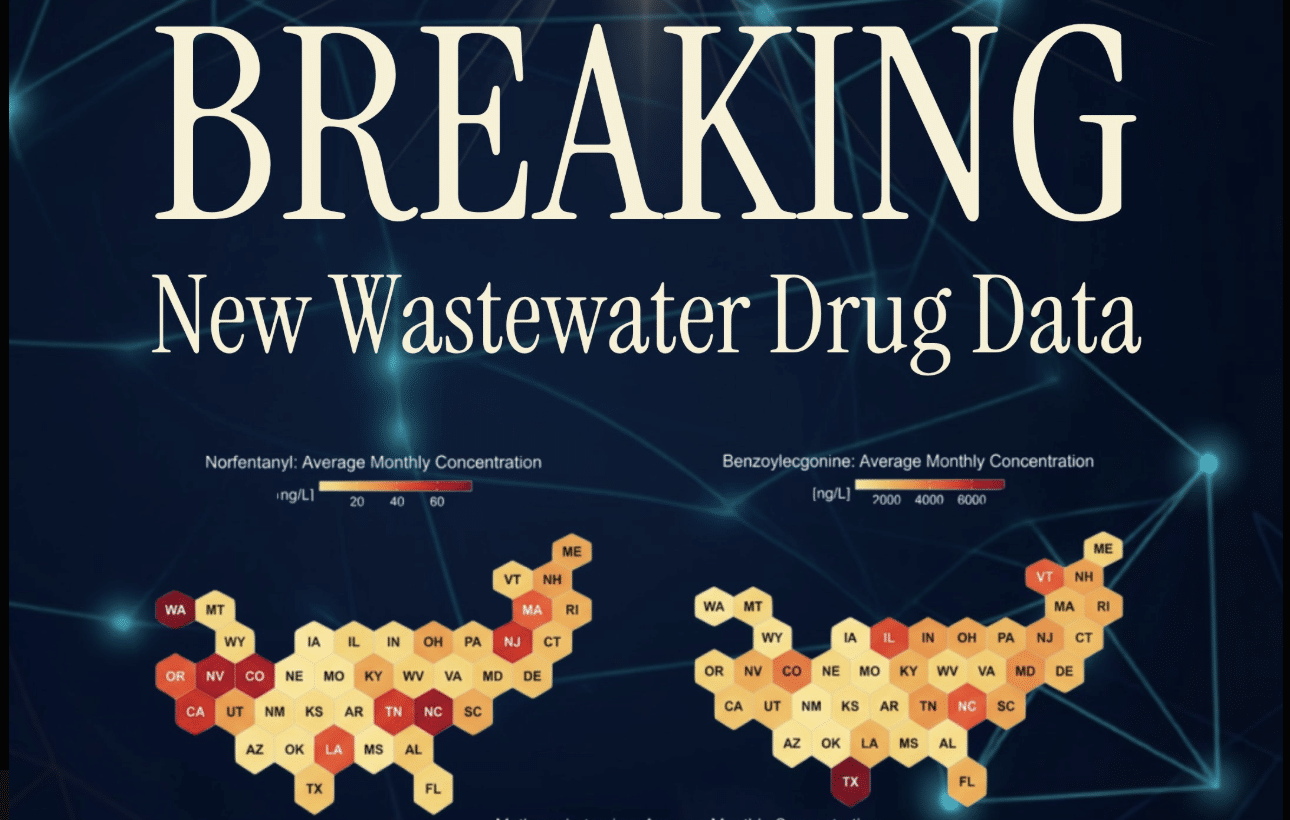
The Office of National Drug Control Policy (ONDCP) has published its first report on wastewater-based drug testing, something that wasn’t commercially available during President Trump’s first term and has become of interest to the administration during his second term. The ONDCP claims the data will “empower local communities to respond to illicit drug use,” while effectively shining a spotlight on a small number of individual counties.
The report focuses on quantitative data for fentanyl, cocaine and methamphetamine as well as qualitative data for seven novel psychoactive substances (NPS) selected by ONDCP: acetyl fentanyl, carfentanil, ketamine, medetomidine, para-fluorofentanyl, tianeptine and xylazine. Quantitative analysis refers to the concentration of a substance relative to the size of the population using that sampling site, which isn’t necessarily possible for those that are less prevalent or more potent than fentanyl, cocaine or meth. The data represent about 18 percent of the United States population, and according to ONDCP is the country’s largest wastewater drug-monitoring project to date.
After first analyzing the seven NPS by census region, the agency decided to hone in on individual counties where at least six of the seven had been identified.
“Counties where at least six drugs were detected may signal broader polysubstance activity, making them important areas for closer monitoring,” the report states. It also labels counties as “hotspots” for fentanyl, cocaine and meth use.

Similarly, the report points out that medetomidine, para-fluorofentanyl, carfentanil and acetyl fentanyl were identified in all census regions, “signaling potential emerging and re-emerging threats.” But there’s no indication of scale for any of the NPS data, even in the report’s accompanying supplement.
For some states, the data really reflect a single county. Other states have data from up to nine counties. And within the county-level data, there’s no standardization in how many sampling sites were included, or whether multiple sites were spread out versus concentrated in one location.
The government isn’t required to get the public’s consent to test wastewater because, legally speaking at least, property is no longer private once we’ve thrown it away; it’s the same concept behind why cops don’t need a warrant to go through trash cans on the curb.
Biobot Analytics, the first commercial wastewater-testing company, began contracting with ONDCP in January. (The National Institutes of Health has already been working with Biobot for wastewater drug-testing since 2020.) In May, the new National Drug Control Strategy called for the establishment of a “national wastewater-based monitoring system,” and referenced wastewater testing as a means of confirming AI analyses of emerging drug trends on social media.
Notably, wastewater data doesn’t distinguish between regulated and unregulated versions of a substance. This means that Adderall use, whether prescribed or not, is getting categorized as methamphetamine.
The utility of wastewater testing mostly depends on whether the data is going to public health or to law enforcement. However anonymized the samples might be initially, it’s not difficult for law enforcement to trace the information back to a specific toilet if they really want to.
“Unlike many sources, wastewater is unbiased by household income, race or gender, ensuring equal representation,” Biobot stated in a 2023 blog post about wastewater testing in the context of allocating opioid settlement funds. “With 80 percent of American households and almost all public restrooms included, wastewater analysis offers insights into where substances are used.”
Wastewater itself isn’t biased by income, but it’s harder to say that about wastewater analysis, which is entirely contingent on access to indoor plumbing.
Top and inset images (cropped) via Office of National Drug Control Policy/X.com