

The United States Sentencing Commission is seeking public comment on proposed amendments to the federal sentencing guidelines, which could for the first time in decades update the egregiously arbitrary and outdated the penalties for trafficking methamphetamine. About one out of four people in the entire Federal Bureau of Prisons population is serving time for meth trafficking. Public comment may influence whether the amendments would be applied retroactively.
Unlike with other banned substances, meth convictions are punished according to substance purity. In 1988 the USSC decided that different mandatory minimums would be triggered depending on whether the meth in a given case was “actual” (sample weight represents pure meth) or “mixture” (sample weight includes fillers). Then in 1990 the commission added “ice,” a poorly defined category for crystal meth (as opposed to powder) with purity above 80 percent. Courts ended up treating it all as 100-percent pure “actual” meth.
There is no evidence base that supports any of this and no official explanation for why meth was singled out this way. Powder meth is just crystal meth that has been crushed up.
“Over the next 10 years, Congress considered changes to the statutory penalties for methamphetamine, frequently invoking comparisons between methamphetamine and crack cocaine in terms of the dangers and harms associated with the two drugs,” reads a draft of the proposed 2026 amendments. “With the Methamphetamine Trafficking Penalty Enhancement Act of 1998, Congress halved the quantities of methamphetamine set forth in the 1988 Act to the quantity threshold triggers that apply today. In doing so, it enacted mandatory minimum quantity thresholds for methamphetamine (actual) that matched those in place at the time for crack cocaine. Although the statutory penalties for crack cocaine have changed, the same statutory penalties for methamphetamine remain in place.”
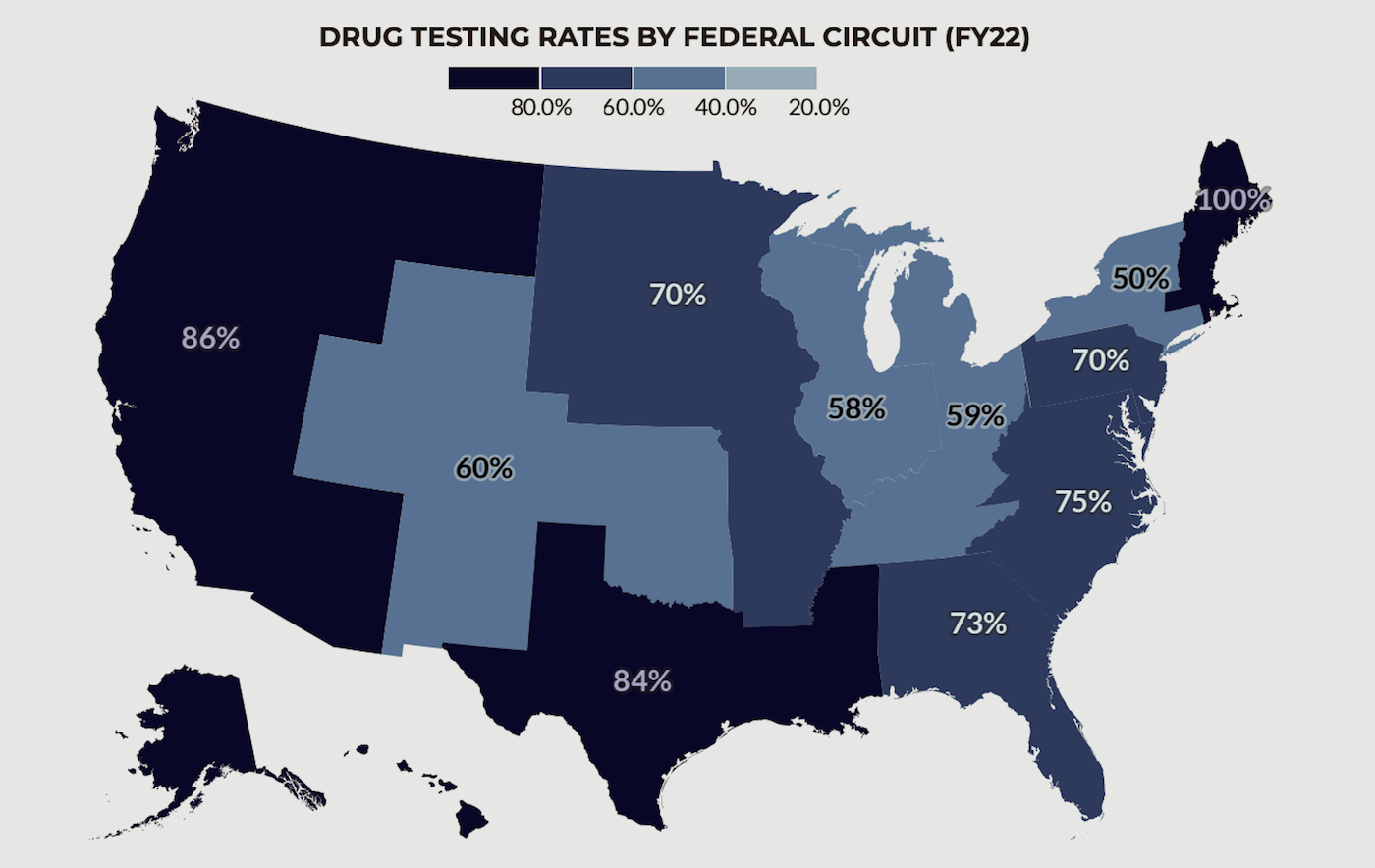
Higher-purity meth was assumed to signify a higher level of the drug-distribution chain. But today, it’s the norm for meth to be over 90-percent pure—meaning there is no functional difference between “actual,” “mixture” and “ice,” yet they all meet the criteria for the highest penalties. Getting a forensics lab to determine the purity is expensive, and so the people sentenced to the higher penalties for “actual” meth are just the ones whose samples happened to get tested. Frequency of testing varies widely across the country, but it’s more common in border districts.
Almost half of all federal drug-trafficking cases are now related to meth, and those convictions come with the longest sentences—eight years on average, more than a year-and-a-half longer than the average sentence for fentanyl trafficking even though only about 1 percent of federal overdose cases involve meth.
Despite the substantial shifts in meth purity and the landscape of the drug war as a whole, for a quarter-century the USSC left the meth sentencing guidelines to rot until finally revisiting them for an analysis published in 2024. An amendment was proposed, but in 2025 the commission adopted the other amendments in the cycle without voting on that one.
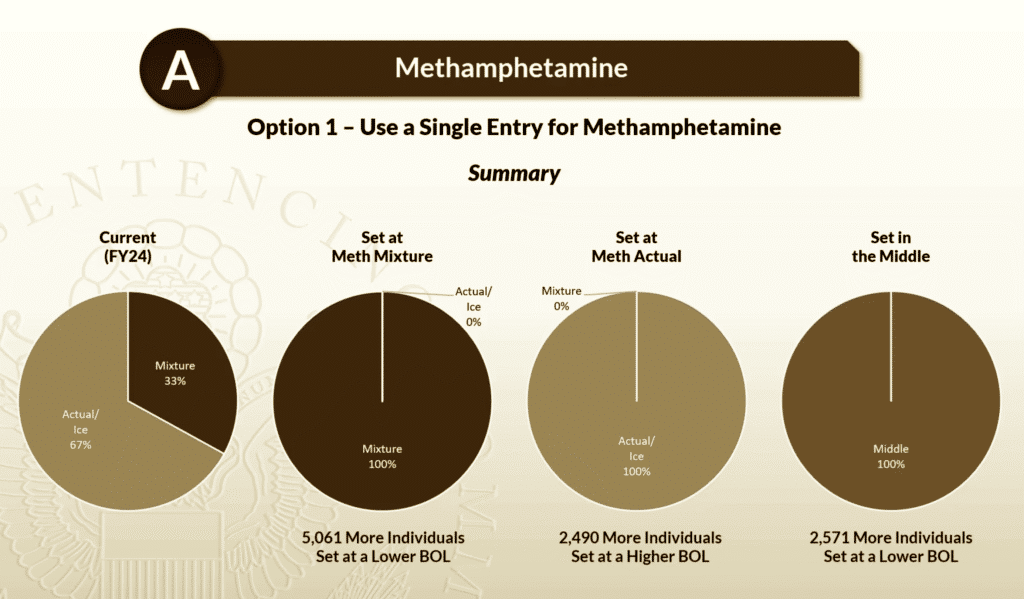
The proposed 2026 amendment would remove references to “ice,” and proposes two options for reconciling the meth sentencing disparities. The first is to set one uniform quantity threshold for all meth sentencing, removing the distinction between “mixture” and “actual.” The new threshold could be the lower one currently used for “mixture,” the higher one currently used for “actual,” or the ones used for fentanyl or cocaine base, which are somewhere in the middle.
Using the “mixture” threshold would result in lighter overall sentencing for meth convictions, while using the “actual” threshold would result in harsher overall sentencing. Using the fentanyl or cocaine base thresholds would affect fewer people, but the net change would be toward lighter sentencing.

The second option is to retain the concept of two different meth thresholds, but begin all cases from a baseline threshold that’s in the middle, like the one currently used for cocaine base. From there, the courts would use one or more mitigating factors in each case to either raise the sentencing to “actual” or lower it to “mixture.”
Factors that could reduce someone’s sentence include lack of weapons involvement; having been coerced into participation; furnishing prosecutors with useful information for other cases; or being especially vulnerable due to age or a health condition including drug dependence. The factors that could increase someone’s sentence are essentially the opposite of those, along with others like use of a pill press or dark-web platforms. If both reducing and heightening factors were identified, the latter would be applied.
The deadline to submit comment online or by mail is February 10.
Images (cropped) via United States Sentencing Commission