

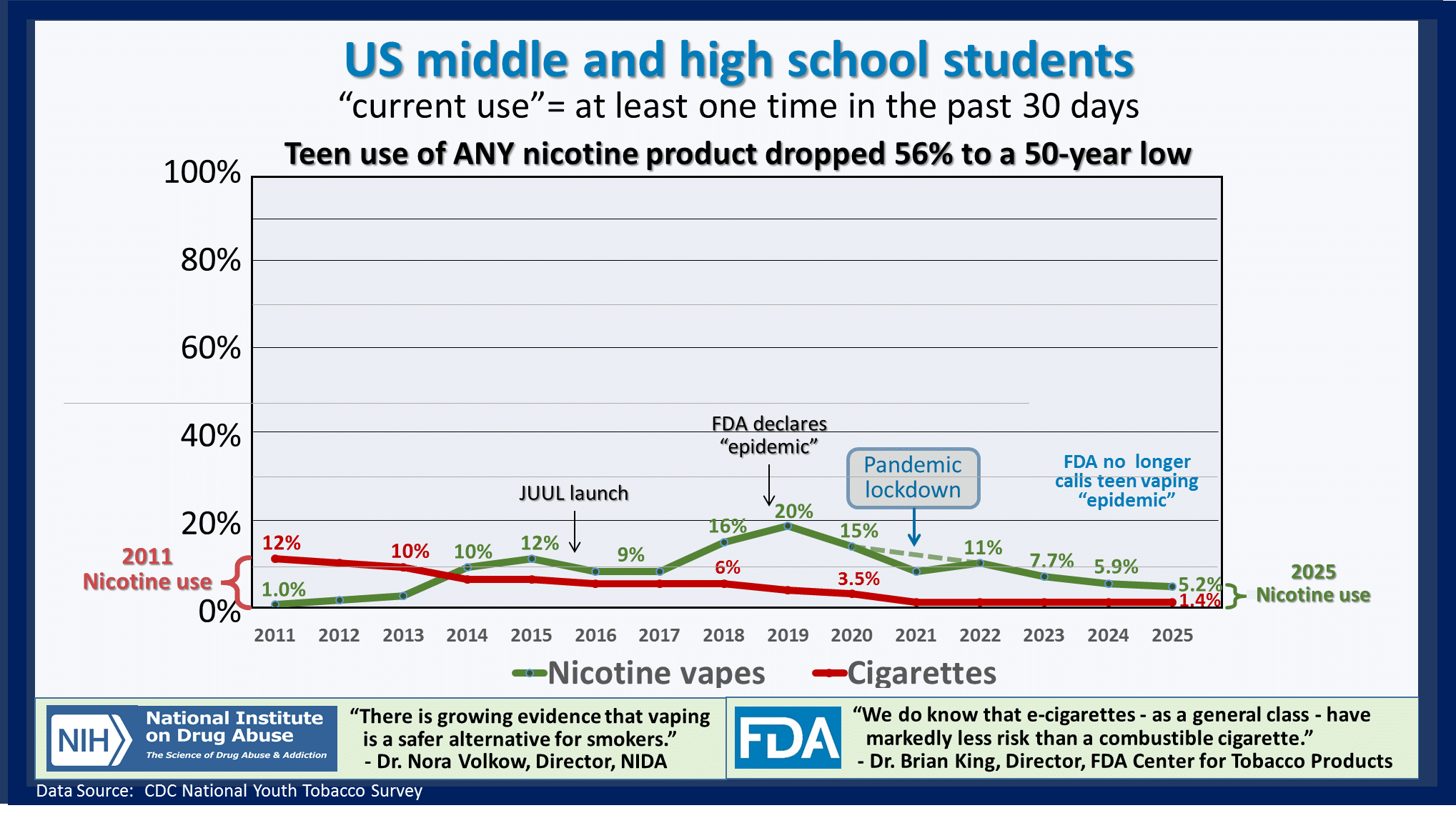
Teen vaping in the United States has plummeted over the past six years, according to surveys from the Centers for Disease Control and Prevention (CDC), the Food and Drug Administration (FDA) and the National Institutes of Health.
Many people nonetheless seem to believe that teenage nicotine vaping is rising. And this includes the administrators of US schools, as indicated by constant media reports of school systems all over the country installing vaping detectors.
In 2025 I testified in person at a state hearing on a proposed “registry bill”—effectively a vape flavor ban. I had five minutes to explain what CDC/FDA surveys actually show. I was followed by testimony after testimony from school officials claiming they were seeing a crisis.
Though I do not know why this huge gap between the evidence and schools’ perceptions exists, I have some ideas.
I had little chance of changing the lawmakers’ minds. When a high school principal shows up with two bulging bags of disposable vapes that have been confiscated in his school system, and parents testify about the impacts of the “crisis,” that weighs far more on the minds of politicians than accurate-but-dry evidence from official government surveys.
Though I do not know why this huge gap between the evidence and schools’ perceptions exists, I have some ideas.
What I do know is that the same CDC/FDA survey that was used in 2019 to claim a “teen vaping epidemic” now shows a 74-percent drop in teen vaping in the years since. (Granted, that figure is for “current use,” however occasional; frequent use, which may imply dependence, “only” dropped by 62 percent.) And I think it would be difficult to argue that teen lying on anonymous surveys has suddenly skyrocketed.
I can think of several factors that may explain why school officials’ perceptions currently—and very honestly and earnestly—are at odds with what I consider to be objective survey evidence. In each case, I’ll attach a term for a well-known source of potential bias in scientific measurements.
First, teachers are now hyper-vigilant about vaping, thanks to years of loud media and political messaging on the subject. So they catch far more kids than they previously would. This is what’s known as sensitivity bias; the hyper-vigilance is self-reinforcing.
The fact that schools are now chock-full of vape detectors, again meaning they catch more kids than previously, is part of this sensitivity bias. Many US schools have detectors due to the Juul settlement, which sent nearly half a billion dollars to states.
And inevitably, schools that are chock-full of vape detectors will sometimes experience them going off without cause—a student using hairspray or perfume in a locker room, for instance—meaning a certain proportion of cases are what we call false positives.
The narrative of a vaping crisis in schools is driving truly harmful sin taxes and bans all over the US. The harm reduction community needs to confront it head-on.
Returning to sensitivity bias, this extends to the students themselves. They have been hammered with scare stories, so that today, more than in the past, many may think that vaping is super-scary and highly addictive. If they try a nicotine vape, they may rapidly fear they are becoming “addicted,” or at risk of horrific lung injury, and may even turn themselves in to a school nurse or a teacher for help.
Finally, people vape all kinds of things besides nicotine. There is no reason to think that school officials are experts at distinguishing between nicotine and THC, say, when the CDC itself fails to draw a clear distinction. Some school incidents recorded as “vaping” won’t involve nicotine at all. This conflation is known as lumping bias (or category bias).
If some or all of these hypotheses are substantially true, it would mean that in the past, far more students were vaping but fewer school officials were aware of it; whereas now, fewer students vape but those who do are far more likely to be caught, or to self-report.
I believe the gaping chasm between evidence and perception in US schools must be addressed. Just as the drug war has been justified as a series of child protection measures, the same is happening with nicotine today. The narrative of a vaping crisis in schools is driving truly harmful state-level sin taxes and bans all over the US right now. The community of tobacco control experts and consumers who support harm reduction needs to confront it head-on.
Top photograph (cropped) by SuSanA Secretariat via Wikimedia Commons/Creative Commons 2.0. Inset graphic by Charles Gardner.
The Influence Foundation, which operates Filter, has received unrestricted grants from Juul Labs, Inc. Filter‘s Editorial Independence Policy applies.