

“I was told countless times, ‘You should stop smoking.’ But when I said I had tried, no one offered advice on what else to try,” Kim “Skip” Murray told Filter.
That included her doctor. She recalled going to see him when she came down with bronchitis one time. “The doctor said to me, in a really grumpy voice, ‘I told you a year ago that you’re going to keep getting sick if you don’t stop smoking.’”
When Murray explained how many times she had tried to do just that, and how her most recent attempt had only lasted two days, the doctor just said, “I think you should try harder next time.”
“He did not offer me any medication or suggest nicotine replacement therapy,” Murray said. “If he’s not willing to offer tools to help me succeed, how am I supposed to believe I’m worth helping?”
The doctor’s “quit or die” attitude left her feeling a “failure,” and she never made another attempt to quit. After more than 50 years of smoking, she eventually stopped “accidentally,” after she started working at a vape shop and tried the products herself—a journey that led her to become a tobacco harm reduction advocate, who has written for Filter.
“Urban smokers are nearly twice as likely to quit as rural smokers.”
Murray lives in a rural part of Minnesota, a few miles from a town called Brainerd. She’s far from alone among rural residents—who have higher smoking rates than their urban counterparts—in facing particularly high barriers to quitting. And while a lack of helpful smoking-cessation advice in rural medical settings is part of the story, there’s a lot more to it.
Smoking rates in the United States have taken a significant tumble in recent years, in large part due to uptake of safer nicotine products, like vapes and pouches. In 2024, the country achieved its lowest smoking rate up to that point, of 9.9 percent. But in some groups, smoking rates remain stubbornly high. Providing them with accurate information and effective options is vital, when an estimated 25-30 million US adults still smoke, and the country’s biggest cause of preventable death still claims close to 500,000 lives each year.
“Urban smokers are nearly twice as likely to quit as rural smokers,” noted a recent report, “The Forgotten Smoker,” published by the tobacco and nicotine products company Philip Morris International (PMI), which also focused on people with mental health conditions and veterans.
There’s a temptation to assume rural areas’ higher average age might account for this. According to the last US Census, the median age in rural and small-town communities was 41.3, compared to 38.8 for the whole population. The 45-64 age group has the highest smoking rate in the US; and people aged 65-plus, though smoking at a lower rate, are the most vulnerable to smoking-related disease and death. The “forgotten smokers” among these older age groups were discussed at the Nicotine Summit in Washington, DC, in May.
“Older age distribution in rural areas may play a role, but it is only likely one part of a much more complex picture.”
But according to Lorna Bittencourt of the University of Minnesota’s School of Public Health—lead author of a study titled, “Smoking Quit Attempts and Associated Factors Among Rural Adults Who Smoke Daily in the United States,” which was cited in the PMI report—taking this as the whole explanation for the rural-urban disparity would be reductive.
“Older age distribution in rural areas may play a role,” Bittencourt told Filter, “but it is only likely one part of a much more complex picture involving socioeconomic conditions, health care access and longstanding tobacco-related disparities.”
Rural communities, she continued, often face reduced access to healthcare and smoking cessation services, transportation barriers, economic stressors and fewer tobacco treatment resources.
Other researchers paint a similar picture. Dr. Ruoyan Sun is an assistant professor with the Department of Health Policy and Organization at the University of Alabama at Birmingham, whose work has also covered smoking behaviors by location. She was among the speakers at the recent Nicotine Summit, and like Bittencourt, she warns against oversimplified explanations.
“One important lesson is that rurality is more nuanced than simply labeling areas as ‘urban’ or ‘rural,’” Sun told Filter. She said binary classifications risk masking important variations.
“Higher smoking prevalence in rural areas is partly explained by socioeconomic and demographic factors,” she continued, “but these do not fully explain why adults in rural areas are less likely to quit.”
“I called this person when I was still smoking, requesting help. The best they could do was to tell somebody to drive up to 100 miles to pick up brochures.”
The point about lack of access to smoking-cessation resources rings true to Marc Slis, who lives in the small community of Hancock on Michigan’s Upper Peninsula. Trying to quit smoking there, with a health system ill-equipped to help him, was excruciatingly difficult, he told Filter. “What I found was that there were little or no smoking cessation resources available in the area.”
Slis explained that the health department in question covers five counties of about 71,000 residents across roughly 14,000 square miles. Faced with extremely high smoking rates in such a thinly spread population, the health department designated one person, with no formal training or experience, to be the smoking-cessation coordinator.
“I called this person when I was still smoking, requesting any help they could give me,” Slis said. “The best they could do was to tell somebody to drive up to 100 miles to pick up brochures.”
“In other words, there is no smoking-cessation help available in the five-county area that I live in,” he continued. “It illustrates that the number one cause of preventable death is not only not a priority for a five-county health department, but also not even on their radar.”
Like Murray, Slis ran his own vape shop for years; discovering vapes had finally enabled him to quit smoking. But he’s still exasperated by the lack of help communities like his get from health authorities.
“If this is the state of things in other rural areas,” he concluded, “I think this alone may be responsible for much of the low quit rates and high smoking rates seen in rural areas.”
“Tobacco product regulation could be an opportunity to advance health equity in rural America, particularly if paired with efforts to improve access to support and health care.”
Another important issue Bittencourt pointed to is that tobacco-related inequities in rural communities are often overlooked in tobacco control conversations.
“In a recent paper, we discussed how tobacco product regulation could be an opportunity to advance health equity in rural America, particularly if policies are paired with efforts to improve access to cessation support and health care infrastructure,” she said.
The internet is one obvious place to find tools and information, especially for people in remote areas, but here too there’s a disparity. According to the Federal Communications Commission, over 22 percent of people in rural areas of the US, and almost 28 percent living on Tribal lands, “lack coverage from fixed terrestrial 25/3 Mbps broadband.”
One study tested three strategies to promote engagement with an online program to encourage rural adults to quit smoking. Printed materials; printed materials plus a loaned iPad with data plan coverage; or print materials, the iPad, plus up to six individualized coaching calls to support technology needs. It found that those who received the coaching support “had improved smoke-related outcomes.”
“Our study provides a better understanding of the resources needed to support digital access in rural populations,” the authors concluded, “and the results could be used to improve approaches to encourage people living in rural areas to stop smoking.”
“One important takeaway is that reducing rural smoking disparities will likely require more than individual-level interventions alone.”
Murray agrees. “So much of health care and cessation is now digitalized,” she said. “If a person doesn’t have good internet or cell service, it is next to impossible for them to have access to modern health care and cessation services. I am fortunate to have reliable internet access and can take advantage of telehealth, because I would not be able to drive for several hours just to attend an appointment.”
But no single intervention is likely to end a rural smoking disparity that translates into a severe health disparity. Instead, it would take a range of far-reaching changes.
“I think one important takeaway is that reducing rural smoking disparities will likely require more than individual-level interventions alone,” Bittencourt said.
“Addressing these disparities will also require structural approaches,” she continued, “including improving access to evidence-based cessation treatment, expanding health care access in rural communities, and ensuring that tobacco regulatory policies consider the unique needs and contexts of rural populations.”
People’s desire to stop smoking is evident in all parts of the country: The PMI report cited CDC data showing that over 67 percent of US adults who smoke would like to quit. Rather than implying that people in rural areas—or anywhere else—just need to “try harder,” it’s imperative to make sure they have the right tools.
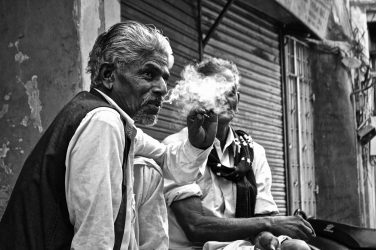
Photograph via PublicDomainPictures.net
The Influence Foundation, which operates Filter, has received unrestricted grants from PMI. Filter‘s Editorial Independence Policy applies.