

On September 15, President Donald Trump announced he’s deploying the National Guard and other federal agencies to Memphis, Tennessee. “Today, at the request of Governor Bill Lee of Tennessee, who’s standing with us as you know, I’m signing a presidential memorandum to establish the Memphis Safe Task Force and it’s very important because of the crime that’s going on not only in Memphis, but in many cities and we’re going to take care of all of them,” Trump said. The presidential memo referenced Elvis Presley as a symbol of Memphis’s cultural heritage, while omitting the city’s Black music legends, including B.B. King, Isaac Hayes and Al Green.
Memphis harm reductionists are now preparing, working to advise marginalized people in anticipation of a damaging impact.
Trump’s move had been advertised. He recently made similar threats to Chicago—which have been withdrawn for now—and previously deployed troops in Los Angeles and Washington, DC. Those deployments have prompted shock and fear, as well as scrutiny of the supposed justifications and the outcomes.
California Governor Gavin Newsom and local officials were livid when Trump sent National Guard troops and marines to Los Angeles in June to quell pro-immigration protests (and put on a military parade in a park). That deployment ended in July.
If DC’s ongoing situation is any guide, we have a pretty good idea of what the Memphis outcomes might be.
After Trump federalized law enforcement in DC, deploying troops there in August, residents protested or stayed home, leaving businesses empty. A federal agent was hit by a Subway sandwich. “I did it. I threw a sandwich,” confessed Sean Charles Dunn, a former DOJ employee, thus freeing the federal government’s investigative apparatus to concentrate on people drinking beer or smoking weed.
It’s currently unclear exactly what the Memphis deployment will consist of—though it’s likely to involve National Guard troops from other states—or when it will begin. But if DC’s ongoing situation is any guide, we have a pretty good idea of what the outcomes might be.
In mid-September, the Washington Post analyzed 1,273 arrest records, more than a third conducted by federal officials (they didn’t count immigration arrests). One in four arrests were arrested for firearms, even though Trump calls the Second Amendment “an indispensable safeguard of security and liberty.” The gun seizures included a search so illegal the judge berated federal officials from the stand; agents had stopped a young Black man after they saw him tug at his backpack.
The second most common type of arrest by federal officers—one in seven—was for low-level incidents like people drinking alcohol in public or smoking marijuana. They were overwhelmingly young Black men, the Post reported.
While Tennessee Gov. Bill Lee (R) has welcomed the prospect of militarized federal encroachment in Memphis, local leaders beg to differ. “I’m certainly not happy,” said Mayor Paul Young (D).
Those working with people who are marginalized, unhoused and use drugs are more than “not happy.” They’re afraid.
“We know that this National Guard deployment is supposedly to ‘combat crime,’ which often means targeting unhoused people or other ‘undesirables,’ including people who use drugs.”
Dr. Paige Lemen is co-founder of 901 Harm Reduction, a Memphis-based group providing supplies and resources for people who use drugs. In June, as Filter previously reported, Lemen herself was arrested, and described how she had been transporting a drug sample for lab testing. She now fears the city’s most vulnerable will be increasingly threatened.
“We’re concerned because we know that this National Guard deployment is supposedly to ‘combat crime,’ which often means targeting unhoused people or other ‘undesirables,’ including people who use drugs,” Lemen told Filter.
She noted a glaring double standard around drug use. “Everyone uses drugs, and most people use safely in their home and don’t use it chaotically or in a way that develops a substance use disorder. But people who are unhoused can’t use it in the privacy of their own home.”
This visibility of drug users who are also in survival mode on the street, together with behaviors resulting from common mental health issues, makes them easy targets for law enforcement, Leman added.
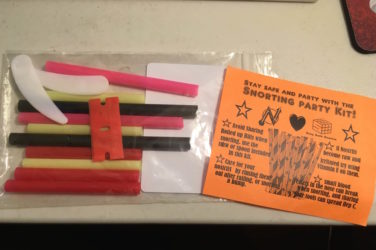
The group has created a survival guide to be distributed to people in Memphis ahead of the deployment, including as wallet cards and flyers. They remind residents about the doublespeak authorities use to detain people for activities that aren’t against the law. The arrests may not stand up in court. But even a few days in jail can wreak havoc on a person’s mental health and life, as Lemen knows.
“Police often use vague pretexts—’public intoxication,’ ‘disorderly conduct,’ or ‘loitering’—to justify detention/arrest of people who are unhoused, neurodivergent, or disabled,” the guide reads. “These arrests are often discriminatory and can be challenged in court, but the person still suffers the arrest, jail, and record in the meantime.”
It’s against the law to arrest someone just because they are thought to be experiencing substance use disorder, the guide notes. “But if police claim to see an “act” (e.g., holding a pipe, nodding off in public, or appearing intoxicated), they often use that as grounds for charges, even when weak or discriminatory.”
The guide warns that, “Even sterile syringes and safer use supplies can be treated as ‘drug paraphernalia’ if police decide to. Always frame them as public health tools.”
The guide advises people to stay calm if they’re stopped by officers, and to remember that they have the right to remain silent. If officers demand to see identification documents, which many unhoused people lack, the guide’s advice is to respond: “I am not required by law to carry ID. Under Tennessee law, I only need to verbally state my name and address, and only if that information is known, if I’m lawfully detained.”
The guide further warns that, “Even sterile syringes and safer use supplies can be treated as ‘drug paraphernalia’ if police decide to. Always frame them as public health tools.” It suggests saying: “These are harm reduction supplies to prevent overdose and disease and were acquired.”
If officers tell someone they’re not free to leave, they have the right to ask why. “If you’re detained or arrested, ask for a lawyer and remain silent,” the guide states. It also reminds people that they should never sign anything they don’t fully understand.
Lemen said that 901 Harm Reduction’s guide will be updated in real time, based on developments on the ground.
Based on what’s happened in LA and DC, they’re bracing themselves.
“After witnessing the results and consequences of this Military force in those cities, we’ve learned that this was NOT about ‘combating crime,’ the guide states. “Instead, the National Guard has targeted, harassed, and arrested unhoused community members, people with past criminal records & records of drug use in MASS numbers!”
Image via the White House