

The National Institute on Drug Abuse has released the latest Monitoring the Future Survey (MFS), which for over 50 years has provided data on how various regulated and unregulated substances are used and perceived by teenagers. What the 2025 MFS appears to reaffirm is that after rates of youth substance use dropped dramatically at the onset of the COVID-19 pandemic, and then leveled off in 2021, they never crept back up—even as pandemic-era restrictions were gradually lifted. Use of alcohol, cannabis, nicotine vapes and cigarettes has essentially remained at record lows.
NIDA has used the MFS to survey 12th graders since 1975; some may remember it as the National High School Senior Survey. In 1991, the survey was extended to 10th graders and eighth graders. Today, the resulting data are often used to influence public policy, including by the Office of National Drug Control Policy. Though the MFS is grant-funded, NIDA indicated during a January 7 briefing that the project hasn’t been affected by recent upheaval in federal funding streams and that researchers don’t anticipate any disruption for 2026.
The new MFS was released in December 2025, and collected 23,726 surveys from 270 public and private schools. The data are interactive and available to the public.
“It is possible that the factors that disrupted and lowered drug use during the pandemic from 2020 to 2021 resulted in permanent change.”
Though the increase was not statistically significant compared to 2024, in 2025 all three grades reached record levels of what the MFS considers “abstention”—no use of alcohol, cannabis, nicotine vapes or cigarettes. Abstention for the past 12 month-period was reported by 50.8 percent of 12th graders, 69.3 percent of 10th graders and 82.3 percent of eighth graders.
In 1975 when the first MFS was conducted, 95 percent of 12th graders had tried either alcohol, cannabis or cigarettes at some point (vapes were added to the MFS in 2017); only 59 percent reported the same in 2025. In 1991 when the MFS added 10th and eighth graders, three out of four eighth graders reported having tried alcohol, cannabis or cigarettes. In 2025, only about one out of four reported the same.
The trajectory of “abstainers” has been of particular interest to MFS researchers in the past couple of years, as the dust settles from the dramatic drop-off in youth substance use that occurred at the beginning of the pandemic.
“It is possible that the factors that disrupted and lowered drug use during the pandemic from 2020 to 2021 resulted in permanent change,” states the 2025 MFS. “[S]ubstance use could have quickly rebounded to pre-pandemic levels when students returned to school buildings in 2022 and afterwards, if pre-pandemic patterns of social interaction and drug use rapidly re-established. The 2025 results indicate that the lowered levels of student abstention after the pandemic onset are lasting and, in fact, continue to drop even further.”
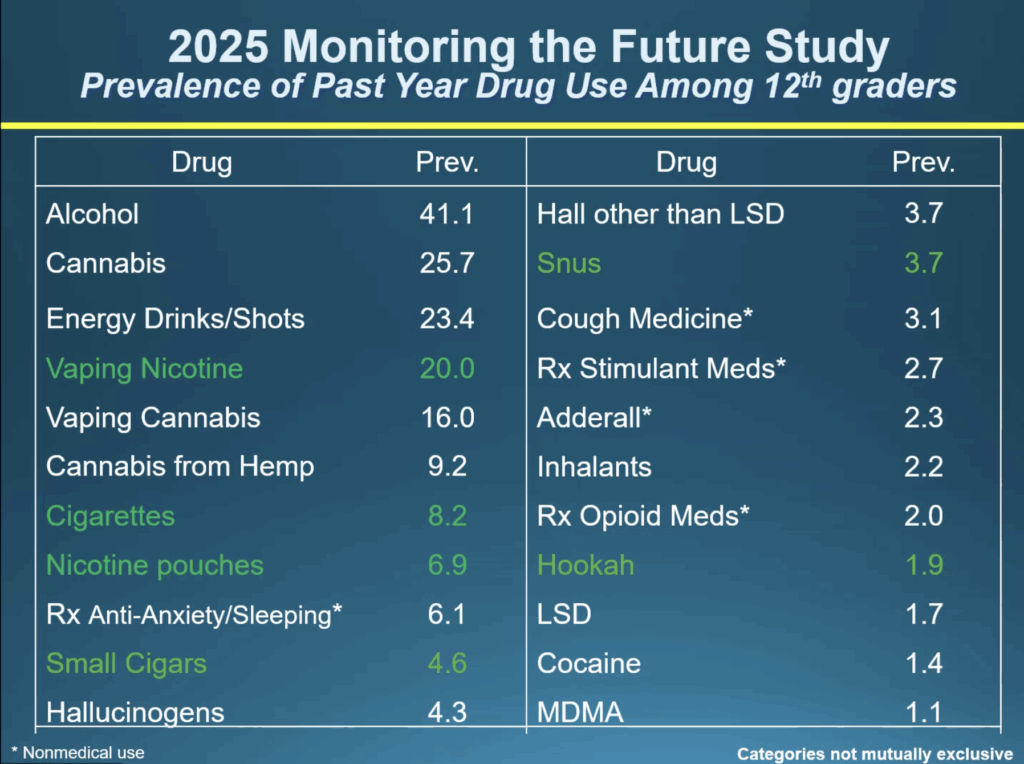 NIDA slide from January 7 briefing
Alcohol remains the most commonly used substance. Cannabis use is about on par with use of nicotine vapes for eighth and 10th graders, with cannabis a little more popular among 12th graders.
Despite a massive media and public policy campaign against the so-called youth vaping epidemic, MFS surveys indicate that nicotine vaping among teens is about half as prevalent as it was before the pandemic.
The highest rates were reported around 2019-2020, when 35.3 percent of 12th graders, 30.7 percent of 10th graders and 16.3 percent of eighth graders answered that they’d used nicotine vapes within the past year. It was always the case that only a fraction of those past-year users vaped daily or frequently, a reality often obscured by media coverage.
By 2025 those past-year estimates had dropped to 20 percent for 12th graders, 14.3 percent for 10th graders and 8.5 percent for eighth graders. Vaping cannabis has also been declining across all three groups since 2020, but not quite as sharply.
The 2025 MFS indicates that nicotine pouches are becoming more popular among teens, but that those increases aren’t statistically significant nor are the pouches being widely used. Past-year use among 12th graders, for example, was 7 percent.
“Nicotine pouches have generated much media attention amid concerns that adolescent use may grow rapidly, often drawing comparisons to the rise of nicotine vaping from 2017 to 2019,” the survey states. “As of 2025, prevalence remains relatively low.”
Heroin and cocaine appear to be on an upward trajectory for all three grades. But while in some cases the increases from 2024 to 2025 are considered statistically significant, this is essentially because the 2024 numbers were so low that any increase looks big when viewed as a percentage. Past-year use of heroin (or at least, what was believed to be heroin) increased from 0.2 percent to 0.5 percent for eighth graders; from 0.1 percent to 0.5 percent for 10th graders; and from 0.2 percent to 0.9 percent for 12th graders. Responses for past-year cocaine use told a similar story, just with slightly higher decimals.
Image (cropped) via Institute of Education Sciences