
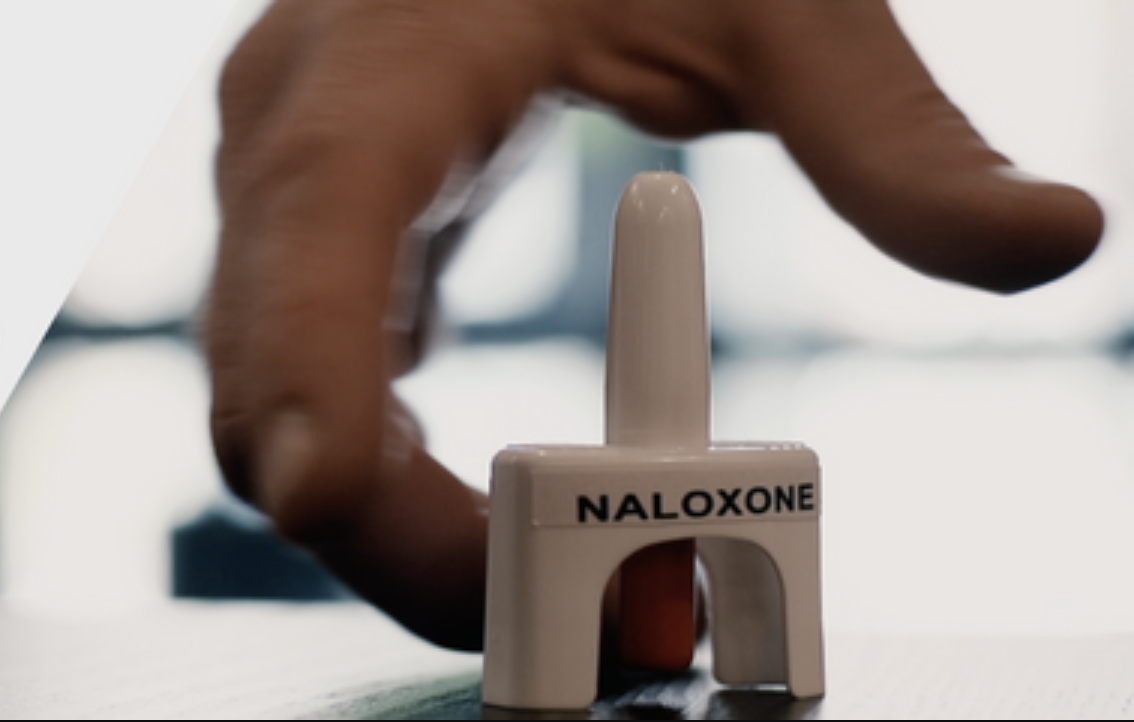
Two years after its approval by the Food and Drug Administration, opioid-overdose reversal product Rezenopy is about to make its commercial launch. At 10 mg of naloxone per nasal spray, each dose of Rezenopy is the equivalent of two-and-a-half doses of Narcan. It’s the highest-dose naloxone nasal spray available—a distinction that comes with no proven benefits to people at risk of overdose, but does help the product serve its higher purpose of being moderately attractive to shareholders.
Rezenopy is manufactured by Summit Biosciences, which obtained FDA approval in April 2024. In March 2025, the company reached a deal with Scienture Holdings, which is now handling the product’s sales and marketing. In January, after Summit obtained a patent protection that will cover Rezenopy until 2041, Scienture formally put the product on the market. While Scienture stated that the initial distribution period would focus on wholesalers, commercial rollout is expected to begin around April.
Earlier in March, Scienture announced that through group purchasing agreements—contracts that represent multiple health care businesses getting a collective discount price—it would be “providing access” to more than 5,000 health care entities. These reportedly include hospitals, clinics, nursing homes, EMS providers and rehab centers.
“Rezenopy addresses a critical public health need with a differentiated, high dosage formulation designed to combat today’s more potent opioids,” Shankar Hariharan, the executive chairman and co-CEO of Scienture, stated in January. “With a sizable and growing naloxone market, strong FDA approval status and additional [intellectual property patent] protection, we believe Scienture is well positioned to drive meaningful impact while building long-term shareholder value.”
Scienture has estimated that the new group purchasing agreements will give Rezenopy the “potential” to reach more than 60 percent of the institutional market. The company’s stock jumped about 30 percent in the days after it announced the agreements.
“This collaboration is not just about expanding our portfolio,” Hariharan stated in 2025, “it’s about making a real difference in the fight against opioid addiction.”
Rezenopy is the only naloxone nasal spray product with FDA labeling that suggests a maximum dose.
In 2021, Hikma Pharmaceuticals launched the naloxone arms race with its 8-mg naloxone nasal spray Kloxxado. Next came Zimhi, an autoinjector from Adamis Pharmaceuticals that delivers about 4.5 mg of naloxone intramuscularly, meaning it hits the bloodstream more directly. From there the market jumped from naloxone to the higher-risk, poorly evidenced opioid antagonist nalmefene. Opvee, a nalmefene nasal spray product from Indivior Pharmaceuticals, was pushed on law enforcement departments so aggressively that it prompted a New York State attorney general investigation, and was subsequently pulled from marketing. (We probably haven’t seen the last of it, though.)
As the next step was inevitably a nalmefene autoinjector, in 2024 the FDA approved one from Purdue Pharma. Zurnai quietly entered the market in 2025, though it’s not clear to what extent the product has been made available commercially.
During its FDA evaluation process, Rezenopy was compared to Kloxxado and Zimhi and deemed to be about on par in terms of naloxone exposure. However, it is the only naloxone nasal spray product with FDA labeling that suggests a maximum dose—no more than two in a 24-hour period.
“It is specifically designed for patients who often require multiple doses of lower-strength naloxone for stabilization in emergency situations,” Narasimhan Mani, president and co-CEO of Scienture, stated in December 2025.
These patients are mostly law enforcement. Though the claim that higher-potency opioids require higher-dose naloxone products has been a rewarding one for various cops and pharma companies, a 4-mg Narcan spray actually already contains more naloxone than the dose usually required to reverse an overdose. When it seems like an overdose was too strong for one dose of Narcan and only after five—or more—did the person finally respond, that’s very likely because the cop or well-intentioned bystander kept pumping in dose after dose during the two or three minutes it took for the first one to work.
While nasal spray products are widely used by cops, EMTs and hospitals can administer naloxone through IVs. In many harm reduction circles, the gold standard is generic intramuscular naloxone. Non-nasal spray formulations can be titrated and administered in a more humane way to people who’ve developed physical tolerance to opioids. An unnecessarily high dose triggers precipitated withdrawal, an acutely painful phenomenon that can easily lead to someone overdosing again.
It’s doubtful that 5,000 hospitals and clinics and the like are going to begin using Rezenopy, especially in place of any bulk naloxone purchasing agreement they already have. Scienture is carrying forward the tradition that pharma companies have established with these products since Kloxxado—shoving them toward public-facing institutions so as to give the appearance of widespread uptake, to cover the awkward fact that no one actually asked for them.
Image via stopoverdose.maryland.gov