
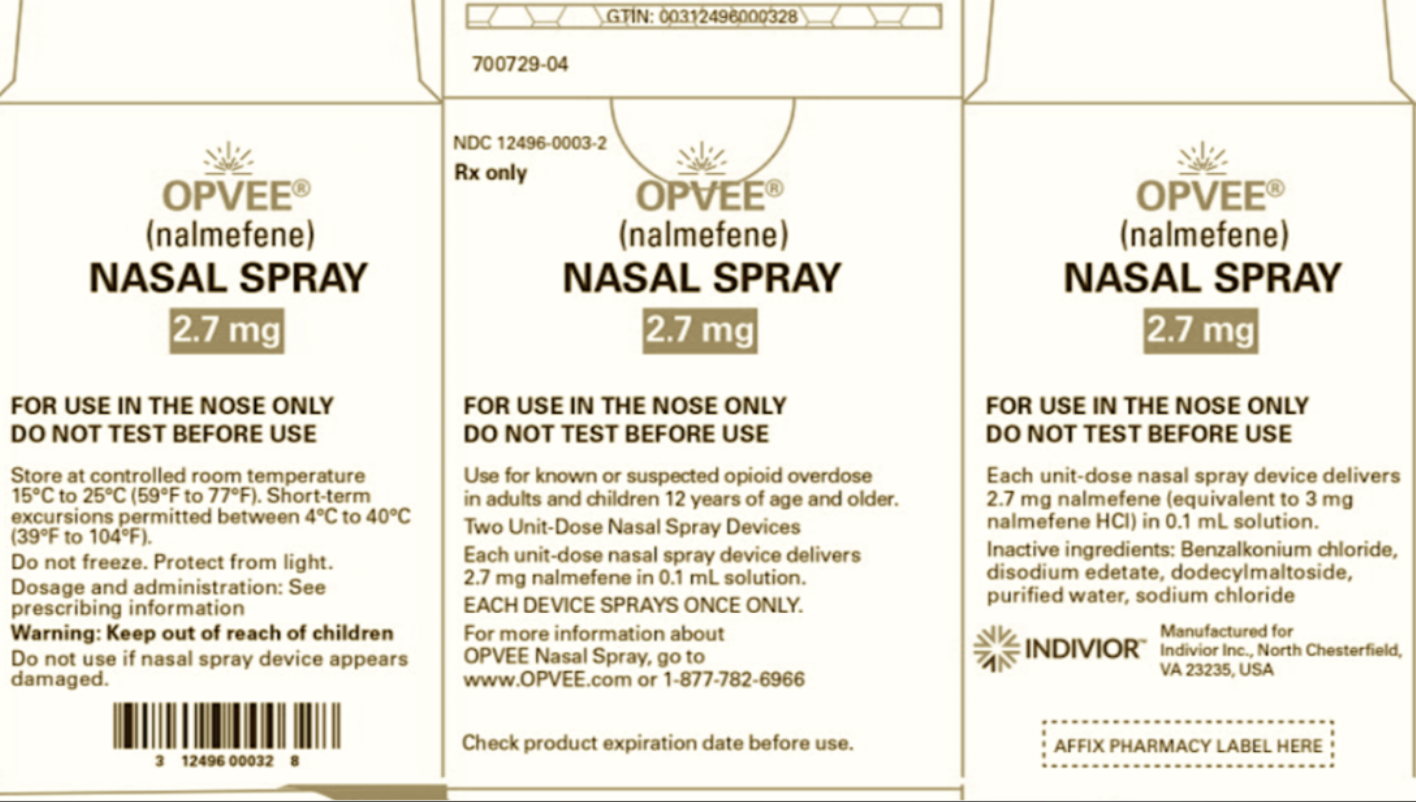
Less than two months after an investigation into deceptive marketing prompted Indivior Inc. to stop promoting its overdose antidote Opvee, company representatives are still advancing the same claims. These include falsely suggesting that naloxone products won’t reverse fentanyl overdose, and downplaying potential risks of nalmefene products like Opvee—namely precipitated withdrawal, the life-threatening syndrome at the center of the backlash.
In a study published October 22 in medical journal Cureus, authors aimed “to evaluate the prevalence and clinical significance of precipitated withdrawal” associated with intranasal (IN) nalmefene (which by default means Opvee). They reviewed 246 instances of Opvee use and found that only two were linked to precipitated withdrawal. All 246 cases were self-reported to Indivior directly, and all six authors are currently employed by Indivior.
“‘[S]tandard’ doses of naloxone used in a community setting could result in preventable fatalities when confronted with a potentially lethal dose of a synthetic opioid such as fentanyl,” the authors wrote. “Post-marketing surveillance data suggest that the risk of precipitated withdrawal with IN nalmefene is low in real-world settings. These findings support the continued deployment of IN nalmefene as a life-saving intervention.”
Prolonging the effects of an overdose reversal increases the risk of overdosing again.
In 2023, the Food and Drug Administration approved Opvee as the first opioid-overdose antidote formulated with nalmefene, rather than the better-known opioid antagonist naloxone. The product was enthusiastically received by local law enforcement departments (and the federal Biomedical Advanced Research and Development Authority). But it was rebuked by harm reduction groups, several health departments and the country’s preeminent toxicology associations, who all warned that deployment of Opvee instead of naloxone products like Narcan would put lives at risk.
The effects of nalmefene last hours longer than those of naloxone, which Indivior has framed as a competitive advantage even though there’s no need for naloxone to last any longer than it does—and prolonging the effects of an overdose reversal actually increases the risk of immediately overdosing again.
Having an overdose reversed is generally not a painful experience for people who don’t regularly use opioids. But for people who do, an excessive dose of an opioid antagonist triggers an excruciating syndrome called precipitated withdrawal. The longer it lasts, the more likely it is that the person will use more and more opioids trying to relieve the symptoms.
In early September, Indivior Vice President of North America Medical Affairs Ann Wheeler, who is one of the Cureus study’s six coauthors, told stakeholders that Indivior would no longer promote Opvee. That decision came amid a settlement with the New York State attorney general’s office, in which Indivior agreed that effective September 29 it would “not make any written or oral statement about nalmefene/Opvee that is unfair, false, misleading, deceptive or unconscionable.” The company also agreed to “not represent that nalmefene/Opvee has approvals, characteristics, uses, benefits or qualities that it does not have.”
The settlement is specific to commercial marketing activity within the state of New York.
It isn’t clear how many of the cases without precipitated withdrawal involved people who were ever at risk of precipitated withdrawal.
One of the findings highlighted in the study is that more than one-third of the reported reversals came from Michigan.
“To date, there have been no precipitated withdrawal adverse events reported from Michigan,” the authors wrote. “The absence of reported precipitated withdrawal in this mixed urban and suburban setting suggests a favorable safety profile, especially considering the scrutiny around the risk of precipitated withdrawal for this product.”
It might also suggest that, perhaps, one-third of the study’s data was submitted by the Oakland County Sheriff’s Office. The OCSO, which covers most of the suburbs in the northern Detroit metro area, was the first law enforcement department to start using Opvee back in late 2023.
Naloxone misinformation is so deeply embedded in cop culture that officers systemically conflate opioid overdose with all kinds of things that are not opioid overdose. In addition to not clarifying how many of the 244 cases without precipitated withdrawal involved people who regularly used opioids—versus people who were never at risk for precipitated withdrawal in the first place—the study also doesn’t clarify how many cases were confirmed to involve opioid overdose. Versus just involving deployment of Opvee. Authors did not respond to Filter’s request for comment on various aspects of the study.
Elsewhere in the study they note that their findings are consistent with a recent “independent review by two clinical experts of body camera footage of a first responder administering IN nalmefene to an individual with a suspected opioid overdose … and no evidence of precipitated withdrawal.”
Though not employed by Indivior, both those experts have a financial relationship with the company, including over $10,000 apiece in Opvee-specific consulting fees and travel expenses in late 2024. Filter had also previously reached out to them about that body camera footage review, to ask if the individual had been at risk for precipitated withdrawal; it doesn’t appear that he was.
So for the most part the paper’s approach is a familiar one: Highlight cases where Opvee didn’t cause precipitated withdrawal, using ambiguous language that never confirms or denies there was ever a risk of precipitated withdrawal. But the paper also includes an unconventional claim: Maybe people who use fentanyl regularly actually become immune to precipitated withdrawal.
“[Fentanyl’s] rapid uptake into the central nervous system is followed by a redistribution to peripheral tissues including muscle and adipose. Converging lines of evidence indicate that … redistribution to peripheral tissues creates a reservoir, slowly releasing fentanyl back into the circulation,” the authors wrote. “This sustained fentanyl exposure in chronic users could mitigate the manifestation of severe precipitated withdrawal when a reversal agent is administered.”
The length of time a drug stays detectable in various bodily tissues is relevant for drug-testing, but not for experiencing the effects. Fentanyl’s effects peak pretty quickly. But part of the Opvee marketing playbook was mischaracterizing fentanyl as a long-lasting drug—so long-lasting that overdose symptoms could spontaneously return hours later, by which time naloxone would have worn off. But not nalmefene.
Image (cropped) via National Library of Medicine