

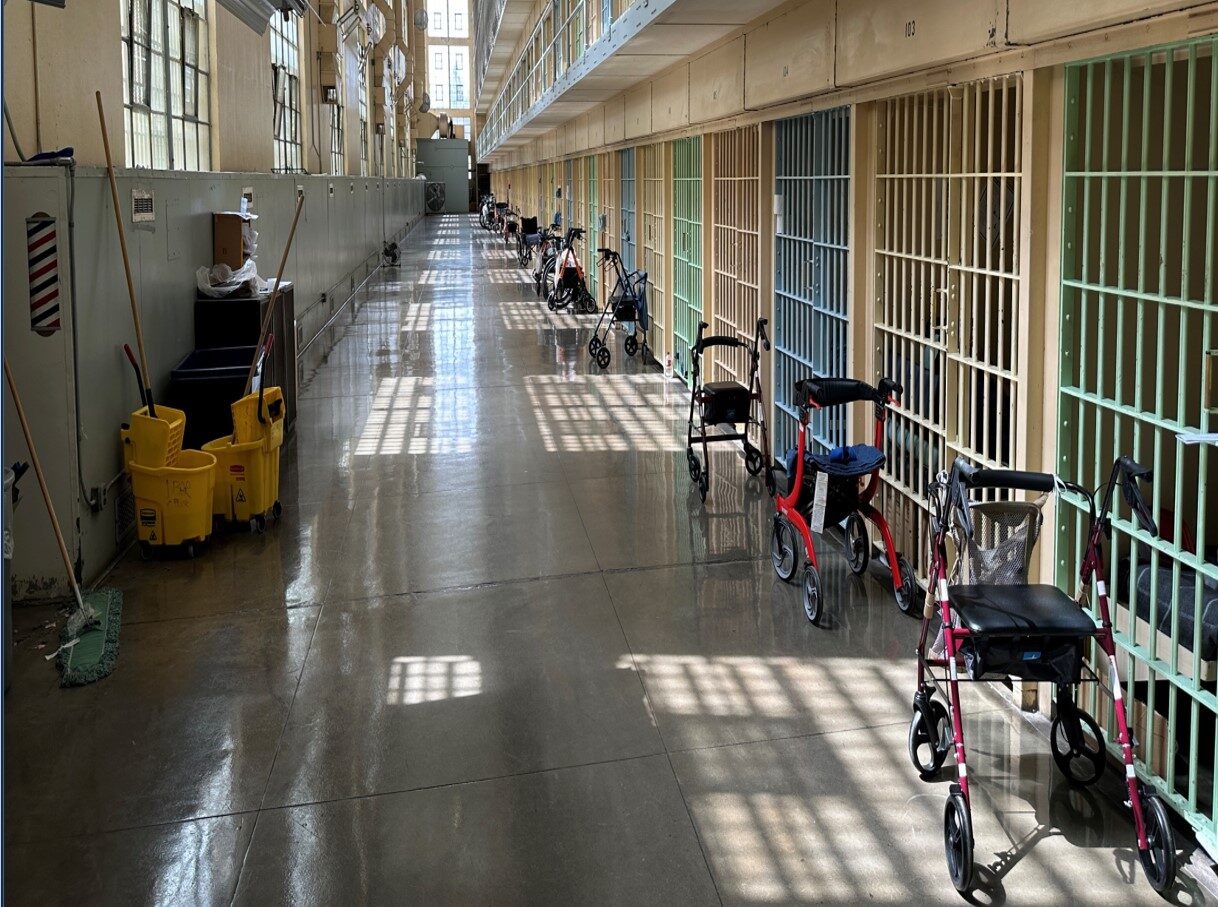
Ralph*, one of the men incarcerated with me at South Central Correctional Facility in Tennessee, hasn’t showered in more than three years. He’s in his seventies and unable to stand up from his wheelchair on his own. There are no wheelchair-accessible showers here.
An “inmate helper” is paid $0.59 an hour to push Ralph’s wheelchair to designated places like the chow hall, or to medical appointments. They can help Ralph get his wheelchair into one of the shower stalls, which since there is no ramp means lifting the chair over a nine-inch base. But that’s where the help stops. The shower itself has a single handrail, and the shower head is not adjustable. So, like many of the disabled prisoners here, Ralph’s only real option is to use the sink. Our cells are “wet cells,” meaning they have sinks and toilets. None of them are designed to be wheelchair-accessible either.
“Sometimes I can smell myself,” he told Filter, “so I try to stay away from people.”
The Americans with Disabilities Act requires prisons to have accessible cells and bathrooms. Federal courts have determined that the provision of showers is part of standard prison operations and that lack of accessible showers is a violation of the ADA. At one point Ralph decided to file a grievance about the lack of ADA-compliant showers, but changed his mind after talking to a staff member who told him it would be risky to file any paperwork that could cost the facility money. He recalled them saying: There are worse places you could be living.
Even though that staff member has since left, Ralph figures a grievance is still too big a risk.
He’s not the only one. In my living unit there are currently eight people using wheelchairs and another four using wheeled walkers, but according to South Central’s grievance staff there have been no grievances filed about ADA compliance in at least the past two years. Those were just the records that were within reach, so it could easily be longer.
South Central is one of four Tennessee Department of Correction prisons that is privately operated by CoreCivic. I’ve been housed in two of the other three, and both had ADA-compliant bathrooms. Over the course of my three decades of incarceration I’ve also been housed in other TDOC prisons with the same layout as South Central, and they also had ADA-compliant bathrooms, at least when I was there. TDOC did not respond to Filter’s request for comment.
When so many people in wheelchairs are locked inside a place that is not wheelchair-accessible, they become vulnerable to other kinds of harm.
Many of the harms older prisoners are suffering here is the result of infrastructure that needs to be updated. Prisons weren’t built to be nursing homes, but that’s what they are now. Within the next couple of years, one-third of the United States prison population will be over age 50. TDOC has just one medical facility, with space for about 100 prisoners who need nursing home-level care. According to a prisoner who worked there before transferring to South Central in late 2025, it’s almost impossible to get a bed there.
When so many people who use wheelchairs are locked inside a place that is not wheelchair-accessible, it makes them vulnerable to other, more predatory kinds of harm. For example, there aren’t enough assigned helper positions for everyone who actually needs help, so those who do get a helper assigned to them are lucky. And the helpers know that.
Buster*, who also uses a wheelchair, takes medication three times a day. That means he needs to go to the pill window three times a day. He also has to go to a lot of medical appointments, not to mention back and forth to the chow hall. At South Central this involves going up and down a steep hill with very uneven terrain. Even someone young and fit who could normally push their wheelchair themselves would find this hill not just difficult, but dangerous. So Buster needs help. But because of the vulnerable position he’s in, he’s often found himself with an assigned helper who would only do the job if Buster paid them a fee.
“A bag of coffee a week, or a box of cakes,” he said. “It’s all about the hustle.”
One time he objected, and found his wheelchair broken shortly after. It took weeks to get a replacement. So Buster tries to just pay the fees and not complain. If he was younger he’d confront his assigned helpers about the extortion, but he’s not; that’s why they’re assigned to him in the first place.
If someone’s having problems with their assigned helper, they’re supposed to have an opportunity to say so during a quarterly medical assessment. Filter spoke to three people with assigned helpers about whether this assessment was useful. One said that when medical staff asked if they were happy with their assigned helper, it was while the helper was still in the room. So naturally they’d said they had no complaints. The other two people reached by Filter had never had any such assessment.
One man in our pod has been incarcerated for 56 years. He walks around asking people what time the bus is coming.
At South Central we’ve formed an “eldercare collective” where we pool resources to try to make sure everyone who needs denture cream or hemorrhoid ointment gets it, and no one falls through the cracks just because they don’t have any money or outside family to help them. But we can’t change the fact that prison has become an abusive environment for the older members of our community.
When four gang-affiliated prisoners robbed Eddie*, they took every piece of property he owned—even his dirty laundry. He recalled how one of them picked up his denture cup and laughed at the sight of Eddie’s teeth inside it.
“I asked them, Please don’t break my dentures,” Eddie told Filter. “He threw them on the floor and stomped them with his boot.”
That was in 2024, and Eddie still has no teeth. He’s lost considerable weight as a result. He’s nearing the end of his 25-year sentence, and will be 70 when his release date comes.
“I really don’t think I’ll make it to the home stretch,” he said.
Decades ago when I began my sentence, older prisoners were more or less left alone, out of respect. As long as they didn’t get into debt, they were relatively safe. But these days, the influx of young men with ridiculously long sentences and little to lose has created a generation that doesn’t distinguish between victims.
Another argument against the trend of longer and longer sentences is that the prison system is increasingly filled with people who no longer remember what they’re being punished for. One man in our pod has been incarcerated for 56 years. He walks around asking people what time the bus is coming.
Imagine a nursing home in the free world full of grandpas and great-grandpas with black eyes, broken limbs, no shoes, no teeth, isolating themselves because they haven’t been able to shower in years and don’t want to subject anyone else to their smell. One hopes there would be outrage and calls for change, but often such conditions persist because the residents are unable to object and because the abuse and neglect is hidden away from the public. Imagine how much worse the situation could get if the nursing home is in prison.
*Names have been changed
Image (cropped) via Oregon Department of Corrections