
[Read Part 1 of this story here]
In May, Georgia Governor Brian Kemp (R) approved a budget increase of nearly $200 million for the Department of Corrections (GDC). The first thing it seems to have bought was a culture change.
In June, officers at this facility began locking gates that had been regularly left open since the early days of the COVID-19 pandemic. Many cell doors still don’t lock, but unauthorized modified deadbolt locks keep us contained within our respective living units. In addition to the doors that lead outside to yard, the gates to the walkways that connect to the other living units are locked too.
Staff only allows the living units to go anywhere one at a time, and each unit must return before the next is released. For example, each living unit is now fed separately, and once finished must clear the walkways before the next can go eat. This takes three hours, so everything runs late now. The young new corrections officers don’t last any longer than they used to, but a five-person Corrections Emergency Response Team can still oversee our movements on days when not enough staff have shown up to work.
This complicates the physical exchange of contraband, such as food or drugs or cell phones. Drone deliveries must be executed with pinpoint precision. Amid the adjustment, many in-house forms of recreation have surged in popularity, including tattooing and various forms of gambling.
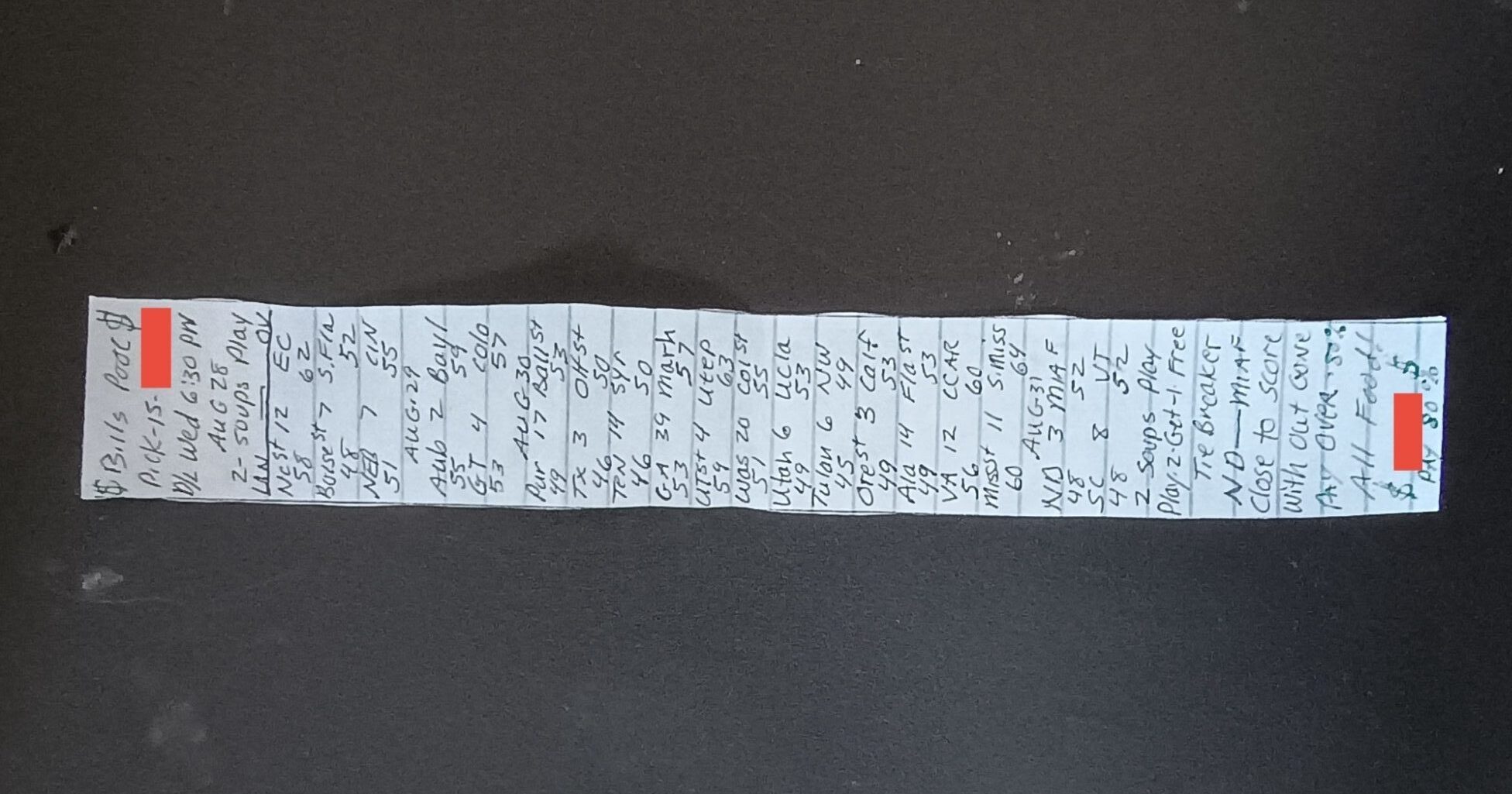
Many prisoners have gravitated toward a high-risk, high-reward form of sports betting called parlay—you bet on multiple games at a time, and all must go your way for you to win.
Any sport with enough teams playing enough games within the same week can be used for a parlay pick sheet, which, here, must bear a minimum of four games. Win a “4-pick” ticket, and the payout is 10 times whatever you placed as your bet.
Bet one Ramen soup and win a bagful. One bag of coffee can turn into a week’s worth of food from commissary.
A 5-pick ticket pays out 15 to 1. A six-pick, 20 to 1. You can see the appeal for people living a state of chronic deprivation, particularly when access to other coping mechanisms is in flux. Bet one Ramen soup and win a bagful. One bag of coffee can turn into a week’s worth of food from commissary.
Gambling has always been a hustle from both sides of the table—player and house. Wherever there are prisoners playing poker, someone’s running the table. Wherever there are parlay pick sheets, someone’s taking the bets and drawing up the point spreads—the predicted difference between the final scores for each team in each game, which levels the playing field for players to place their bets.
“This is an all-or-nothing game,” Cola*, several decades into a life sentence, told Filter. “If the actual score with the spread applied as stated in the ticket equals a tie, the Parley wins. If any of the teams chosen fail to cover the spread, the Parlay wins.”
The Parlay can cap the bets in order to protect their hustle from bankruptcy; $5 is a standard maximum bet. But players who want to bet more will have others submit additional tickets for them.
All bets must of course be placed before any game on the ticket begins. So due to the difficulty getting tickets and payment items from one unit to another in a timely fashion, you have multiple Parlays operating within the same prison at the same time.
“To gain a larger customer base, different Parlays will have different odds for the payoff,” B*, a scary-smart lifer whose math skills serve him well in this role, told Filter. “Or different spreads on some of the games. Changing the spread by one point will bring gamblers your way … the library newspaper sports section is in big demand because people want to compare official spreads to the tickets. Always looking for any advantage.”
Very long tickets may have a dozen or more games. Nearly impossible to win—but still possible. Anyone who wins a 10-pick ticket can practically charge a fee to help others pick their tickets the following week. Winning spawns its own hustle, for as long as they continue to win at least.
Pool is sort of the prison lotto ticket—people who know nothing about sports will pick random teams and hope for the best.
Pool is one of a few similar ventures. For the person taking the bets, this is a safer and easier with less overhead than parlay.
“Write up the tickets, distribute, collect and record every player’s picks,” said Cola, who runs this prison’s most popular college football pool. “Draw up as many Master sheets as needed to put one in every living living unit. Then catch every final score of every game and determine who gets the pot.”
For all that, he keeps 20 percent of the take. In a 1,200-bed prison, a good Pool might get 300 tickets played for each pot, though of course some of them represent the same person submitting under another name.
Pool tickets usually cost two Ramen soups or their equivalent. There’s only one winner, so this game is sort of the prison lotto ticket—people who know nothing about sports will enter and pick random teams and hope for the best.
After years of mass deaths earned GDC a light verbal spanking from the Department of Justice, a Senate committee was formed to evaluate what if any problems might need addressing, and in the end determined that we didn’t need recreational programming but rather a shift toward high-security, single-cell housing for all. As prisons across the state are slowly shifted in that direction, officials promise that this is what is required to stem the flow of contraband and thus the epidemic of homicides, suicides and organized torture that runs through the system unchecked.
Aside from the fact that never once in history has prohibition been successful, at a fundamental level the thing driving violence in prisons isn’t drugs or cell phones. It’s debt.
*Names have been changed for sources’ protection
Image of redacted pick sheet via Anonymous