
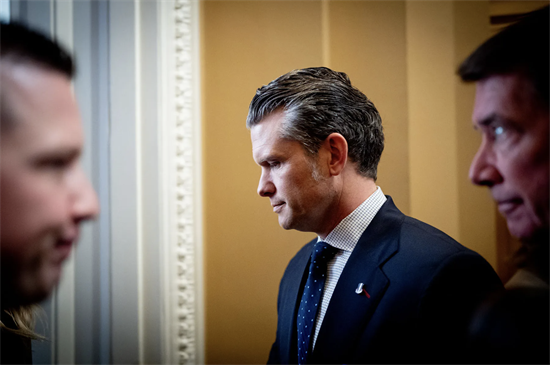
Democratic lawmakers are demanding that “War Secretary” Pete Hegseth release footage of a strike that killed two helpless survivors of an air attack on a boat in the Caribbean. So far he’s refused. “We’re reviewing the process, and we’ll see,” Hegseth said at a press conference in California on December 6.
On November 28, the Washington Post had reported that the initial strike left two men clinging to the wreckage of the vessel. After roughly 45 minutes, the military fired again. A source told reporters that Hegseth had said there should be no survivors: “The order was to kill everybody.” The September 2 strike in question was the first of at least 22 that have claimed at least 87 lives so far.
The government’s justification for the strikes is that the United States is “at war” with “narcoterrists” who have attacked the country with drugs as their weapons. The strikes are necessary to save American lives, they say: 25,000 per boat, according to President Donald Trump.
The same week that the Post revealed the double strike in this noble anti-drug crusade, Trump pardoned Juan Orlando Hernández, the former president of Honduras, who was serving a 40-year-sentence for drug trafficking.
The Trump administration has not identified any those killed in the strikes, though some of their families have come forward. Experts point out that if they were ferrying drugs—and no evidence has been presented that they were—it’s an insignificant amount, and almost certainly cocaine rather than the fentanyl that’s been involved in so many US overdose deaths. Military experts have chafed at the notions of “narcoterrorists” and being “at war” with men in boats far from US soil who have not initiated hostilities. Still, the strikes have continued with bloody regularity, even after SOUTHCOM chief Alivin Holsey resigned (or was likely pushed out by Hegseth).
“It’s not looking good for Hegeseth. I think his days are numbered.”
Outrage over the double strike, however, continues to grow as more information emerges. The military’s rules of engagement cite a shipwreck as the perfect example of when it’s “clearly illegal” to open fire. That would make the incident a war crime.
“It’s not looking good for Hegseth,” Sanho Tree, director of the Drug Policy Project at the Institute for Policy Studies, told Filter. “I think his days are numbered.”
Hegseth may not have taken full stock of his precarious political position. Despite uproar over his double strike, he boasted on December 4 about the 22nd known boat attack, which killed four men.
Retired Judge Advocate General counsel for the US Air Force Colonel Greg Thompson formerly advised on strikes in the Pacific theater as well as Iraq and Afghanistan. He said that although the boat strikes in general might pass legal standards for rules of engagement (military law does not take a moral position), a second strike on survivors appears to violate rules of proportionality—that loss of life and other damage should not exceed concrete military advantage.
“It’s illegal to strike someone out of the fight and defenseless.”
“The idea that you could restrike, if the target is not destroyed, it’s possible,” he told Filter. “But it’s illegal to strike someone out of the fight and defenseless.”
Thompson stressed throughout the interview that we need more information and a full congressional investigation.
The administration is scrambling. It’s claimed that the two survivors had tried to salvage the alleged drugs and had radioed for help, thereby raising the prospect of others arriving at the scene to continue their supposed trafficking mission. But Admiral Frank Bradley, who ordered the strike, testified under oath that they did not have a radio.
Top Democrats who have watched the full video are livid. Representative Jim Himes (D-CT), the ranking member on the House Intelligence committee, called the video of the second strike “one of the most troubling things I’ve seen in public service.”
Senator Adam Schiff (D-CA) warned the strikes risked plunging American into a “a full-fledged war.”
Regime change in Venezuela, which holds vast oil reserves, is widely seen as a motive for the boat strikes. Tree pointed out that while the Trump administration is hoping President Nicolás Maduro will flee without armed conflict, hostilities, and the plan to hit boats, have been in the works for a while. “Trump wondered in 2018, ‘Why can’t we just take their oil?”
“You don’t solve public health problems with bombs,” Tree added. “Otherwise we’d be bombing tobacco and alcohol executives.”
“Hernández knew how to blow smoke up Washington’s ass and say all the right drug-war things.”
He also described Hernández’s release as hypocritical, given his role in facilitating drug trafficking on a scale that dwarfs the alleged activities of the boat victims.
“Under Juan Orlando Hernández, president of Honduras from 2014 to 2022, the Central American country was one of the largest drug corridors, the poorest country in Latin America, and the deadliest place in the world for environmental activists,” Tree said. Hernandez was convicted in 2024 of deploying his forces to ensure cocaine made it unhindered to the US.
Trump justified his pardon by claiming that, much like himself, Hernández had been targeted by a corrupt Democratic administration. In 2019, Trump praised him for battling drug trafficking, despite proof he facilitated and profited from the drug trade and associated violence. “He’s working with the United States very closely. We’re stopping drugs at a level that’s never happened,” Trump said.
“Hernández is cynical, corrupt. He manipulated the gringos so perfectly,” Tree said. “He knew how to blow smoke up Washington’s ass and say all the right drug-war things.”