

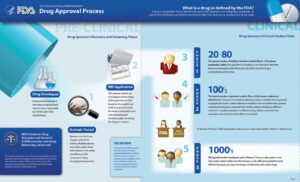
The Food and Drug Administration will no longer expect pharmaceutical manufacturers to submit two pivotal trials in applications for new drug approval, dropping the standard to a single trial. The change comes amid a vast acceleration of deregulatory actions across the federal government, as well as within the FDA.
Though not a strict requirement, two well-controlled studies demonstrating safety and efficacy has long been the FDA’s default position. The agency did not announce the new policy on its website, but in a February 18 New England Journal of Medicine article by Commissioner Dr. Marty Makary and Chief Medical and Scientific Officer Dr. Vinay Prasad, who also directs the FDA’s Center for Biologics Evaluation and Research.
“The FDA’s historical reliance on two clinical trials rather than one was intended to provide credible causal evidence that a therapy could improve clinical outcomes with acceptable safety in a world where biologic understanding was more limited than it is today,” the authors wrote. “Two trials should be seen as just one of many interlocking facets of clinical credibility, and in 2026 there are powerful alternative ways to feel assured that our products help people live longer or better than requiring manufacturers to test them yet again.”
Makary and Prasad argued that the approval process will not become less rigorous since the two-trial standard was never foolproof to begin with, and greater scrutiny will now be placed on each trial that is submitted. They also noted that many drugs are already approved based on a single trial, and that the FDA retains the authority to request a second trial.
The new standard is intended to “substantially” cut costs for sponsors, with the paper citing estimates that the cost of a pivotal study can range from $30 million to $150 million.
“Lowering capital costs for drug developers may remove a persistent argument in justification of lofty and rising drug prices for everyday Americans—the onerous cost of research and development,” the authors wrote. “The FDA expects a surge in drug development in response to our initiative.”

“Who was consulted? Was anyone consulted? What were the data that drove the decision?” Center for Medicine in the Public Interest President Peter Pitts, a former FDA associate commissioner, told Regulatory Focus. “Was there industry input? Was there patient input? Was there input of any kind from anybody other than Drs. Makary and Prasad?”
In May 2025, shortly after his appointment to FDA commissioner, Makary began an “aggressive” internal rollout of artificial intelligence tools that purportedly “allow FDA scientists and subject-matter experts to spend less time on tedious, repetitive tasks that often slow down the review process.” These include a generative chatbot called Elsa that reads, writes and summarizes scientific documents, and a more recent agentic AI tool used for “more complex tasks” including review validation.
Makary has also established the Commissioner’s National Priority Voucher pilot program, a new expedited approval process that will see certain drugs cleared to go to market after just one to two months of review. The standard has been six months for priority drugs, and 10 months for most drugs. Makary had initially planned to give a voucher to a psychedelic treatment for depression developed by Compass Pathways, but it was cut at the last minute.
President Donald Trump’s second term has seen sweeping rollbacks of economic and environmental safeguards that have often attracted less media attention—from the Department of the Interior opening federal lands to development under expedited permits to the Federal Communications Commission forcing anti-consumer policies past the public during the 2025 government shutdown. Earlier in February, the EPA revoked its 2009 finding that greenhouse gas emissions are a public health threat, the legal basis of their regulation under the Clean Air Act.
In December 2025 the White House announced that the administration had so far completed 646 deregulatory actions, and only five regulatory actions. Deregulation is expected to be the de facto theme of Trump’s 2026 State of the Union Address on February 24.
“Deregulation is the unsung hero of this entire economic turnaround,” state Trump’s prepared remarks. “We are cutting costs through deregulation faster than anybody ever thought possible.”
Top image (cropped) and inset graphics via Food and Drug Administration