
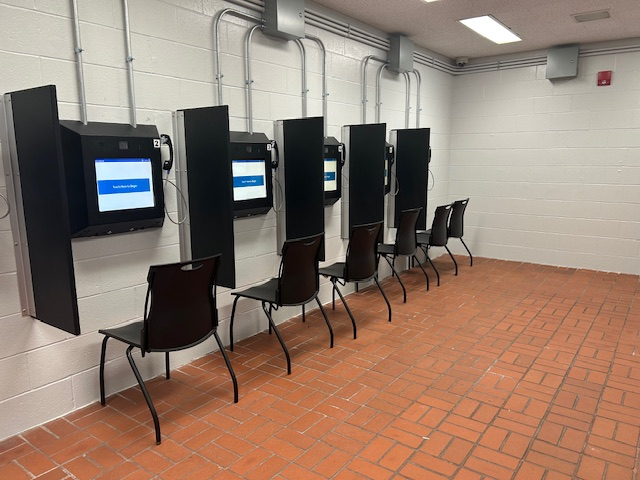
The Federal Communications Commission (FCC) has released the finalized version of its order regulating the costs of incarcerated people’s communication services (IPCS). The document released November 6 contains subtle but materially significant changes from the draft proposal shown to the public in October, and continues the commission’s trajectory of quietly defaulting on essentially every major provision of the original regulations it approved in 2024.
The 2024 IPCS order represented a historic shift in access to phone calls and video visits for the nearly 2 million people in prisons and jails across the United States. Corrections departments contract these services to for-profit IPCS providers, which charge exorbitant fees with very little oversight. The regulations included lower caps on the per-minute costs of phone, the first-ever caps for video calls, and eliminating “site commissions”—AKA kickbacks, wherein corrections departments would award their IPCS contracts to the provider that gave them the biggest cut of the profits, resulting in even higher costs to families.
IPCS providers, along with various corrections and law enforcement associations, had filed a continuous stream of legal objections attempting a variety of tactics to avoid the impending regulations. The FCC had initially not entertained these. But in mid-2025, following a change in leadership and shift to a Republican majority, it announced it was putting the regulations on hold.
In October, over the objections of advocates, and amid a lawsuit investigating the delay, the FCC published a draft proposal that gutted the regulations and replaced the 2024 price caps with new ones nearly twice as high. At the end of the month, when the commission formally approved the revision, it also slipped in a last-minute 6.7-percent “inflation factor” with no notice to the public.
At the time, the FCC said only that an unnamed IPCS provider had written a letter suggesting the caps should be raised to account for inflation, albeit to a figure approximately twice what the commission landed on. As expected, per the finalized version released November 6, the provider behind the inflation factor was Securus Technologies.
Securus, which along with ViaPath Technologies (better known as GTL) dominates most of the IPCS market, had claimed an adjustment of 11.6 percent would offset the FCC’s use of data from calendar year 2022. The commission agreed to adjust for inflation but questioned Securus’ math, stating that the company “does not explain or justify the starting point for its calculation” nor could the numbers be confirmed independently.
The order still has not been published in the Federal Register. Once it is, the public will have 30 days to submit comment, and providers will have 120 days to come into compliance. These remain “interim” rate caps while the commission continues to seek comment. It’s aiming for permanent rate caps by spring 2027.
In addition to bumping up the costs with the inflation factor, the FCC may also be preparing to backtrack on its prohibition of kickbacks. The October draft proposal and the finalized version from November 6 say mostly the same things regarding kickbacks, but in her dissenting statement Commissioner Anna Gomez (D) warned that the commission “manages to leave a window open with a niche question in Footnote 278 asking whether a site commission in ‘excess of the facility cost additive remain[s] prohibited.'”

Original price caps approved in 2024

Revised price caps shown to the public in October

Price caps unveiled November 6 following the FCC’s vote to adopt
IPCS providers maintain that without sufficient compensation they’d be forced to pull services from the least-profitable facilities, which generally means rural jails with the smallest average daily populations. Smaller jails are where IPCS are most expensive. A 15-minute phone call in some could cost over $12; the 2024 rate caps dropped that to $1.35.
After FCC Chairman Brendan Carr (R) first announced in June it was in the public’s best interests to put the 2024 order on hold, I wrote that he was right. This did not come from anything remotely close to approval of what the FCC was doing, but from talking with currently incarcerated people who pointed out that overpriced services are better than no services, and from my own assumptions about the number of small jails that could be affected as well as the existence of evidence to support these claims.
Over the past few months, as the situation has developed and as I’ve learned more, I’ve realized that my initial opinion was wrong. An analysis published in mid-October by nonprofit Worth Rises show that about three-quarters of US prisons were already at or under the 2024 rate caps, which belies the claim that those rates don’t compensate providers sufficiently to keep them in business. And for the people incarcerated in prisons with higher rates, the 2024 order represented massive relief; Worth Rises projected that calls would increase by 2 billion minutes per year. The revised caps would cut that increase by 66 percent, because they’re higher than the existing prices at almost all US prisons—94 percent. Only Florida, Kentucky and Oklahoma prisons subject incarcerated people and their families to rates higher than the revised caps.
State prison IPCS contracts cover all the facilities in that state’s prison system, and a provider wouldn’t withdraw from one facility just because it’s less profitable than others. County jails are often negotiating contracts on their own, and are potentially vulnerable to losing IPCS entirely if the sheriff’s department doesn’t reach a favorable agreement with a provider. But despite the FCC’s repeated implication that the 2024 rate caps would have led to a widespread loss of services, and had already done so at a handful of facilities, there is still no evidence to support claims that this has happened at more than one single jail.
“Ultimately, we do not have the option to wait until market failure becomes more widespread to intervene,” states the November order. This line did not appear in the draft shown to the public either.
“IPCS providers have these data, but fail to submit them, and then claim that the FCC lacked the data necessary when the decision the agency makes is not in their favor,” Gomez said. “In this Order, rather than requesting providers to provide sufficient data before setting new rates, the Commission fulfills their requests without any new data. Again, the Commission rewards bad behavior.”
Top image via Peoria County Sheriff’s Office. First, second and third inset graphics via Federal Communications Commission.