

Canada has obligations to implement measures that actively protect the right to life, regardless of what the government thinks, asserts a new report from the United Nations Human Rights Committee (UNHRC).
Its discussion largely centers on the climate crisis, missing and murdered Indigenous women and girls, and medical assistance in dying. The report also has significant implications for housing and drug policies, however—areas where Canada’s government was interrogated and criticized in the preceding UNHRC meeting.
The report, released in mid-March, stems from the UNHRC’s review of Canada’s implementation of the International Covenant on Civil and Political Rights—the first such review since 2015.
The right to life obliges governments not only to avoid policies that actively cause death. They must also implement policies that will actively prevent death.
The dispute over the right to life honed in on the Canadian government’s beliefs about what kinds of obligations it creates. Where the Canadian government sees it as a negative right, the UNHRC has long held that it is a positive right with positive obligations.
In other words, the right to life obliges governments not only to avoid policies that actively cause death. They must also implement policies that will actively prevent death.
In recent years, the federal government argued to the Federal Court of Appeal that a lawsuit filed by children on the basis that climate inaction threatens their right to life should be thrown out, because the lawsuit claims positive rights. The Canadian Charter of Rights and Freedoms doesn’t create positive rights, the government argued.
UNHRC member Hélène Tigroudja took aim at that line of reasoning. The right to life as originally conceived in the 1960s may only have created negative obligations. But she said the position of the UNHRC hasn’t been stuck in the 1960s.
“This is not a theoretical or doctrinal issue. It’s a fundamental issue, and the COVID-19 pandemic, financial crisis, climate change, have taught us a rude lesson, which is that states obligations evolve and need to evolve and that the interpretation of the covenant is not set in stone,” she told the UNHRC meeting.
Tigroudja also voiced specific concerns about recent developments in Canadian drug policy, and their impact on the right to liberty and security of the person.
The report notes that Canada’s position still hasn’t changed, even as the country has recognized the existential climate threat.
“The committee is concerned about the state party’s position according to which the right to life does not, or would not, create positive obligations,” the report states.
Tigroudja also voiced specific concerns about recent developments in Canadian drug policy, and their impact on the right to liberty and security of the person, which is also protected in the International Covenant on Civil and Political Rights.
“The recent high commission’s report on drugs and prisons shows that the criminal response and criminalization merely exacerbates discrimination, vulnerability, and exclusion of individuals who use drugs and does not reduce their usage in any way,” Tigroudja said.
She also raised concerns about the rise of involuntary detention for people who use drugs, which has seen expansions in British Columbia., Alberta and Manitoba, and asked whether the government intended to replace criminalization with harm reduction.
The UNHRC report recommends that Canada develop its drug policy into a public health and human rights approach, rather than a criminal one.
A Justice Department official responded that the government has a variety of harm reduction measures in place, and a Manitoba government official defended its recent “protective care” legislation.
The UNHRC report recommends that Canada develop its drug policy into a public health and human rights approach, rather than a criminal one. And it urges the country to give people the ability to enforce the UNHRC’s interpretations and decisions on human rights law within the legislative and judicial system.
In a press release from a coalition of human rights groups, Beeta Senedjani, community policy and network coordinator for the Canadian Drug Policy Coalition, welcomed the report’s findings.
“We strongly support the committee’s call for Canada to take ‘all necessary steps’ to address these concerns through effective mechanisms across federal, provincial, and territorial governments, and to ensure access to remedies through domestic courts,” she said.
“We also endorse the call for Canada to establish a national mechanism to monitor implementation and to ensure that individuals can seek enforcement of the committee’s decisions.”
Michèle Biss, executive director of the National Right to Housing Network, said Canada’s self-perception as a strong proponent for human rights isn’t in keeping with reality.
“We have a far more limited understanding of human rights,” she told Filter. “We tend to treat human rights as largely symbolic and not as something very concrete, certainly in the context of economic and social rights.”
When it comes to the right to housing, the government’s resistance to a positive rights framework may be because it would create a legal obligation for the government to provide housing, rather than tinkering with tax incentives and hoping the market will solve it.
The report comes at a time when Canadian drug policy has been in a years-long backslide.
Similarly, with drug policy, it could create obligations to expand policies like safe supply, re-implement decriminalization and more.
The report comes at a time when Canadian drug policy has been in a years-long backslide, with jurisdictions dropping decriminalization and curbing safe supply based on spurious claims. Even policies with mountains of research backing them up, such as overdose prevention centers and harm reduction supply exchanges, have been dropped or limited.
More recently, Ontario and Alberta have moved to end what remains of their supervised consumption sites.
People who use drugs have seen varying degrees of success in preserving harm reduction in the courts.
More than a decade ago, Canada’s first supervised consumption site and an early study showing the promise of safe supply were both saved from the then-Conservative federal government’s decision to end the programs.
More recently, a BC court temporarily saved a decriminalization pilot project from provincial legislation, only for the federal government to step in and cancel it. The Federal Court sided with the federal government in that case.
Today, Drug User Liberation Front co-founders Eris Nyx and Jeremy Kalicum are awaiting final arguments in a case to determine the constitutionality of their drug trafficking convictions for running an unsanctioned compassion club selling tested heroin, cocaine and methamphetamine to its few dozen members.
“Homelessness was mentioned specifically in the context of the drug toxicity crisis … We’re happy to see the UNHRC note that intersection and also push Canada to do better.”
With housing, Biss noted that the government has taken a more active role in the past, and had a positive impact on past housing crises.
“There’s a whole history in the context of housing, where in the 1960s [and] the 1970s, Canada took a much more proactive approach to housing, and the federal government in particular hada more active role, particularly in providing social housing,” she said.
Since then, the federal government had effectively abandoned public housing construction—until recently. The federal government introduced a housing strategy in 2017, and implemented right-to-housing legislation in 2019. That came with a number of requirements for the housing minister, including maintaining a housing strategy and setting targets for ending homelessness.
The government is currently reviewing that housing strategy. Though drug policy has regressed, Biss said she’s still hopeful that a more positive-rights-based approach to housing could emerge.
Housing and drug policy are deeply interlinked, she added, particularly in the overlap of who experiences homelessness and those who feel the biggest impact of the drug toxicity crisis—something the UNHRC also recognized.
“Homelessness was mentioned specifically in the context of the drug toxicity crisis,” Biss said. “We’re conscious that there is a deep connection between these two issues, and we’re happy to see the UN Human Rights Committee note that intersection and also push Canada to do better to adopt positive measures.”
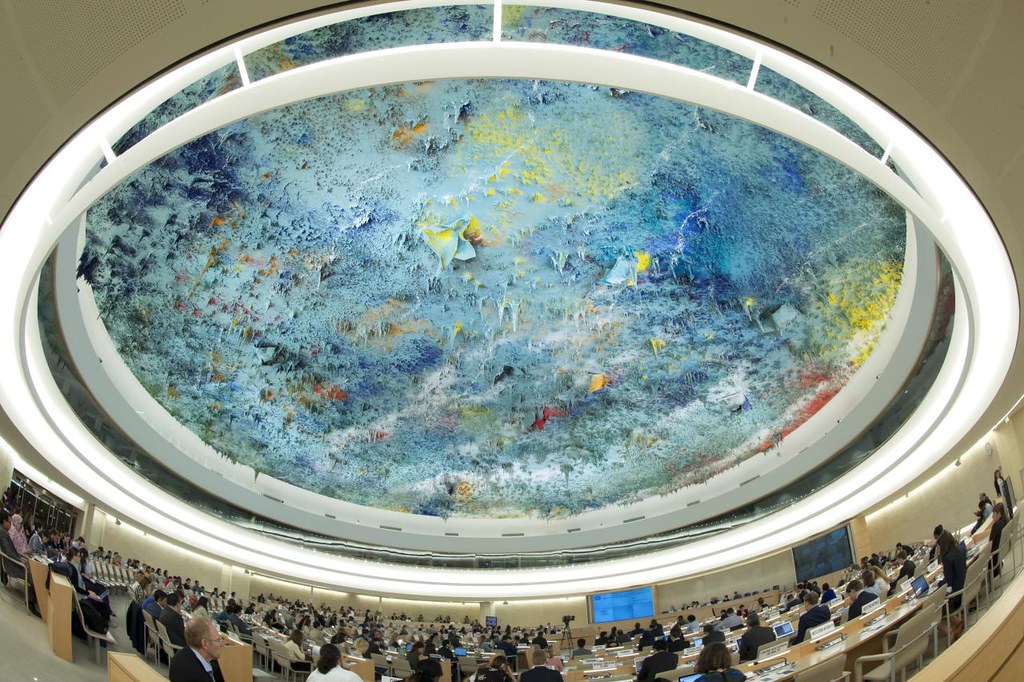
Photograph from 2017 UNHRC session by UN Geneva via Flickr/Creative Commons 2.0