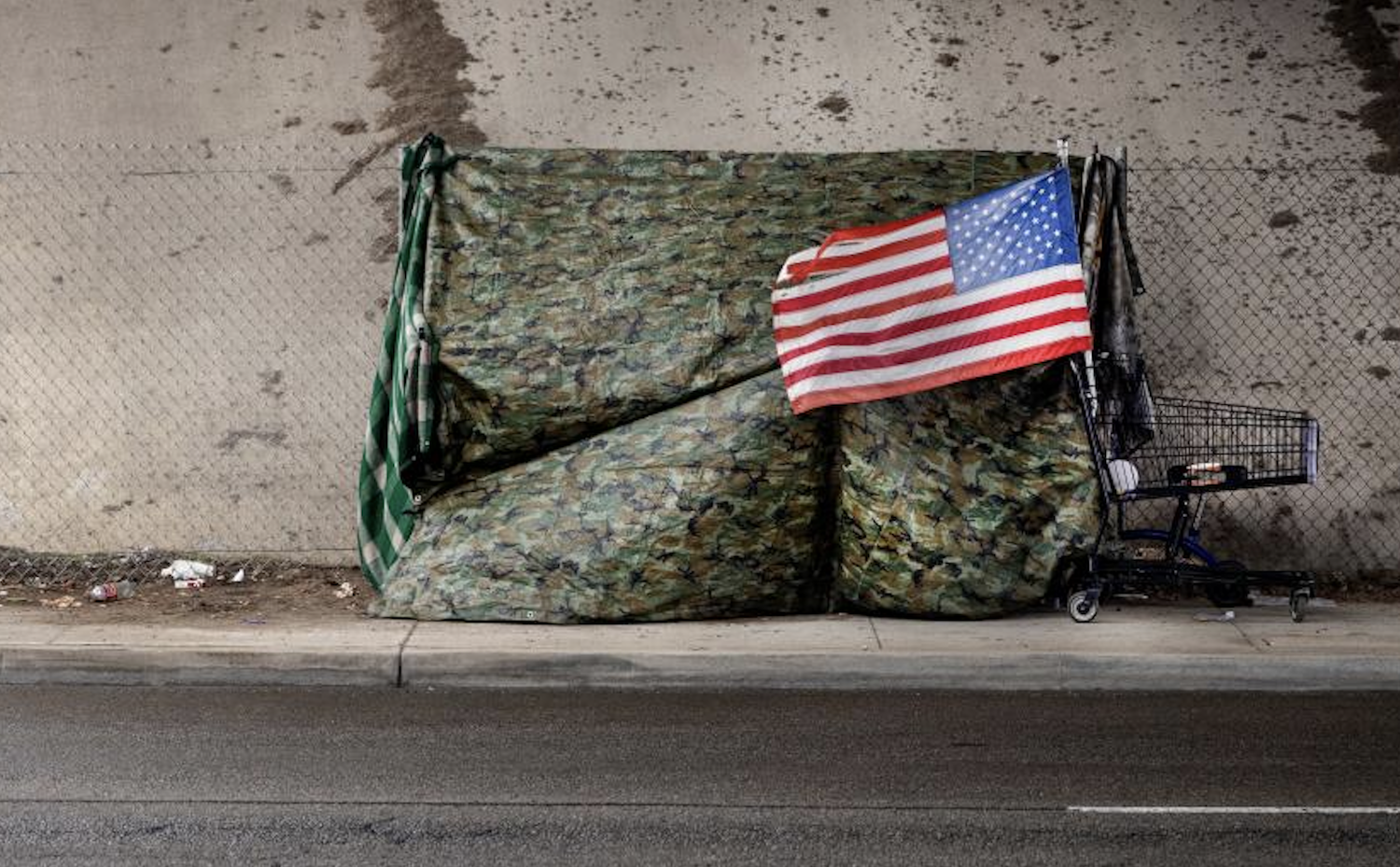
On March 11, the Department of Justice and the Department of Veterans Affairs jointly announced a memorandum of understanding (MOU) that authorizes the government to assume legal guardianship over veterans who are deemed “unable to make their own health care decisions.” Advocates expect this new authority to be primarily wielded against veterans without stable housing.
The DOJ will be able to designate VA lawyers as special assistant United States attorneys, which gives them the authority to initiate guardianship proceedings in court.
“Guardianship and conservatorship are among the most extreme legal interventions that can be imposed on a person,” the Disability Rights Education and Defense Fund stated March 12. “They can strip individuals of the right to make their own medical decisions, control their finances and direct their own lives. These are not routine protective measures—they are sweeping losses of civil rights that are notoriously difficult to reverse.”
The agencies claim the highly unusual collaboration is meant to “help some of America’s most vulnerable Veterans get the ongoing care they need.” But funneling those veterans into guardianships is yet another mechanism that the Trump administration has created in service of the 2025 executive order calling for disabled people who live outside to be removed from public view. The DOJ/VA announcements obliquely acknowledge that the population the MOU applies to “includes some Veterans who are either homeless or at risk of homelessness.”
“I am possibly headed to be one of these veterans at risk, and my ex-husband is already there,” Army veteran and trauma coach Angela Peacock told Filter. “With no next of kin or family support, many in my generation could easily land ourselves in a position like this.”
Following deployment in Iraq, Peacock had a nightmarish experience of seeking trauma support through the VA system and being overly medicated with psychiatric drugs. Today, she guides others seeking relief from similar heavy medication cocktails on how their prescriptions can be safely reduced or discontinued.
“It is true that veterans without family or support who can’t make their own medical or financial decisions need help doing so,” she said. But “prolonged institutionalization can contribute to persistent depressive symptoms and diminished agency.”
The DOJ and VA are using the legal tool of guardianship to tackle a longstanding issue: veterans receiving inpatient care for complex physical and mental health conditions, especially those who lack family or appointed healthcare proxies, often languish in VA facilities with no clear path to discharge.
The special attorneys who will be assigned to these cases do not represent the veterans, but rather the VA and DOJ, whose stated goal per the MOU is to “ensure the efficient use of VA medical resources.” This creates a conflict: in their most vulnerable moments, veterans may depend on government attorneys who could view guardianship primarily as a means to free up hospital beds, rather than as a last resort.
The agencies are “sidestepping the law … through a process riddled with conflicts of interest,” House Committee on Veterans’ Affairs Ranking Member Mark Takano (D) stated March 11. “VA should not be both the caregiver responsible for veteran’s wellbeing and the legal driver of stripping veterans of their rights.”
View this post on Instagram
Unhoused veterans, particularly those who are physically disabled, have long described the labyrinthine journey they were forced to take when attempting to access stable housing. On Reddit threads discussing the MOU, many posts expressed fears of predatory guardianship and a state-sponsored grab of their benefits.
“Imagine being wards of the VA and having to do whatever they want,” a Redditor identifying as a Navy veteran posted in the r/VeteransBenefits subreddit March 11. “No choice on whether you are going to take that pill or not. Basically become government property all over again.”
“As a former homeless vet, and with the way things are going, possibly homeless again in the next year, this is absolutely terrifying,” another Redditor wrote March 12.
Some pointed out how housing, mental health care and food banks have previously been deemed too expensive to fund, yet somehow a forced guardianship program is feasible. Others predicted that the guardianships will inevitably be outsourced to private contractors who will choose the veterans’ housing while they “accept and invest the compensation payments on [their] behalf.”
A member of the U.S Army W.T.F! Moments public Facebook group summed up the prevailing mood about the MOU: “What’s the worst way this can be used against veterans? That’s the question everyone should ask.”
Veterans’ service organizations have practical solutions to the problem that the federal government intends to bludgeon with guardianship. In a March 13 statement, the Iraq and Afghanistan Veterans of America (IAVA) called on Congress to pass the End Veteran Homelessness Act of 2025 (HR 1957), which rather than removing rights from the most vulnerable veterans would provide them with case managers to help them navigate the housing system.
One day after the DOJ/VA announcement, ProPublica dropped a bombshell report on an exodus of VA mental health care providers, hundreds of whom have left since President Donald Trump began his second term. The regime has similarly slashed protections for veterans who are unhoused or at risk of losing their housing.
“They’ll get them off the streets and put them into housing (camps), and declare the homeless veterans crisis over,” another Redditor posted March 11. “Will anyone actually be helped? Probably not, they just don’t want to see the homeless vets anymore.”
Image via Department of Veterans Affairs