
Troops appeared on the streets of Washington, DC, on the night of August 12. The previous day, President Donald Trump had announced he was placing the DC Metropolitan Police Department under federal control and deploying the National Guard to the nation’s capital. He claims this is a necessary response to out-of-control violent crime—a picture contradicted by the evidence. His plan, which involves clearing the streets of people experiencing homelessness, will inflict devastation on the most vulnerable.
Trump’s DC move fits his previous pattern of authoritarian crackdowns, particularly on left-leaning cities. But it was apparently triggered by an August 3 assault on Edward Coristine, a 19-year-old former “DOGE” employee and current Social Security Administration staffer, in an alleged carjacking. A photograph of a bloodied Coristine after the incident caught the attention of the president, who reposted it on social media and vowed retaliation. This individual assault has become the pretext for a sweeping assault.
“This is only the beginning,” White House Press Secretary Karoline Leavitt said on August 12, with about 800 troops and 500 federal law enforcement agents expected to be deployed. “Over the course of the next month, the Trump administration will relentlessly pursue and arrest every violent criminal in the district who breaks the law, undermines public safety and endangers law-abiding Americans.”
“Other cities are hopefully watching this,” Trump said, warning them to “learn their lesson.”
She said that unhoused people would be taken to shelters and offered mental health or substance use disorder treatment. “If they refuse, they will be susceptible to fines or to jail time. These are pre-existing laws that are already on the books. They have not been enforced.”
At an August 11 press conference with Attorney General Pam Bondi and Defense Secretary Pete Hegseth, Trump invoked the 1973 Home Rule Act, which established limited local control over DC’s municipal affairs but maintained federal oversight. “[Something’s] out of control,” Trump said, “but we’re going to put it in control very quickly, like we did on the southern border.”
“I’m deploying the National Guard to help reestablish law, order and public safety in Washington, DC, and they’re going to be allowed to do their job properly,” he said.
He also threatened that other cities could be next—singling out New York City, Los Angeles, Chicago and Baltimore. “Other cities are hopefully watching this…. And maybe they’ll self-clean up,” he said, warning them to “learn their lesson.”
As for the targets of the DC operations, Trump said: “We have slums here. We’re getting rid of them.” He described the city as being taken over by “violent gangs,” “bloodthirsty criminals,” “wild youth,” “drugged-out maniacs” and “homeless people.”
Trump didn’t explicitly add what is nonetheless crystal clear: that his crackdown will persecute Black and Brown DC residents.
To address Trump’s claims about violent crime in DC, such incidents have been on a downward trajectory for over a decade. In 2010, 1,046 violent crimes per 100,000 residents were recorded; the figure for 2024 was less than half that amount, at 494. The reported crime rate in 2024 was the second lowest since 1966.
Though 2023 saw an increase in the most serious incidents, the level remained well below those of the 1980s and ’90s. Since 2023, homicides have fallen 32 percent in 2024, and by another 12 percent in 2025 so far. The evidence refutes Trump’s feverish portrayal of a city in chaos.
Trump didn’t explicitly add what is nonetheless crystal clear: that his crackdown will persecute Black and Brown DC residents.
DC, with over 700,000 residents, is demographically 42.5 percent Black, 36.6 percent white and 11.6 percent Hispanic/Latino. According to the most recent “Point in time” census, taken in January, DC had 5,138 people experiencing homelessness—a 9 percent decrease from the year prior. A regional analysis, including DC and the surrounding metropolitan area, found that 67 percent of unhoused single adults, as well as 79 percent of unhoused adults in families, were Black. The proportions are similar among unhoused youth.
Trump has long been railing against encampments of unhoused people, including in DC. Back in March, NBC Washington reported that he complained publicly and to the DC Mayor Muriel Bowser (D) about “unsightly” encampments that he wanted removed.
In response, Bowser ordered the immediate clearance of an encampment along the E Street Expressway. She seems to have violated the city’s own policy, which requires 14 days’ notice before such an action, so people living there can secure their belongings and make plans to move or seek shelter. City officials showed up and ordered everyone present to vacate the site with just one day’s notice.
In late March, Trump issued an executive order to “[Make] the District of Columbia Safe and Beautiful,” which among other provisions required the National Park Service to immediately remove all “homeless or vagrant encampments” on federal land. According to Interior Secretary Doug Burgum, this has resulted in 70 encampments being cleared thus far.
“We will give you places to stay, but FAR from the Capital,” Trump declared in an August 10 social media post.
That was followed by Trump’s far-reaching executive order in July, which empowered cities and states to take aggressive action to raid encampments, round people up and force them into treatment programs. It also directly attacked harm reduction interventions and “Housing First” policies.
Trump’s new campaign in DC adds another menacing twist—the threat of removing unhoused people to distant locations. “We will give you places to stay, but FAR from the Capital,” he declared in an August 10 social media post. It recalls his administration’s cruel detention of undocumented migrants in remote facilities.
Donald Whitehead Jr., executive director of the National Coalition for the Homeless, is familiar with the devastating impacts of encampment clearances and among many advocates condemning Trump’s actions in DC.
“This plan does nothing to solve homelessness, it actually will cause more harm to people experiencing homelessness,” he told Filter. “What we need is a strategy that provides housing and supportive services for people. Criminalizing them does not address homelessness.”
A number of harm reduction and homelessness service providers in DC, whose participants will be directly impacted, were unable to provide comment by publication time.
As a federal district, DC fundamentally lacks control over its own affairs, so is vulnerable to the whims of national politicians. Under the DC Home Rule Act, Congress maintains ultimate authority over its budget and laws—and has historically used that power to block policies like abortion access for low-income women, regulated cannabis sales or syringe provision.
Mayor Bowser’s position appeared to harden against “this authoritarian push.”
DC also lacks an autonomous criminal-legal system. The US Attorney’s Office prosecutes misdemeanor and felony charges in the district, and cases can result in people being incarcerated not in local facilities, but in the federal prison system, often far from their communities.
Under the Home Rule Act, Trump can only federalize the city’s police for up to 48 hours unless he notifies Congress. Then, he can maintain control for up to 30 days; to go longer than that requires an act of Congress.
Mayor Bowser initially called the takeover “unprecedented and unsettling,” but seemed to indicate she would cooperate, given Trump’s authority under the Home Rule Act. “We have a responsibility to support the executive order and one of the roles I have is to ensure that we work very collaboratively with our federal partners,” she said.
Her position seemed to harden later on August 12, when she called on DC residents “to protect our city, to protect our autonomy, to protect our home rule and get to the other side of this guy,” urging them to “make sure we elect a Democratic House so that we have a backstop to this authoritarian push.”
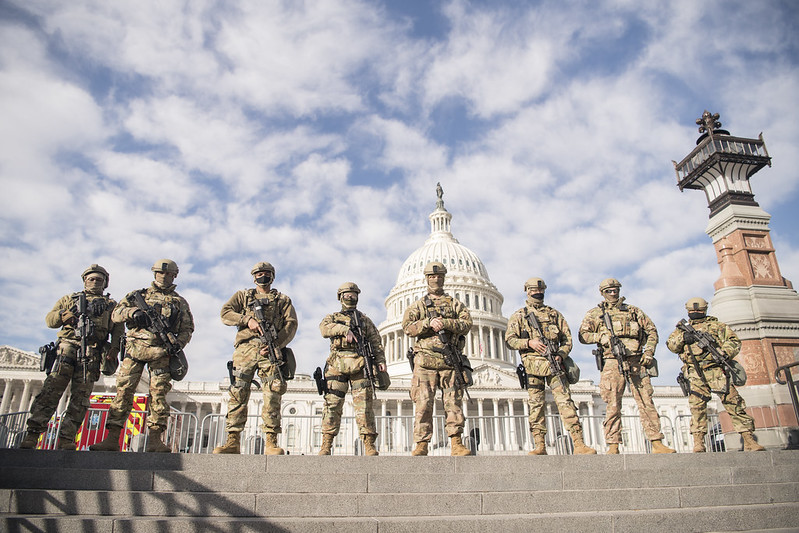
Photograph of National Guard troops in 2021 by Virginia Guard Public Affairs via Flickr/Creative Commons 2.0