
The methadone clinic cartel is increasingly turning to technology in order to stay in control and expand its reach. Opioid treatment programs (OTPs) were content with the 1970s status quo, but changes were forced onto them as a result of COVID. For tech companies, the pandemic opened up opportunities to change the way methadone is delivered and generate profits for investors.
As the company Opio puts it, “OTPs haven’t evolved with the rest of healthcare … The tech sector left opioid treatment programs behind. Until now.”
Methadone tech companies are showcased in the cavernous exhibition hall at the annual American Association for the Treatment of Opioid Addiction Dependence (AATOD) conference. Like MethaSpense, offering dispensing machines; Methasoft, with software that measures and tracks every drop of medication; and Sonara, which created the “Virtual Dosing Window”—actually an in-home patient policing tool. New businesses, masquerading as “patient-centered,” are keen to join the methadone-industrial complex.
Opio also had a display at the 2025 event, with the tagline: “Unlock bold new possibilities.” Enclosed in a large glass cubicle was a computer, connected to a jumble of machinery and piles of plastic bottles and caps. It was called ZING.
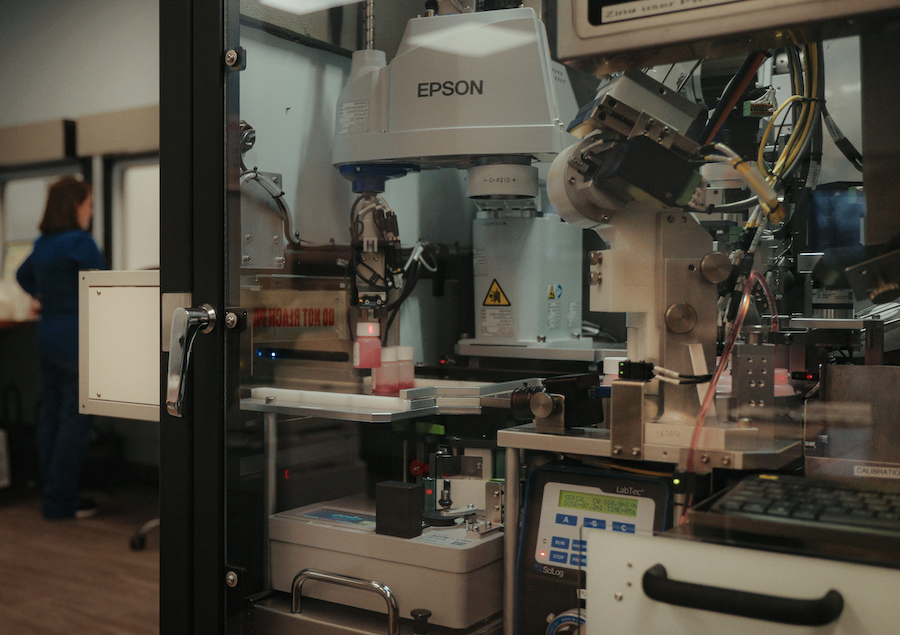
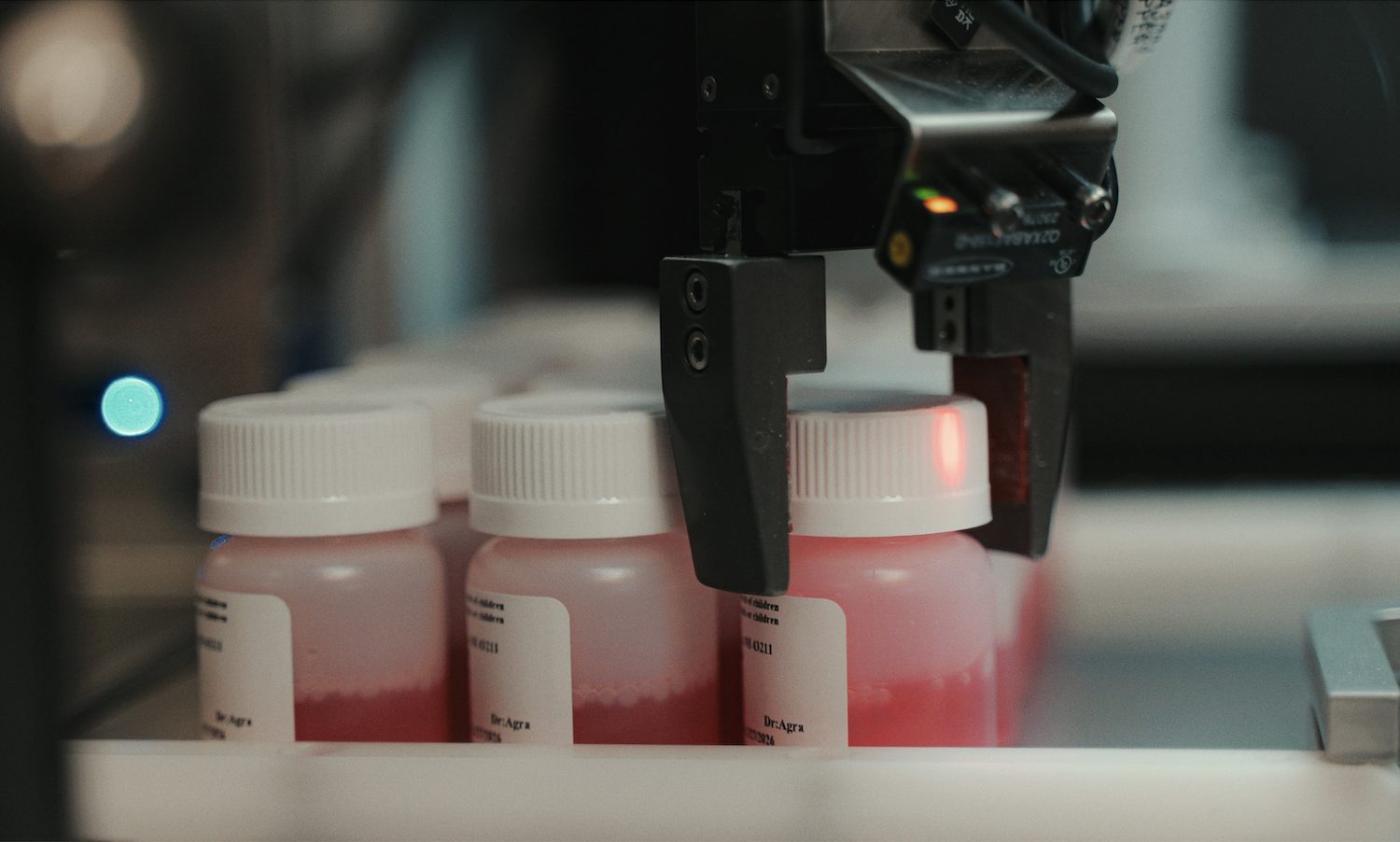
The rep told me ZING was a stand-alone robotic dose assembly machine that connects to a clinic’s existing methadone dispensing system. It measures, pumps, caps, seals, labels and photographs each dose. The machine can fill 28 bottles in about 4 minutes. According to the Opio website, “ZING robotic technology revolutionizes methadone dose assembly, allowing clinics to optimize staffing, support nurses, and increase patient capacity.”
“Every time a nurse is placing, filling, capping, sealing they’re not thinking about the human being who is standing right in front of them.”
ZING is promoted as the solution to a nursing shortage. High staff turnover rates in OTPs lead to long lines, for patients who dose daily and those who have “earned” take-home medication.
“Every time a nurse is placing, filling, capping, sealing they’re not thinking about the human being who is standing right in front of them,” said Dustin Mets, the CEO of Ohio OTP CompDrug, in a video promotion for ZING. That’s an astonishing admission.
“I think the Association for Behavioral Health in Massachusetts reported 80 to 100 percent turnover in nursing positions in OTPs,” Sam Wilson, Opio’s co-founder and COO, told Filter. “So it’s very costly and it provides a pretty poor patient experience when the nurse is changing so frequently. It’s very difficult for them to build relationships.”
Bill Kinkle, an RN who has taken methadone, has firsthand experience of that. “On Saturdays the line would be backed up because the nurse filled each bottle for each client at the dosing window,” he told Filter. “People with seven or 14 take-homes had to wait for the dispensing machine to spit out the methadone in each bottle. Nurses then printed and sealed each bottle, plus writing the number on each cap. It’s so time-consuming.”
Nurses play a critical role at OTPS; if they don’t “run the pumps” or prepare the “pre-pours” (take-home doses), patients don’t get methadone and Medicaid isn’t billed. But they’re working in a setting unlike any other—a carceral environment, designed by the Drug Enforcement Administration (DEA), where they have almost total power over patients.
The clinic structure pits nurses—stationed behind thick, bulletproof plexiglass—against patients, who are viewed as untrustworthy criminals. A nurse’s job consists of programming a MethaSpense machine to fill a plastic cup with one dose of methadone, pushing it through a hole in the plexiglass, and observing patients swallowing it. Then they ask the patient to speak or lift up their tongue to ensure ingestion. This is what nurses do all day, every day.
OTPs operate like a factory assembly line, where nurses might medicate up to 1,000 patients or more daily. It’s a stressful environment for everyone. In these “dose and dash” circumstances, it’s almost impossible for nurses to have meaningful human interactions with patients. Is it any wonder so many quit?
It frustrates Kinkle. “OTPs are a gaping sore in the nursing field,” he said. “They’re essentially penalty boxes for nurses who aren’t trusted to work anywhere else.”
A robotic machine that fills bottles as fast as lightning doesn’t fundamentally change the relationship between nurses and patients.
If ZING frees nurses from the monotonous filling of thousands of pre-pours and shortens patient wait times, that’s a positive. It will be particularly important if OTPs follow the updated guidelines from the Substance Abuse and Mental Health Services Administration guidelines to allow far more take-homes from Day One.
But a robotic machine that fills bottles as fast as lightning doesn’t fundamentally change the relationship between nurses and patients. That’s why it won’t, as Opio claims, “let nurses be nurses.”
Nurses play a central role in clinics’ culture of cruelty. They police and punish patients for rule violations like failing to respond in time for a bottle recall, and rescind take-homes for positive urine screens or even if a lid on a single bottle doesn’t “look right.”
“We would lock the doors at 2 pm and were discouraged from letting a patient in late,” one former clinic nurse recounted, “even if they were running across the parking lot to make it in the door before the clinic closed.”
It’s not just inhumane, but medical malpractice. Missed doses set patients up to buy adulterated fentanyl on the street, risking overdose and death.
Opio has developed another product. ZING Satellite is a telehealth booth linked to the ZING robotic dose assembly machine. It can be placed within federally qualified health centers, pharmacies, hospitals or correctional facilities.
“I worked in a hospital setting as a clinical pharmacist in Montana in a neonatal intensive care unit,” Amber Norbeck, Opio’s co-founder and CEO, told Filter. “Part of my job was to help moms get treatment, but it was really hard because there’s only four methadone clinics in the state. Drive times and access is an issue.”
“I was also serving other rural hospitals remotely through technology after hours,” she continued, “and I thought, if I can serve another hospital remotely through dose verification and remote dispensing, why can’t we apply similar technology to the opioid treatment space? We can solve the geographic access gap. So that’s how this company was founded.”
Every step in the dosing process is tracked, traced and timestamped; a camera records the entire interaction.
This is how ZING Satellite works: A patient enters a booth or room and their eyes are scanned using IrisID to confirm their identity. Opio boasts that it’s the same technology used by airport security. A nurse located remotely in an OTP, usually in the same state, starts the virtual dosing session by verifying patient information and then directs the machine to fill either one dose of methadone or a number of take-home bottles. The patient signs a touch screen, then the nurse remotely unlocks a secure transfer drawer. The bottle is collected and the nurse watches while the patient swallows the liquid.
Every step in the dosing process is tracked, traced and timestamped; a camera records the entire interaction. The DEA, obsessed with surveillance and diversion-control, has approved ZING Satellite use in several states.

The National Institute on Drug Abuse contributed funding for the development of ZING Satellite to expand methadone “access points,” and they’ll be available in 2026 for a monthly rental fee of $2,995 plus software and setup fees. The ZING unit alone costs $300,000, though AATOD members get a price drop to $225,000.
“ZING Satellite will be registered as a satellite medication unit of an existing OTP. It replicates the entire experience at the dosing window,” Wilson said. “The way that this technology is designed is so that one nurse can be serving multiple remote ZING Satellite locations at the same time. And while ZING is assembling the take-homes, they could greet another patient in another area. It’s creating the maximum usage of the workforce to create access points in areas where we know from conversations with our OTP customers that they can’t sustain a business operation in more rural areas.”
In other words, OTPs can’t make enough money serving small, rural communities. ZING Satellite is a smaller investment than a brick-and-mortar facility, allowing a few nurses to medicate dozens of patients virtually and boost profits.
There is something profoundly alienating about providing virtual dosing to dozens of patients at the same time, as each stands alone in a remote location. It’s a virtual assembly line, with patients medicated by a robot under constant DEA-endorsed monitoring.
Opioid treatment programs don’t need yet more humiliating patient surveillance technology. Instead, clinics need to be shut down.
Like clinics themselves, Zing Satellite amounts to separate and unequal treatment. Can you imagine any other medication being dispensed in this stigmatizing way? And if patients have to dose daily in ZING Satellite, the convenience factor is eliminated and getting to it becomes the centerpiece of their lives.
There is a dangerous lack of access to opioid use disorder medications in rural areas. Opio’s lucrative plan to fill this gap is to place Zing Satellite in locations such as rural hospitals or clinics all over the US. Yet it’s a ludicrously convoluted and expensive response to a problem that has a simple, accessible solution.
“It is a completely unnecessary piece of tech because methadone doesn’t need to be locked away in a clinic or in liquid form,” Kinkle said. “If it was available like every other medication in pill or wafer form, all that precious time nurses would like to use being with patients could be used in other outpatient areas.”
Wilson explained that the name ZING comes from the word “moderniZING.” But opioid treatment programs don’t need yet more humiliating patient surveillance technology. Instead, clinics need to be shut down, which would make the nursing shortage a non-issue.
Every patient should be able to pick up a prescription of methadone the good old-fashioned, nonstigmatiZING way—at a community pharmacy once a month.
Photographs courtesy of Opio