Another International Overdose Awareness Day arrives on August 31. It’s a time for us to reflect once more on a global tragedy that has reached unprecedented levels in recent decades.
Millions of people will painfully remember lost loved ones. But besides commemoration, we need calls to action—because these deaths are overwhelmingly preventable. And for that, we need a clear understanding of what must change.
The term “drug-related deaths” is widely used to describe overdose fatalities. The description sits comfortably with the dominant narrative—that drugs are so dangerous, people may die after using them. But how accurate is it to frame overdose this way? Are people really dying simply because “drugs are dangerous”?
A complex mix of factors contributes to overdose deaths, but let’s take a closer look at four key drivers.
None of these behaviors or information deficits are freely chosen. But harsh prohibition laws change everything.
First, people typically don’t know the purity or “strength” of the substance being consumed, which may turn out to be so high as to be fatal.
Second, people don’t know whether their drugs contain other, unexpected substances, which may, in combination, greatly increase risks.
Third, companions of a person overdosing may not promptly call for emergency medical support.
And fourth, people frequently use drugs alone, or in isolated locations where help is not available.
None of these behaviors or information deficits are freely chosen. People do not prefer to purchase substances without knowing the potency or even the contents, which can range from inert compounds to lethal toxic contaminants. Their preferred place to use and enjoy a drug is not under a railway bridge, in a derelict building or an alleyway. And if they see someone in trouble, their natural inclination is to help, not ignore.
But harsh prohibition laws change everything.
Prohibition forces consumers to buy unregulated substances from underground networks with little or no accountability. As a result, purity and content remains largely guesswork. The high stakes of being caught push suppliers toward more compact and readily concealable drugs, packing more potency per gram. (The transition from morphine to heroin to fentanyl is the classic example.)
Prohibition doesn’t eliminate the drug market, because lucrative demand persists. But it does surrender the market to unregulated suppliers. Which means there is no quality control, no packaging neatly listing the ingredients and dosage, and no consumer rights. Prohibition makes an overdose more likely.
Our four major drivers have little to do with drugs and everything to do with the environment fostered by our drug laws.
Prohibition impacts not only the supply but also consumer behaviors. People who use drugs face the threat of arrest—and the significant lifelong consequences of a conviction, limiting opportunities for employment, housing, education, insurance and travel. That’s why people often use prohibited drugs in secrecy, and often in places that are hidden or less frequented. Prohibition has driven them into situations that make an overdose, if it occurs, more likely to be fatal.
Even when people don’t use alone, their friends or partners are fearful of contacting emergency services when difficulties arise. That’s understandable. They fear being arrested for possession, or that if they have in any way helped the person in using a prohibited drug, they could face charges of supplying that drug. Worse still, if the friend or partner subsequently dies, they could then be charged with manslaughter or murder. Such is the threat from police—often the first to arrive at when an overdose is reported—that people have been known to ring an ambulance from a public phone box, then quickly exit the scene.
In these and other ways, prohibition creates the very factors that put people at risk. Our four major drivers of overdose have little to do with drugs and everything to do with the environment and circumstances fostered by our drug laws.
Consider the stark differences when people use alcohol—a drug that is legal in most countries, though historical examples of its prohibition have had predictable results.
Alcohol production is highly regulated. Drinkers know the contents and the strength of the drug they’re using. They know their glass of wine will not contain other drugs. Brewers and distillers would face serious consequences if they misled people about their products.
These deaths—so many of which could have been avoided if banned drugs were legally regulated—are better described as “prohibition-related deaths.”
People who use alcohol have consumer rights. They are not subject to institutionalized stigma and discrimination, and can openly seek evidence-based health education and support if they need it. When people experience alcohol overdose, their friends or partners need not fear calling emergency services, and bartenders or drinking companions are highly unlikely to face any charges for helping the person use alcohol.
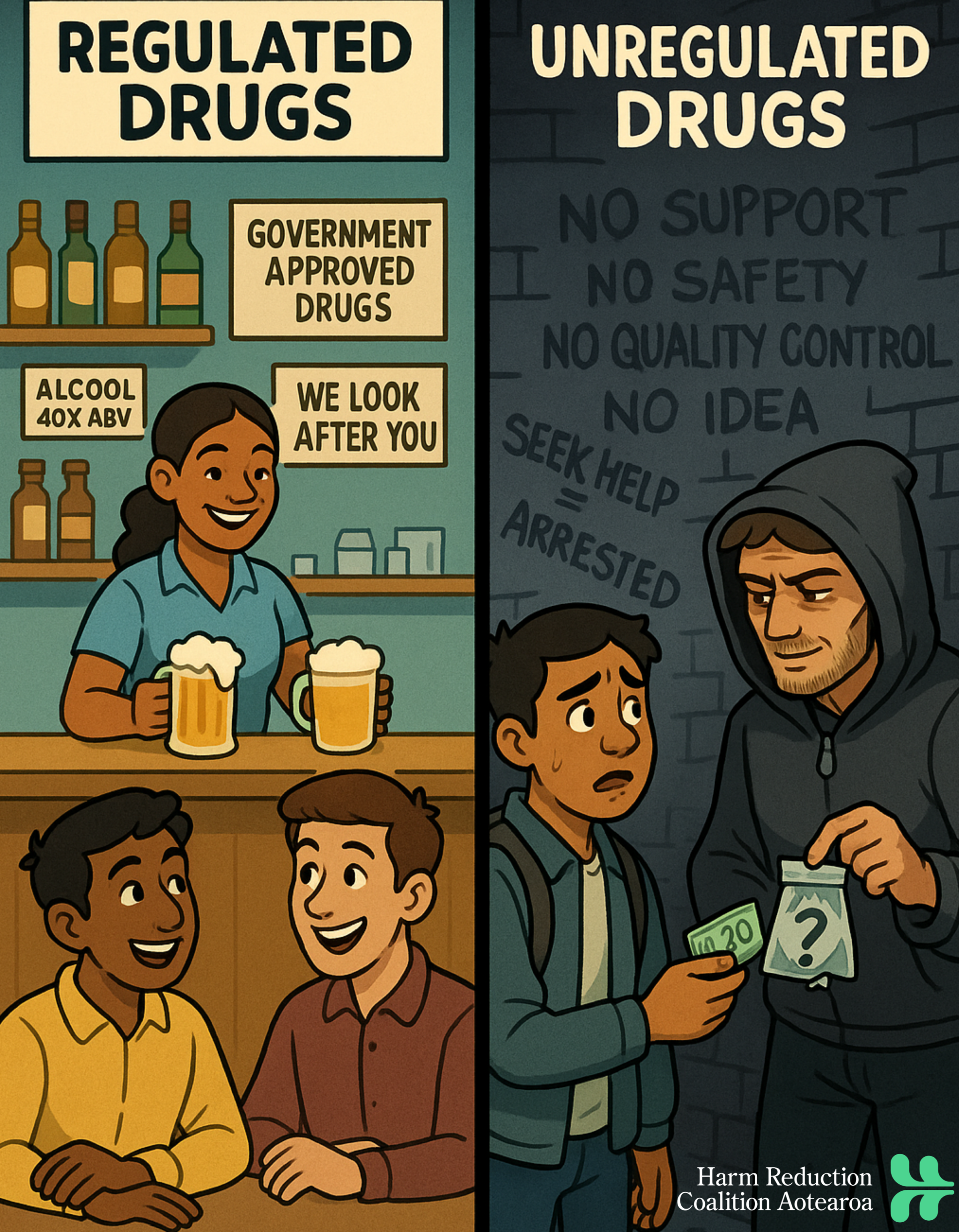
All drug use, legal drugs included, carries a degree of risk. But given the severe, artificial and needless inflation of risks around prohibited drugs, we would argue that referring to overdose fatalities as “drug-related deaths” deflects from the truth—obfuscating a central cause.
These deaths—so many of which could have been avoided if banned drugs were legally regulated—are better described as “prohibition-related deaths.”
This International Overdose Awareness Day, Harm Reduction Coalition Aotearoa calls for more awareness of that reality. We’ve seen far too much gratuitous harm. The deeply damaging prohibition experiment must end: Drugs should be legalized and responsibly regulated.
This article was coauthored by Kirsten Gibson.

Kirsten Gibson has long been an advocate for drug policy reform and harm reduction. Her master’s research examined women’s access to needle exchange services in Aotearoa. Kirsten is a Committee member of Harm Reduction Coalition Aotearoa. She is motivated by driving change to combat myths about drug use and reform drug policy.
Top photograph (cropped) by Can Pac Swire via Flickr/Creative Commons 2.0
-

Dr. Julian Buchanan was a pioneer of 1980s harm reduction in Merseyside, England. Now a retired professor in New Zealand, he helps to lead Harm Reduction Coalition Aotearoa. HRCA can be contacted at info[at]hrca.nz.

Brandon Hutchison is a New Zealand (Aotearoa) drug-law reform activist. Currently the secretary of Harm Reduction Coalition Aotearoa, he has decades of involvement in the cannabis law reform movement in New Zealand. Brandon holds degrees in physics and psychology and is now retired from his “day job” providing IT support to a university department.