

Connecticut senators have introduced a bill to authorize an overdose prevention center (OPC) pilot project. SB 195 was proposed February 11 by the Public Health Committee and is calendared for a February 18 hearing. It comes a year after a similar proposal came to an abrupt end, amid reports that Governor Ned Lamont (D) was open to OPC, but wanted to wait until they’d gained more traction in the United States.
The bill defines OPC as “community-based” facilities where, in addition to supervised drug consumption, drug-testing, harm reduction education and treatment referrals, participants can “receive access to basic support services, including, but not limited to, laundry machines, a bathroom, a shower and a place to rest.”
Under the proposed pilot program, the Department of Mental Health and Addiction Services would operate four OPC at locations spread across the state. They would receive no state funding, and would rely entirely on private grants and donations. The bill would also establish a 13-person advisory committee comprising various stakeholders, including people with lived experience, harm reduction experts, medical experts and members of law enforcement.
The bill does not specify a timeline for opening the sites. It does state that by January 1, 2028, the Commissioner of Mental Health and Addiction Services would be required to report to legislators “regarding the operation of the pilot program, if established,” along with any advisory committee recommendations pertaining to the pilot or to establishing OPC on a permanent basis.
“Being homeless in New Haven and addicted to opiates … a safe place to use with Narcan there would be a life-saver for me,” stated Butch, one of the residents to submit public testimony on the bill. “I have overdosed too many times and know my luck is running out.”
A previous attempt came to an abrupt end in May 2025 when Governor Ned Lamont threatened a veto.
A common theme in the written testimony submitted to date was the potential of OPC to curb public drug use. “Also able to be warm,” noted one anonymous resident.
Connecticut introduced similar legislation in 2023 and again in 2025. The latter attempt, which was packaged inside a larger public health bill, passed through the Senate but came to an unexpected end in May 2025, when Gov. Lamont threatened a veto if the OPC provision wasn’t dropped from the bill.
House Speaker Matt Ritter (D) told the Connecticut Mirror that the governor’s chief of staff had explicitly told him the bill would be vetoed if it were sent forward with the OPC language intact.
After it was removed, however, Lamont denied any involvement, telling the Mirror that he had some concerns about OPC but hadn’t made a final decision yet.
In the months that followed, Lamont expressed concerns around the fact that OPC weren’t already widely established in the US.
“I think I said I’d have to take a look at it, but I’d be pretty reluctant to do it. I think it’s pretty early,” he told the Mirror in July 2025. “I think Rhode Island really hadn’t gotten going yet. New York was going. Donald Trump was in office. He was coming down pretty hard.”
New York City became the first jurisdiction in the US to authorize OPC in 2021. The city has two sites currently in operation, but they’re not authorized at the state level. More than a dozen states have proposed OPC legislation in recent years, but the only three to have so far authorized the sites are Rhode Island, Minnesota and Vermont.
Rhode Island opened an OPC in late 2024, and Vermont—where a veto from Governor Phill Scott (R) was dramatically overturned at the last minute—is preparing to open one in Burlington. Minnesota has backed away from its legislation and has no current plans to open OPC. California legislators passed an OPC bill in 2022, but it was vetoed by Governor Gavin Newsom (D).
“I just figured it was worth a little more wait-and-see,” Lamont told the Mirror.
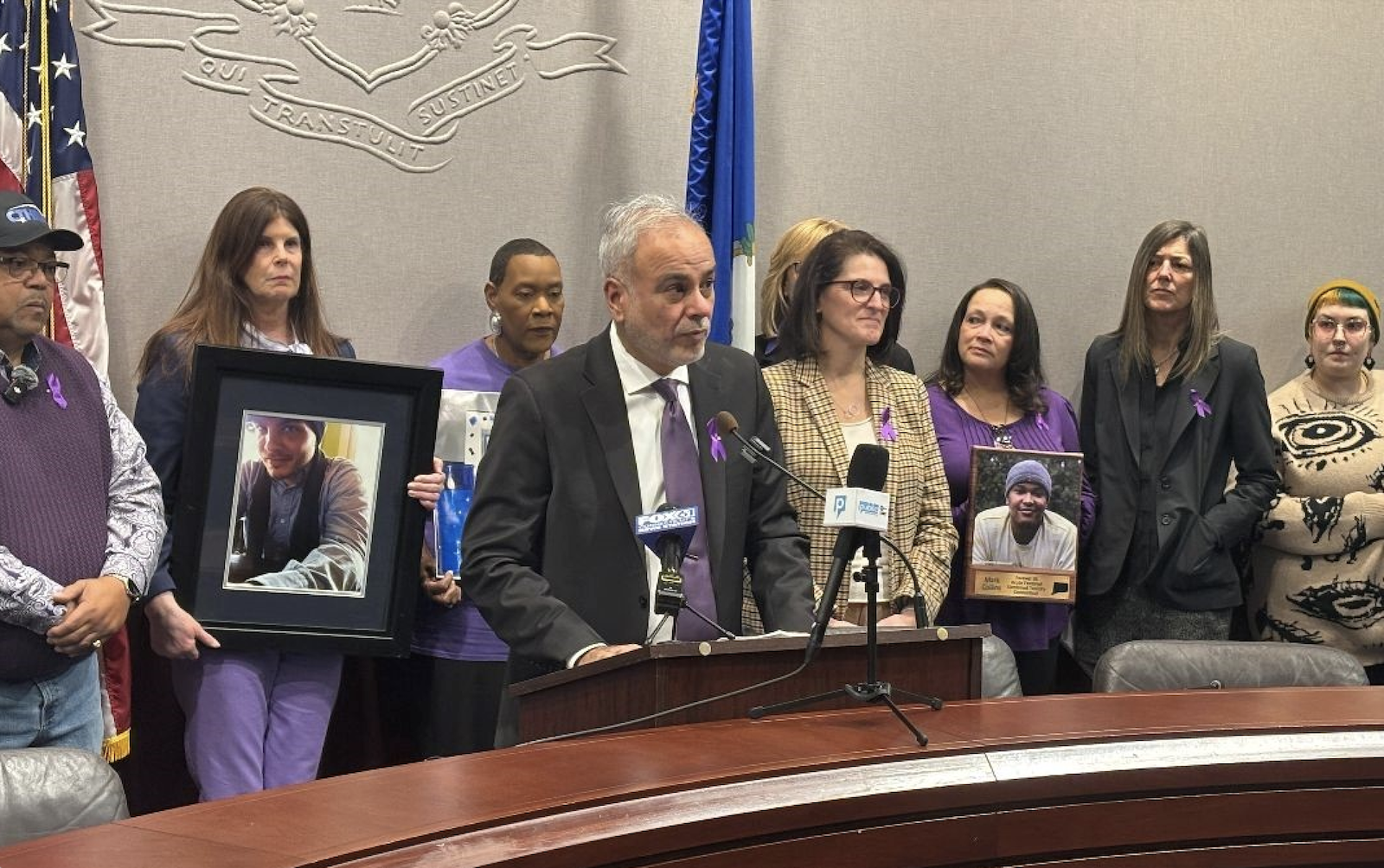
Photograph of public hearing for 2025 OPC legislation via State Senator Saud Anwar.