
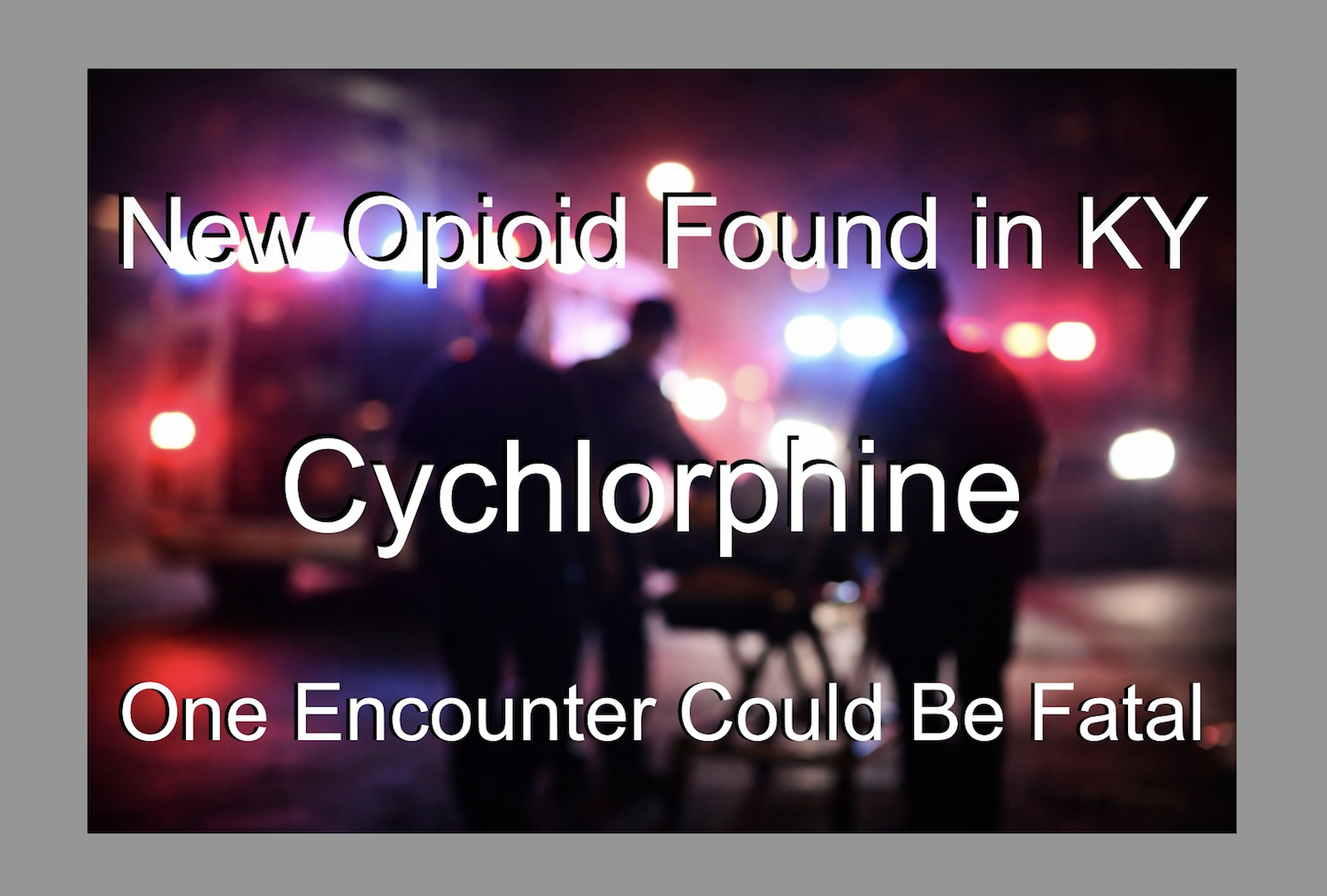
A minor media frenzy has been forming around cychlorphine, a novel synthetic opioid described as the “next killer drug” taking over at an “exponential rate” while standard naloxone has “proven ineffective.” While there are some notable differences between cychlorphine and the various fentanyl analogs and nitazenes that have previously been called these things, in this case some of the warnings appear due to a mixup with a different drug.
N-Propionitrile chlorphine, often referred to as cychlorphine, was first detected in the United States drug supply in 2024 by the Center for Forensic Science Research & Education (CFSRE).
Orphines are their own subclass of synthetic opioid, like fentanyls and nitazenes. Most coverage of cychlorphine includes the claim that it’s 10 times more potent than fentanyl. This is not wrong, but it should be noted that the estimate comes from lab studies of petri dishes, not humans.
CFSRE has described the emergence of orphines as the result of China scheduling nitazenes in mid-2025. As fentanyl crackdowns opened the door for nitazenes, the inevitable nitazene crackdowns opened the door for orphines. However, CFSRE has so far identified cychlorphine in at least 25 overdose deaths—21 in the United States and four in Canada—and in 11 of those cases cychlorphine was the only opioid detected. This is a departure from how nitazenes and other novel synthetic opioids have entered the supply.
“I do think that’s a little unusual for compounds we call opiates to be on their own,” Erin Tracy, lead chemist at the UNC Street Drug Analysis Lab, told Filter. “But other [new psychoactive substances] and other drug classes are often found on their own, like benzos or bath salts.”
The lab is a public drug-checking service at the University of North Carolina at Chapel Hill, where harm reduction organizations around the country send residue samples by mail. Though five of the samples Tracy has identified as cychlorphine appeared on their own, the lab has only seen 11 such samples in total.
To date, there is no publicly available evidence to suggest that naloxone would be any less effective for reversing an overdose of cychlorphine than of any other opioid.
In late January, CFSRE put out a public alert describing the increase in cychlorphine-involved fatalities. In February, CFSRE added cychlorphine to its Forensically Relevant Drug Database and published a health alert, since which time the subject has been gaining more media attention.
Of the 21 US overdose cases, seven were in Tennessee. This doesn’t mean that cychlorphine is concentrated in Tennessee; what often look like “hot spots” on a map don’t necessarily reflect the regions where a new substance is most prominent, but the regions where forensics laboratories are testing for it.
“We do know it’s more powerful than fentanyl and that naloxone, or Narcan, does not completely block the effects of the drug,” Dr. Darinka Mileusnic-Polchan, chief medical officer at the Knox County Regional Forensic Center, stated in a February press release. “[M]ultiple doses may be needed to prevent an overdose.”
To date, there is no publicly available evidence to suggest that naloxone would be any less effective for reversing an overdose of cychlorphine than of any other opioid. In response to Filter’s inquiry, the Knox County Regional Forensic Center said the information had been shared internally by the Drug Enforcement Administration.
“In our discussions with toxicologists from the DEA we were informed that due to the potency of this particular drug that there is a possibility that multiple doses of Narcan would most likely be needed or possibly ineffective,” said Chris Thomas, the Center’s director and chief administrative officer.
On March 2 the Jackson Times Voice used similar language, reporting that the Kentucky Office of Homeland Security had “warned the public and officials that ‘Naloxone was not able to block the antinociceptive effects of Cychlorphine completely’ and that traditional use of the life-saving drug has proven ineffective.”
Naloxone does not work by “blocking” an opioid’s effects, because it’s administered after the effects have already taken hold. In order to block them, it would have to be administered as a pre-treatment. Which it was, in the original study supporting an October 2025 claim in Clinical Toxicology that “Naloxone was not able to completely block the antinociceptive effects of chlorphine.”
N-Propionitrile chlorphine and cychlorphine are the same thing. Chlorphine is actually a different substance.
A pervasive misconception about naloxone is that it affects the opioid molecules themselves. It doesn’t.
The Kentucky Office of Homeland Security and the DEA did not respond to Filter’s requests for comment, but it seems reasonably likely that the DEA has been feeding that claim to KOHS and the regional forensic centers and health departments. “Chlorphine” could have become “cychlorphine” intentionally or without any of the government agencies responsible ever noticing, and neither would be surprising.
A pervasive misconception about naloxone is that it affects the opioid molecules themselves. It doesn’t. It affects the receptors they bind to in the human brain and body, which are the same receptors regardless of the opioid’s potency. It is unequivocally false to say that naloxone doesn’t work well on higher-potency opioids. Using too much can in some cases be as dangerous as not using enough.
“Treatment should be supportive,” CFSRE stated in its February cychlorphine alert. “Treat the airway and breathing first, followed by reversal with cautious administration of an opioid antagonist (e.g. naloxone), being careful not to precipitate acute withdrawal.”
Though chlorphine is not the substance being increasingly detected in overdose deaths, it’s still an opioid, so it would be concerning if naloxone really had proven ineffective, or less effective. Fortunately, the original study showing that naloxone “was not able to completely block the antinociceptive effects of chlorphine” had nothing to do with overdose, and was instead referring to naloxone as a pretreatment for chlorphine-dosed mice, to see if they were still sensitive to pain when their tails were pinched. It actually goes on to say that naloxone pretreatment “fully” blocked the decrease in respiratory rate brought on by chlorphine. But again, we’re talking about the wrong drug, responding naloxone being dosed prophylactically, in mice.