
Back in February, a woman shared a tale of urban woe on social media. She wrote that her husband had been on a crowded train in New York City when “a homeless woman” walked in, pulled down her pants and urinated on the train.
“He hasn’t stopped talking about it for the past 24+ hrs,” the account added. “It is the single most traumatizing thing that’s happened to him in nyc.”
The post went viral, generating 5.8 million views and fueling cycles of online outrage. Many of the initial responses derided the couple as whiny weaklings who should move to the suburbs (or “i hate you both. you should be put in the town stocks.”) Others—including progressive-minded writers like Jill Filipovic and Mindy Isser—voiced frustration at what they saw as the left’s counterproductive downplaying of such incidents. Right-wing accounts duly accused “woke” progressives of turning cities into hellscapes; the forced institutionalization of people who are unhoused or use drugs in public came up more than once.
Though the moment may have registered only for the extremely online, its running themes—many people’s fear or disgust at witnessing poverty, drug use or mental illness, and the resulting politicized crackdowns to “clean up” cities—have been percolating and shaping culture and policy for decades.
Social media tales should be taken with large grains of salt. This incident allegedly took place on a crowded train, and although the story went viral, no corroboration from other witnesses is readily visible.
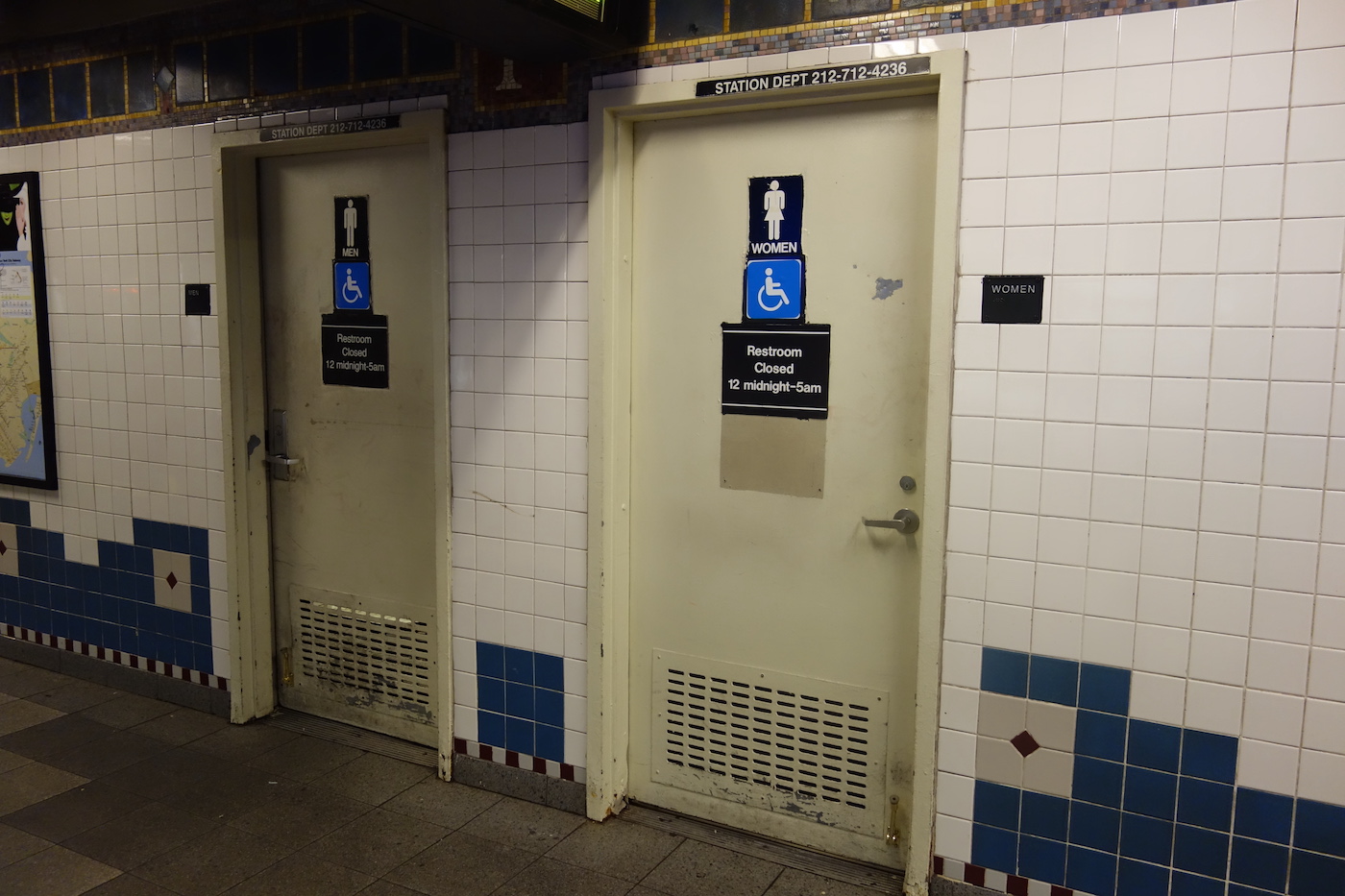
Only 973 public restrooms are operational in New York City, in a population of 8.6 million. Over 350,000 people are unhoused.
But if the story is true—if an unhoused woman boarded a train and relieved herself—it reflects, among other things, a lack of suitable places to do so.
There are very few public restrooms in New York and most other cities in the United States. Research suggests that US cities have, on average, 13 public restrooms per 100,000 residents. And in big cities the number is lower: 10 restrooms per 100,000 residents. Many US cities experiencing homelessness crises do even worse: Philadelphia has only 4.1 public restrooms per 100,000. Houston and Dallas, respectively, have 7.7 and 4.4. That’s far behind much of Europe, for instance.
According to an analysis by the New York City Council, there are 1,064 public restrooms across all five boroughs. Only 973 are operational, in a population of 8.6 million. Over 350,000 people are unhoused in the city, including thousands sleeping unsheltered. They all have to go to the bathroom somewhere.
To Harvey Molotch, emeritus professor of sociology at New York York University with a specialization in urban development, it’s a familiar problem.
“Since the beginning of urban development, the first formations of towns and cities, a primary issue is: Where are people going to go?” he told Filter.
“The notion that crowding causes disease after mass pandemics … it’s brought to a head in the 19th century,” Dr. Molotch added. “There’s a confluence of factors: urbanization, population density, disease and early notions of what causes communicable disease.”
According to Bryant Simon, professor of history at Temple University, there was a nationwide effort to build public bathrooms from the late 19th century through to the First World War. “Mayors of each city would show up and host events where they would be bragging about their public restrooms, and it is such a stark comparison to what we have now,” he wrote. The temperance movement also lobbied for public toilets—they hoped access to outdoor bathrooms would keep people out of the saloons, where they might be tempted to imbibe.
“You have a classic moral panic. Fear of disease, fear of crime. And sex. There’s a fear people are shooting up in restrooms.”
Building on this momentum, another 2 million public bathrooms were built across the US as part of President Franklin Delano Roosevelt’s New Deal public works programs. But by the 1970s and ‘80s, cities across the country started closing public bathrooms, driven by sentiments that would be a comfortable fit on today’s social media.
“You have a classic moral panic,” Molotch said. “Fear of disease, fear of crime. And sex. Drug use. Any disorder in general. It’s a time of the breakout of sexual freedom—heterosexual, homosexual—and drug use. So … there’s a fear people are shooting up in restrooms.”
At the same time as depriving unhoused people of safe spaces to relieve themselves, officials cracked down on public urination. Budget cuts dovetailed with the perception that a city public bathroom was an undesirable and dangerous place: A functional, safe, clean toilet requires regular cleaning and oversight.
“To have a functioning restroom you need to invest a good amount of money and invest in maintaining them,” Molotch said. “Otherwise it becomes a humiliating disaster, where the bathroom becomes dirtier and dirtier.”
Molotch is scathing about the attitudes that have left the country with completely inadequate provision. “It’s American selfishness and unwillingness to invest in the public realm,” he said. “It’s disregard for the homeless and their earthly needs. You put it all together in a martini shaker and the outcome is there’s nowhere to go. For anyone.”
“We know people do use public restrooms as consumption spaces, so we have to increase options for folks and use the spaces to inform people of their options.”
Of course public bathrooms are also places where people, particularly those without housing, may seek to use drugs privately, and that can pose issues—in terms of the safety of a person using drugs alone, and also for bathroom attendants who might discover someone overdosing or dead. But that’s a reason to mitigate the risks, as some have already sought to do—not to deny people an essential resource.
“There are a variety of options,” Trevor Goodyear, assistant professor of nursing at the University of British Columbia, told Filter. “First, we know people do use public restrooms as consumption spaces, so we have to increase options for folks and use the spaces to inform people of their options in terms of safer consumption sites.”
Dr. Goodyear suggested building public toilets with motion censors. “So if someone stops moving, you can have someone check in.” Other low-cost, low-tech features he mentioned include cubicle doors that swing outwards—so an unconscious person wouldn’t block access—rather than inwards. And often, it’s very simple: “Have staff routinely check bathrooms, just a quick knock on the door, ask, ‘Are you ok?”
Building facilities with more space would also help, he said. “That way people aren’t falling and getting wedged between the toilet and wall, which could be a problem.”
“And these innovations benefit everyone, not just people who use drugs,” Goodyear pointed out. “Everyone could use a clean, safe bathroom.”