

The International Monetary Fund has published a call for risk-proportionate taxation of nicotine products—in contrast to policies being adopted by many governments. The paper from the global financial institution, published earlier in March, said taxes on nicotine, alcohol and sugar products “should better align with the harm they cause.”
Written by economist Christoph B. Rosenberg, former deputy director of the IMF’s Communications Department, and tax policy expert Marius Van Oordt, the article discusses the history, present and implications of governments taxing consumer behavior. With the emergence of new options such as vapes and pouches, it states, “Nicotine products present a particular challenge.”
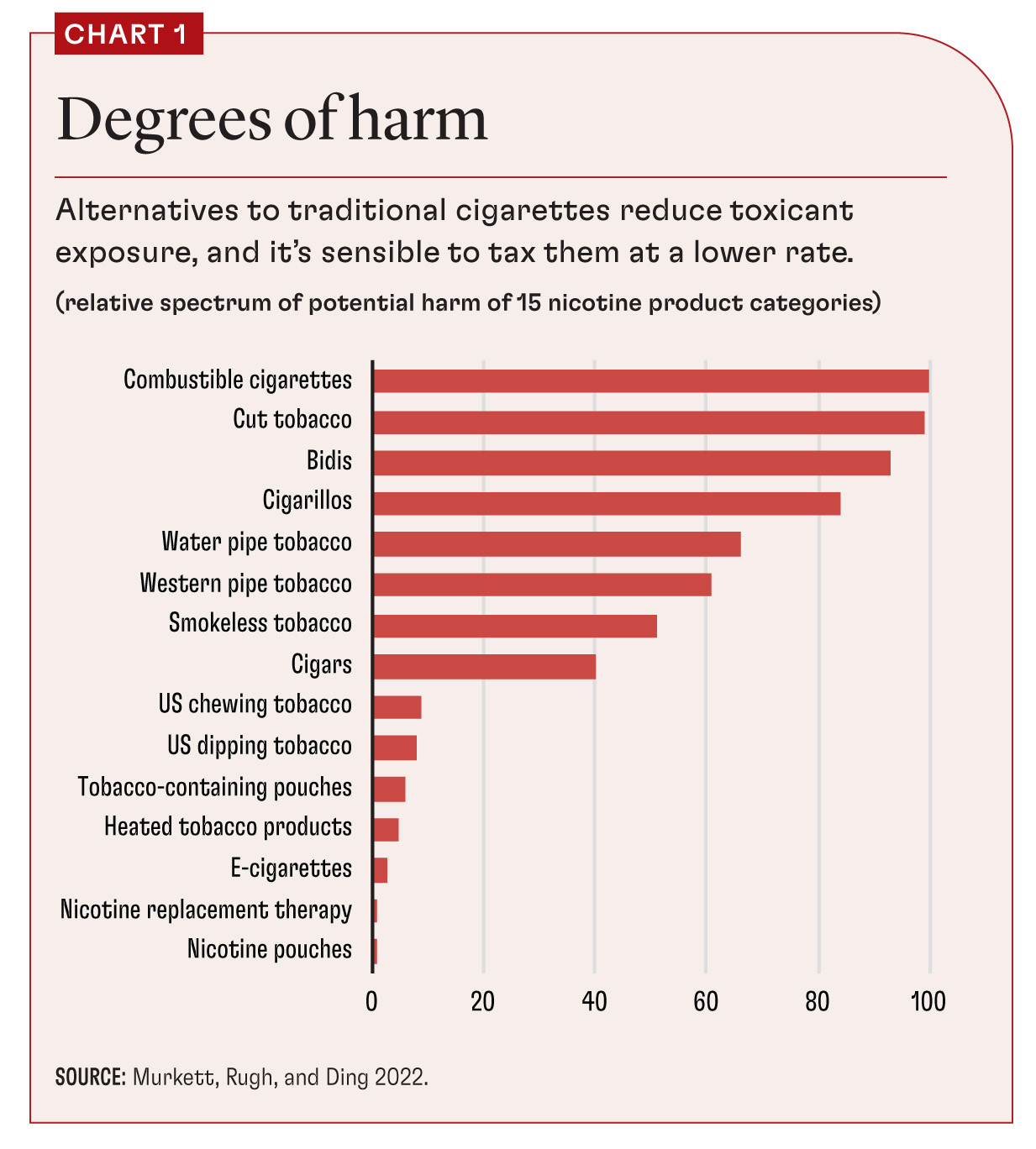
“The good news is that many of these new products, while still harmful, reduce exposure to toxicants,” it continues. “It therefore makes sense to tax them at a lower rate, which can be adjusted as research becomes available and revenue needs evolve.”
“To achieve health goals, policymakers must keep up with these developments … Combining tax and health data makes this job easier.”
“Harmful” is a highly relative term here. As a chart displayed in the article illustrates, pouches, vapes and heated tobacco products are exponentially less harmful than the combustible cigarettes they replace.
When consumer behaviors change with the emergence of options like safer nicotine products and low-alcohol beer, the onus is on lawmakers to respond appropriately, the authors assert: “To achieve health goals, policymakers must keep up with these developments and streamline their often-patchy taxation systems. Combining tax and health data makes this job easier.”
Though the article includes a standard disclaimer that the authors’ views “do not necessarily reflect IMF policy,” it is significant for the IMF to publish it. And it’s being applauded by tobacco harm reduction (THR) advocates, who have long argued that tax policy should incentivize healthier choices.
“This is very basic economics, but it has been strongly opposed by abstinence-only groups richly funded by Michael Bloomberg,” David Sweanor, an industry expert who chairs the advisory board of the University of Ottawa’s Centre for Health Law, Policy and Ethics, told Filter.
“Ensuring cigarettes are far more expensive than low-risk alternatives has been shown to have a dramatic effect in reducing cigarette smoking,” he continued. Sweanor and others made this case in a New England Journal of Medicine paper over a decade ago.
“The IMF’s experts implicitly challenge the economic and policy illiteracy of the World Health Organization, which supports equal taxation on all nicotine products, regardless of their risk.”
The IMF’s implicit endorsement should lend the case real weight in the corridors of power, according to British advocate Clive Bates, of Counterfactual Consulting.
“The International Monetary Fund is the leading governmental agency overseeing macroeconomic policy,” he told Filter. “Is it taken extremely seriously by finance ministries and policymakers concerned with managing a stable, prosperous society.”
“The IMF’s experts implicitly challenge the economic and policy illiteracy of the World Health Organization, which supports equal taxation on all nicotine products, regardless of their risk,” Bates continued. “The IMF paper shows why that is a terrible idea for health and for the economy.”
Sweanor agreed that having “the authoritative IMF” siding with THR advocates on this issue “should be very influential with government tax policy officials.”
“In my long history in this field,” he added,” I have found finance officials to be superior to health officials in grasping the potential of policy to impact health.”
The IMF article cites New Zealand as “a good example of how taxation may help wean people off smoking,” through what it calls “a deliberate strategy to widen the tax differential with less harmful alternatives.”
In that country, the authors write, “the proportion of people smoking cigarettes dropped from 18 percent in 2012 to 8 percent in 2024; the uptake of less harmful e-cigarettes increased from near zero to 14 percent over the same period. Causality is hard to establish, but it seems plausible that rising price differentials in part caused this shift.”
New Zealand is a noted THR success story. Health authorities endorse vaping as harm reduction, and the country has rapidly reduced smoking while simultaneously cutting youth vaping. The government also halved its excise tax on heated tobacco products in 2024.
“Taxation is more than a fiscal instrument; it is a powerful lever for shaping healthier societies.”
Ireland is among countries that have taken a different path. In 2025, the Irish government hiked taxes on all vaping e-liquids—discouraging citizens who vape, or those who might wish to start, with the highest tax rate of any European Union member. As well as sabotaging the financial incentive to switch, this “sends the message that the harms of e-cigarettes are comparable to smoking,” one Irish advocate told Filter at the time.
The IMF paper mentions India as an example of this kind of tax “misalignment.” Vapes are banned there, and the unregulated sales that occur are not taxed. But when it comes to traditional bidis—cigarettes made of unprocessed tobacco rolled in leaves—the authors note that they are taxed “significantly lower than filtered cigarettes” despite comparable levels of harm, and when “smoke-free alternatives are banned.” This, they continue, “falsely signals lower health risks, sustains consumption in often more dangerous products, and diverts investment toward the wrong industries.”
Past research has also indicated that vape taxes in the United States boost cigarette sales. The US does not impose a federal vape tax—despite several legislative attempts—but local governments and over 30 states do. Minnesota, where research indicated that tens of thousands of people were dissuaded from quitting smoking due to a vape tax, is one example.
“Taxation is more than a fiscal instrument; it is a powerful lever for shaping healthier societies,” the IMF paper concludes. “Linking excise taxes to relative health risks can reduce preventable diseases.”
Agreeing, Sweanor said that, “combining access to a range of consumer-acceptable low-risk alternatives with risk-proportionate pricing will dramatically accelerate an already-rapid move away from lethal cigarettes.”
A 2025 briefing paper by the Global State of Tobacco Harm Reduction comes to a similar conclusion, but also sounds a note of caution: Lower taxes on safer nicotine products do not always translate into meaningfully lower prices. Sometimes, it noted, “Instead of reducing prices to encourage a transition from smoking to safer products, companies leverage these tax benefits to maintain higher profit margins.”
“Consequently, it is important that the FDA not dwell upon applications to market low-risk products too long … doing that reduces competition.”
Ian Irvine, professor of economics at Concordia University in Canada, said this depends on how much competition there is in the market. A price fix is easier to maintain among just a few suppliers, he explained.
“But with many suppliers, price-fixing becomes difficult,” Irvine told Filter. It is then much more likely that some competitors will seek to undercut the others, rather than collude on inflated pricing.
This, Irvine continued, has implications for consumers in the US, where the Food and Drug Administration has long dragged its feet on authorizing a wider range of vaping products from a wider range of companies.
“Consequently, it is important that the FDA not dwell upon applications to market low-risk products too long … doing that reduces competition,” he said. “Delays also cement the power of initial suppliers in a market, [making] it more difficult to become an effective competitor.”
Irvine welcomed the IMF paper, saying it’s obvious that taxes should be proportionate to health risks, “just as we should tax zero-alcohol beer less.”
Photograph by World Bank Photo Collection via Flickr/Creative Commons 2.0
The Influence Foundation, which operates Filter, has received unrestricted grants from both the Sweanor Family Fund at the Ottawa Community Foundation and from Knowledge-Action-Change, which publishes The Global State of Tobacco Harm Reduction. Filter’s Editorial Independence Policy applies.