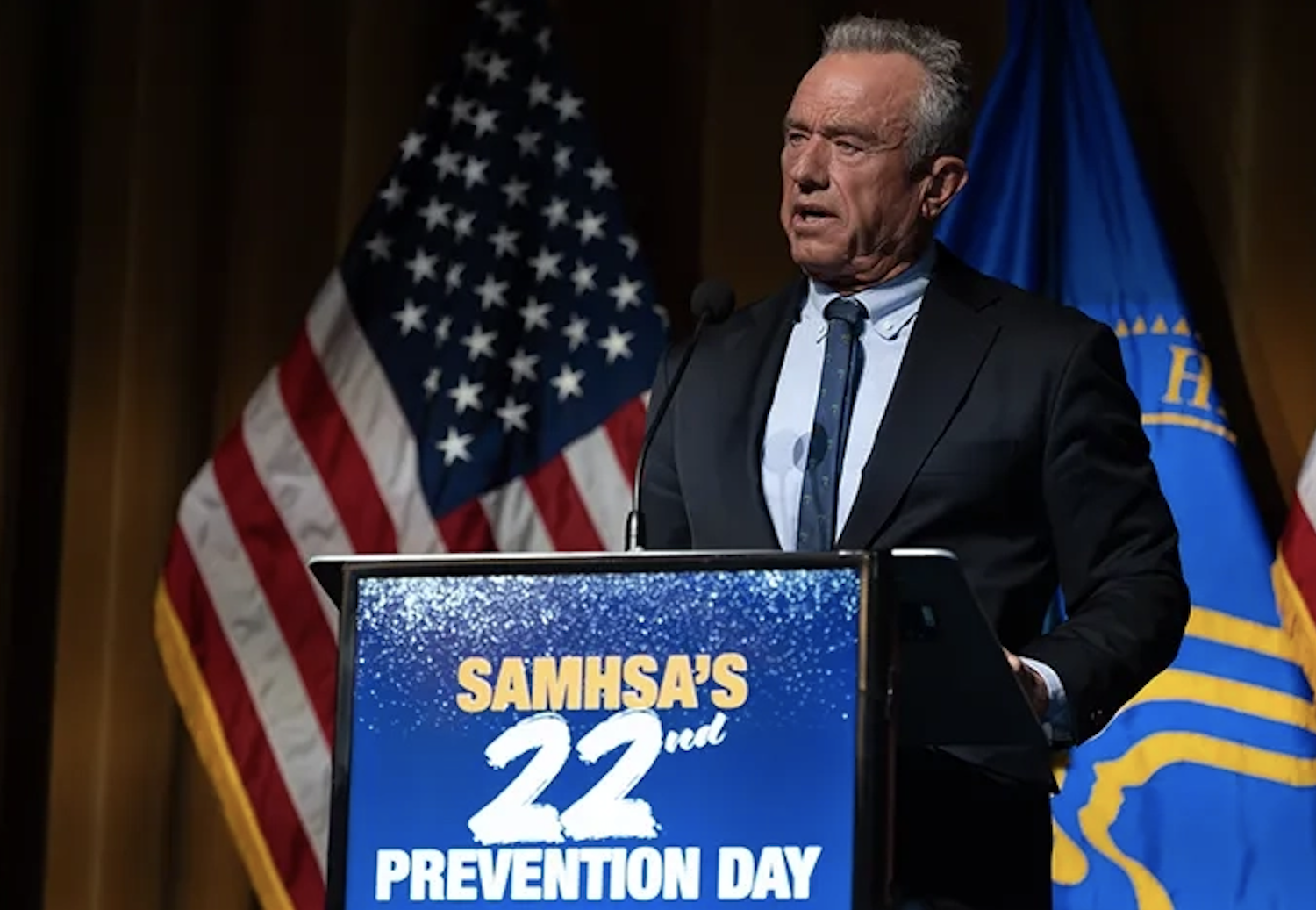
At a sumptuous resort just outside Washington, DC, on February 2 for “Prevention Day,” Health and Human Services Secretary Robert F. Kennedy Jr. announced his Safety Through Recovery, Engagement and Evidence-based Treatment and Supports (STREETS) Initiative. He opened by scapegoating people who use drugs as “negative producers” and “drags on the whole [health care] system.”
STREETS is billed as a $100-million investment to “solve long-standing homelessness issues, fight opioid addiction and improve public safety by expanding treatment.” It will be piloted in eight as-yet-unspecified cities, and is designed to operate in tandem with “assisted outpatient treatment” (AOT)—court-ordered psychiatric probation, similar to probation for drug violations. AOT saddles participants with the ever-present threat of being involuntarily committed to a psychiatric facility for noncompliance, or even just a technical violation. HHS will soon offer $10 million in AOT grants (though this amount has been higher in previous years).
Kennedy now wants provider organizations to “take charge of an addict” for a period of one to three years. Providers would receive bundled payments if they ensure that the people in their custody remain in compliance with an abstinence-only model. This will prove beneficial to providers with stake in urinalysis testing—possibly the most notorious financial scheme in the rehab industry—but is not likely to result in long-term abstinence. It also incentivizes providers to employ policies that are increasingly punitive, result in misleading data, or both.
“While ICE terrorizes our families and communities, STREETS will do little to address our addictions, mental health and homelessness crises.”
STREETS furthers President Donald Trump’s July 2025 executive order titled “Ending Crime and Disorder on America’s Streets,” which was widely condemned as a declaration of war on unhoused people. The Legal Defense Fund likened it to a resurrection of the Black Codes preceding today’s “vagrancy” laws.
The Housing First model, which does not require abstinence as a precondition of access to permanent supportive housing, was created to address the failures of the “tough on homelessness” approach favored in the 1980s. Trump’s HHS has characterized Housing First and harm reduction-based programs as “misguided,” falsely claiming that they’ve been ineffective and “enabled future drug use.” This is reminiscent of proponents of involuntary commitment falsely contending that deinstitutionalization failed, when it was never fully implemented and was arguably still the most successful decarceration effort in United States history.
“While ICE terrorizes our families and communities, STREETS will do little to address our addictions, mental health and homelessness crises,” former Substance Abuse and Mental Health Services Administration official Paolo del Vecchio told Filter, “turning away from proven harm reduction and Housing First approaches while embracing failed practices of coercion and criminalization.”
In red and blue jurisdictions alike, messaging is shifting from public health to public safety. Policymakers are expanding the reach of civil commitment laws to remove unhoused people from public view, disappeared into a vast system of coercive programs. Some fear these may include forced labor farms and detention camps.
Investment in faith-based treatment and “outcome-oriented” payment models all but guarantee increased coercion from providers.
In 2025 the White House announced its Faith Office, which supports “faith-based entities, community organizations and houses of worship” in competing on “a level playing field” for federal grants and other funding opportunities.
“Faith-based organizations play a critical role in helping people re-establish their connections to community,” Kennedy, a 12-step devotee, told the audience on February 2. The same day, Faith Center Director Monty Burks spoke at a separate, virtual event introducing STREETS to community stakeholders.
Several of the Prevention Day event speakers signaled the desire to phase out the health insurance industry’s current fee-for-service models, in which providers are reimbursed based on quantity, and instead use “outcome-oriented” or “values-based” payments that incentivize based on quality—and are still rife with inequities. The costs and administrative burdens of both approaches could be eliminated if we ditched the predatory health insurance industry in favor of Medicare for All.
Investment in faith-based treatment and “outcome-oriented” payment models all but guarantee increased coercion from providers, potentially in violation of the First Amendment.
In January, a separate executive order establishing the “Great American Recovery Initiative” (of which Kennedy is a co-chair) warned that most people who need treatment don’t think that they do. It appears that the public is being primed for the widespread involuntary detention of unhoused people who use drugs and/or have visible symptoms of mental illness.
“We intervene early,” Kennedy told Chris Cuomo of News Nation on February 3. “We catch people on the street and channel them into treatment, out of crisis through detox, treatment, outpatient and into sober housing.”
Cuomo gently pushed back: “You can’t make people get treatment if they don’t want to.”
“We have a community care program that involves the courts,” Kennedy retorted. This, he said, is a more “efficient, economic and humane” approach to those who refuse services.
Image via Substance Abuse and Mental Health Services Administration