
The Federal Communications Commission (FCC) has proposed a revision of its historic regulations lowering the prices of phone and video calls from prisons and jails, which the agency put on hold in June. If approved, the updated regulations would involve “interim” caps, a new pricing structure for the smallest jails and bringing the prices for all facilities slightly closer to what they were originally. The office of FCC Chairman Brendan Carr announced the news October 3. Oral arguments against the delays to implementing the original regulations, meanwhile, will be heard in court October 7.
In almost all United States prisons and jails, incarcerated people’s communication services (IPCS) are not provided by the jurisdiction responsible for people in custody, but instead outsourced to private contractors like Securus Technologies or ViaPath Technologies (better known as GTL) that monopolize services for everyone in the facilities covered by their contract. In 2024, after Congress enacted the Martha Wright-Reed Just and Reasonable Communications Act, the FCC voted to implement a landmark set of regulations that would make IPCS—namely phone calls and video visits—more affordable for people in custody and their families.
The maximum per-minute cost of most phone calls from prisons, for example, was set to be lowered from $0.14 to $0.06. In jails with an average daily population (ADP) of under 1,000 people, the per-minute cap was set to be lowered from $0.21 to between $0.07 and $0.12. The per-minute price for video visits, which had never been regulated at all, was set to be $0.16 for prisons and between $0.11 and $0.25 for jails, depending on the size of the facility.
In late June the FCC delayed the deadline for implementation, more or less indefinitely. Now, the agency is proposing a “uniform $0.02 rate additive above the revised caps to ensure recovery of correctional facilities’ costs of administering service,” stating that this and other recalculations better account for “all of the safety and security measure expenses that IPCS providers reported incurring.”
The pre-regulation phone call caps for prisons as well as for large jails ($0.16 per minute) included a “$0.02 additive for facility costs, which equates to the allowance made for facility-incurred IPCS costs reflected” in kickbacks outlined in their contracts.
The smaller the facility, the less profitable IPCS contracts generally are for providers.
Many security measures and other day-to-day operations in prisons and jails are funded not through federal, state or county government spending, but through kickbacks (AKA “site commissions”) from IPCS providers. This refers to the practice of corrections departments awarding IPCS contracts to the provider that can offer them the biggest cut of the proceeds, and the providers in turn recouping their profits by charging higher prices to people in custody and their families. The regulations were set to ban kickbacks entirely. The practice has become so deeply entrenched that in many jurisdictions kickbacks are legally required.
The National Sheriff’s Association praised the FCC “for taking action to address the cost recovery challenges facing jails and sheriffs across the country,” stating that Carr’s proposal was “an important step toward ensuring that essential safety and security measures can be maintained.”
The new proposal would also include “an additional rate cap tier for extremely small jails.” Under the original regulations, all prisons are priced the same way regardless of size. For county jails, however, caps are divided into tiers based on each facility’s ADP: large (over 1,000 people); medium (350-999); small (100-349); and very small (0-99). The FCC did not respond to Filter’s request for clarification as to whether the proposal referred to the creation of a fifth tier for jails rather than a modification to the “very small jails” tier, and what the ADP cutoff would be if so.
The smaller the facility, the less profitable the IPCS contract generally is for the provider. Since the FCC approved the regulations in 2024, providers’ attempts to avoid them have included essentially threatening to cut services at insufficiently profitable facilities. The FCC had initially not entertained this possibility, but changed its stance in June following a change in leadership and the departure of all but one of the commissioners who had supported the original regulations in full.
The FCC also stated it would set a new deadline for all IPCS providers to bring their pricing structures into compliance, including by getting rid of site commissions. In the original timeline, all facilities had been required to be in compliance with the regulations by July 2025.
The FCC is scheduled to vote on the proposal during its next monthly open meeting October 28.
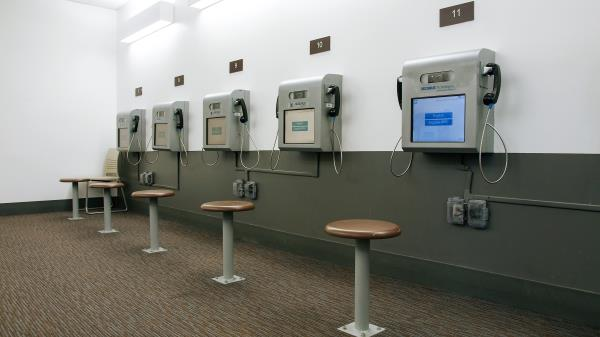
Image of video visit kiosks via San Diego County Sheriff’s Office