“DULF’s pilot project worked,” a Supreme Court of British Columbia judge stated on November 7, referring to the compassion club that sold tested heroin, meth and cocaine to members in Vancouver’s Downtown Eastside.
Justice Catherine Murray pointed to the fact that none of the club’s 47 members overdosed on the supply in the first year of operations, citing a local public health official in calling it a promising sign of the model’s efficacy.
But the compassion club was nonetheless illegal by the letter of the law, Murray found. She convicted Drug User Liberation Front founders Jeremy Kalicum and Eris Nyx of three counts each of possession for the purpose of trafficking. They could ultimately face prison time.
Still, in handing down the verdict, Murray made comments sympathetic to Nyx and Kalicum—and her implied criticisms of law enforcement and politicians teed the pair up for their pending constitutional challenge.
After Murray’s statement, lawyer Tim Dickson confirmed that the defense would be filing arguments that the charges violated the Canadian Charter of Rights and Freedoms. Their challenge is set to be heard from November 24.
The Vancouver Police Department first arrested Nyx and Kalicum on October 25, 2023, after what Murray called a “maelstrom of activity” following an Economist article that September.
While Sturko appeared to take the verdict as an affirmation of the law, some of Murray’s comments may provide fuel for the constitutional challenge.
“The drug section of VPD, which was previously aware of DULF and the compassion club, but claims to not have been aware of the DULF site, commenced an investigation,” Murray said.
“Backbench politicians voiced concern about the government funding an organization that was sourcing drugs on the dark web,” she added.
That comment appeared to refer to, among others, now-independent provincial politician Elenore Sturko, who played a lead role in the moral panic over harm reduction that had begun in earnest a year earlier.
Sturko, who was in the courtroom for the verdict, appeared unfazed by the comment. But as she spoke outside the courthouse to a Global News reporter who has helped to fuel the anti-harm reduction movement, DULF supporters voiced their discontent, laughing as she said she had no animus towards Nyx and Kalicum.
And when other reporters on scene tried to ask questions, Sturko quickly left.
But while Sturko appeared to take the verdict as an affirmation of the law, some of Murray’s comments may provide fuel for the constitutional challenge.
DULF’s lawyers Tim and Stephanie Dickson didn’t stick around after the ruling for comment, but hints at their approach to challenging the constitutionality of the arrests may be found in the group’s other court case.
The Dicksons are also representing DULF in federal court, as the group challenges Health Canada’s 2022 decision to deny it an exemption to operate the compassion club.
Tim Dickson told Filter ahead of a 2024 federal court hearing that DULF was “pleading with Health Canada to become more engaged in solving this problem.”

At an October 2024 press conference (from left to right): Stephanie Dickson, Tim Dickson, Jeremy Kalicum and Eris Nyx
They argue the decision to deny the exemption was political—that Health Canada was not engaging with the evidence behind safe supply, or the potentially life-saving effects of a compassion club.
An analysis founded on that evidentiary base, according to DULF, should lead to a recognition that denying the exemption would violate compassion club members’ Section 7 Charter right to life, liberty and security of the person.
Instead, DULF argues, the decision to deny the exemption rested on overblown fears of harm with scant evidence behind them.
Nyx and Kalicum were operating with broad approval from various levels of government, including letters of support from Vancouver Coastal Health (VCH), the City of Vancouver and even, to some degree, the VPD.
While VCH didn’t provide funding for the compassion club, it described it as “a community-led compassion club model that would provide members with access to safer tested drugs thereby reducing their overdose risk.” And it provided $200,000 for DULF’s overdose prevention site and drug-checking services.
In her decision, Murray appeared to take issue with the police investigation, seeming incredulous of their testimony.
And while the VPD told Nyx and Kalicum that it “could only support what was legal,” according to Murray, Inspector Phil Heard also “voiced support for their reasoning and motivation.”
Murray noted that Heard told the pair, “if there were complaints [about DULF], VPD would investigate.”
But for more than a year as DULF operated, there was no investigation and there were apparently no complaints—until there were.
In her decision, Murray appeared to take issue with the police investigation, seeming incredulous of their testimony.
“In his evidence at trial, Sgt. Mike Cheah, who headed up the VPD investigation, testified that he did not speak with VCH about DULF, even though the funding agreement was mentioned in the Economist article and the media attention focused on it,” Murray wrote.
“Nor did he consider the exemptions granted to DULF by VCH,” she continued. “In fact, Sgt. Cheah claimed to be unaware of the exemptions, despite them being mentioned in the Economist article and being posted on the wall in plain view in the office where the safes were in the DULF site.”
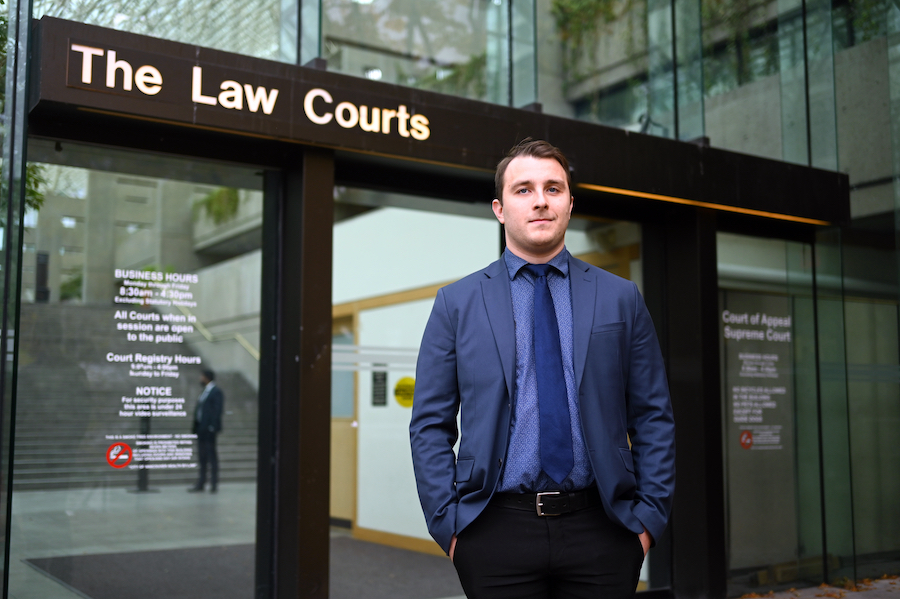
Kalicum outside the court in early November
Murray also pointed out misleading comments by politicians, such as federal Conservative Party Leader Pierre Poilievre, who called it a “disgrace” for the BC New Democratic Party to “give hundreds of thousands in tax dollars to illegal drug dealers in addition to decriminalizing hard drugs.”
“I pause to note that the VCH funding given to DULF was to support the overdose prevention site and the drug checking services,” Murray said, adding that DULF bought the compassion-club drugs “with funds they received from concerned individuals, not with the funds they received from the government.”
Murray’s comments during the trial highlight the degree to which public officials at every level were aware of DULF’s activities long before the arrests.
“The troubling thing about this prosecution is that everyone knew what was happening. It seems like these two are being hung out to dry,” she said, according to Drug Data Decoded. “As soon as politicians started complaining, all of a sudden VPD—which before was fine—suddenly was not fine.”
By the time of their arrest, the evidence of the compassion club’s efficacy had only grown.
The comments point to a route of appeal similar to the judicial review argument before the federal court—that arresting and charging Nyx and Kalicum was a political decision, rather than one rooted in sound evidence.
And by the time of their arrest, the evidence of the compassion club’s efficacy had only grown, despite Health Canada’s earlier exemption rejection.
Not only did no one overdose on DULF’s supply, but membership of the compassion club was associated with an overall likelihood of overdose that was lower by half, according to one study. That research wasn’t published until 2024, after the arrests, but DULF had already published preliminary survey data showing that to be the case.
And that finding was complemented by a slew of other benefits, including reduced interactions with police, fewer hospital visits, less exposure to violence, less reliance on the illicit market, reduced drug use and more. More of those findings were bolstered by peer review earlier in 2025.
And as evidence to support DULF mounts—alongside increasing evidence of the harms of drug enforcement and prohibition—Murray’s comments could inform an argument that the police were serving political ends as they broke the Charter’s right to life, liberty and security of the person.
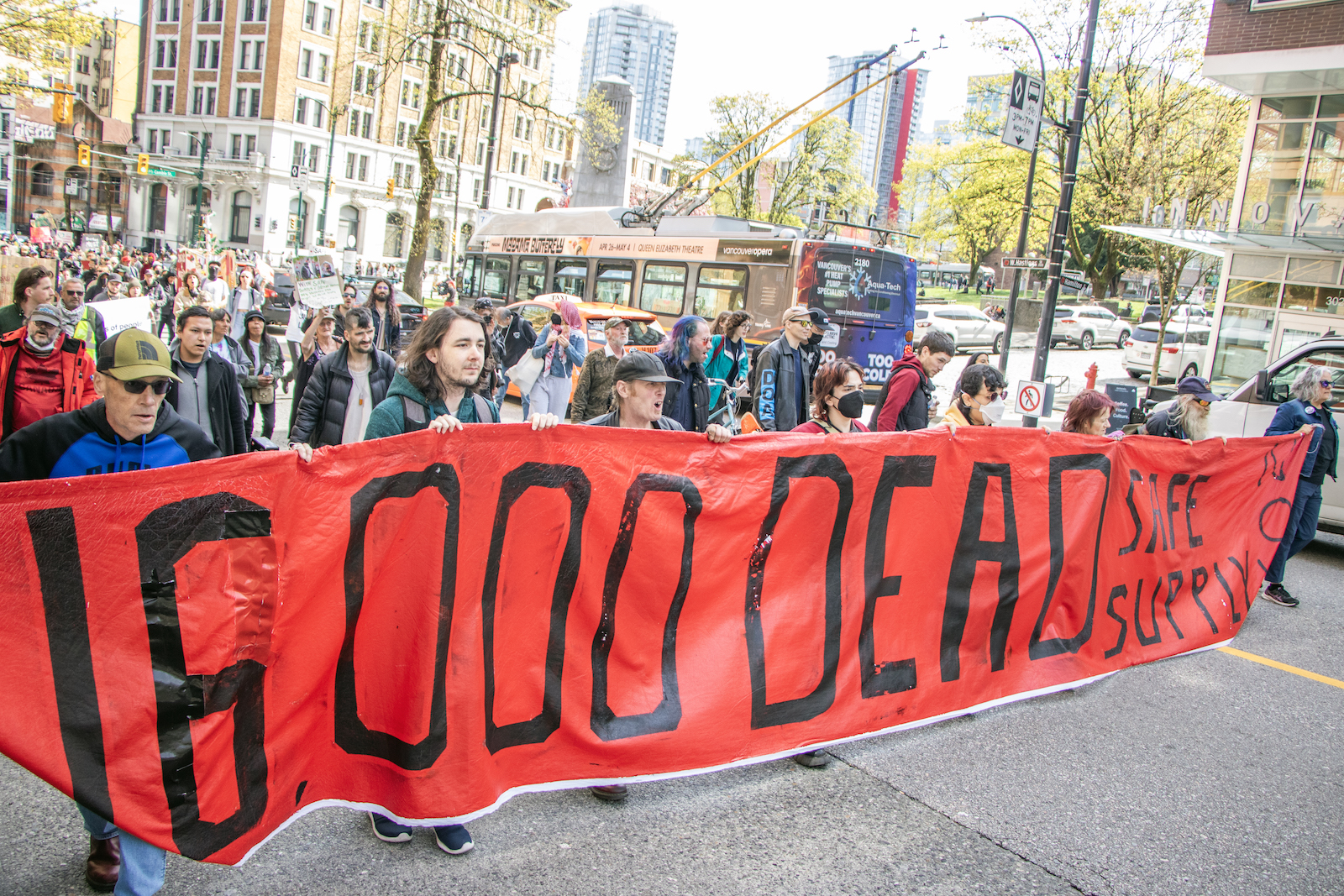
All photographs, including top photograph of April 2025 rally in Vancouver, by Dustin Godfrey