
A senior Canadian bureaucrat struggled on the witness stand to reconcile past statements by the federal government with its claim in court that it was not completely closed off to the idea of a non-medical safe supply model.
The January 26 hearing was for a constitutional challenge to the criminal convictions of Drug User Liberation Front (DULF) co-founders Eris Nyx and Jeremy Kalicum, for operating an unsanctioned Vancouver compassion club selling tested heroin, methamphetamine and cocaine to 47 members.
Eric Costen, who has held various senior roles with Health Canada, didn’t willingly attend—he had to be subpoenaed to appear.
In seeking to have the convictions quashed, DULF’s lawyers are looking to show that policy and politics meant the group had no choice but to operate a compassion club without government authorization, in order to save lives on a scale that the prescriber safe supply model could not. The government claims that there was a genuine potential pathway to authorization.
DULF’s lawyer highlighted how experts have pressed for a non-prescriber safe supply model. He contrasted this with government statements that appeared to completely dismiss the idea.
Nyx and Kalicum were found guilty of drug trafficking in November, though the judge had criticisms of law enforcement and other authorities for their role in the matter. The two launched their constitutional challenge to the convictions later that month.
DULF lawyer Tim Dickson spent much of Costen’s time on the stand highlighting how numerous experts have pressed for a non-prescriber safe supply model. He contrasted this with federal government statements that appeared to completely dismiss the idea.
Dickson’s line of questioning also contextualized the denial of DULF’s 2021 application to Health Canada to operate the compassion club—which was rejected—within a political environment that had turned against harm reduction.
For much of his testimony, Costen struggled to recall details of his work with Health Canada.
When asked about a February 2019 white paper by the British Columbia Centre on Substance Use (BCCSU) calling for compassion clubs, Costen struggled to say when he was aware of it or to supply details.
Asked if he understood that the proposed model wouldn’t involve a prescriber, he said, “Honestly, unless I took the time to read the whole paper, I don’t know if I could say with absolute confidence what I understood and didn’t understand in the moment.”
“Did you have an understanding of what’s going on in this courtroom?” the judge inquired. “Did you do anything to refresh your memory in order to testify meaningfully today?”
That drew the ire of Justice Catherine Murray. Half an hour into Costen’s testimony, she cut in to ask if he had prepared before his appearance.
“Did you have an understanding of what’s going on in this courtroom?” she inquired. “Did you do anything to refresh your memory in order to testify meaningfully today? … It just seems like there’s nothing of substance that’s been said so far.”
Murray asked if the testimony should stand down to give Costen time to prepare, but Dickson continued, asking about conversations Costen had with BCCSU Executive Director Cheyenne Johnson.
Johnson had testified the previous week that she and others had regular conversations with Costen about the issue, and that Costen provided guidance on a four-year effort to get a non-prescriber safe supply model approved.
Johnson noted a number of issues that ultimately put an end to those efforts, according to the Globe and Mail, including regulatory hurdles to accessing pharmaceutical heroin, funding and the political environment.
But Costen appeared to have little memory of his meetings with Johnson, only offering vague generalities on the topics they covered.
“You’re one of the head people dealing with the toxic drug crisis. If something just went a little bit outside your box to your neighbouring group of bureaucrats … would you just stop paying attention?”
Costen similarly cited regulatory hurdles to accessing heroin as a reason the effort failed, but when asked by Dickson about those hurdles, Costen claimed to have little understanding of the processes involved.
The regulations around approving drug production fall under the Food and Drugs Act, and Costen’s work fell under the Controlled Drugs and Substances Act. But Murray had little patience for this excuse from a senior official such as Costen, who worked as associate assistant deputy minister on controlled substances and more recently as associate deputy minister in Health Canada.
“You’re one of the head people in our country dealing with controlled substances and the toxic drug crisis,” she said. “So if something just went a little bit outside your box to your neighbouring group of bureaucrats dealing with it, would you just stop paying attention?”
Dickson came to his point about the regulatory hurdles later that morning by noting that they were created—and could be amended—by the government itself, to which Costen agreed.
The same was true, Dickson argued, for challenges with funding. Another concern was that the federal Substance Use and Addictions Program (SUAP) that funded safe supply pilots was set to sunset after five years.
“Funding not being available … that is a result of the budget priorities set by the prime minister and finance minister,” Dickson said.
But Dickson suggested to Costen that this was a manufactured deadline that the federal government could have extended—and he cited statements from then-Mental Health and Addictions Minister Ya’ara Saks in a parliamentary committee that suggested the pilots would be extended beyond their expiry date.
“Funding not being available … that is a result of the budget priorities set by the prime minister and finance minister,” Dickson said.
Pointing to numerous statements by the government—including from Costen himself—Dickson appeared to argue that while the government could have resolved those challenges for non-medical safe supply, it had no interest in doing so.
That’s despite the advocacy of a slew of experts, including the Canadian Civil Society Advancing Safe Supply Working Group, which submitted policy recommendations to Health Canada in February 2023.
Nick Boyce, a policy analyst with the Canadian Drug Policy Coalition who was part of the working group, followed up a year later after receiving no response to the recommendations—a timeline Costen agreed was “deeply, deeply unfortunate, and I don’t think it reflects well on any of us involved.”
Costen claimed that this statement didn’t mean the government was uninterested in a non-medical safe supply model. Murray again seemed skeptical.
Health Canada responded to Boyce’s follow-up email with a statement from Costen, which said the government was “not considering non-medical models to prescribed alternatives.”
Costen claimed that this statement didn’t mean the government was uninterested in a non-medical safe supply model—saying Health Canada “remains very interested in a non-medical model,” but that “we’ve yet to find a path to fully see it realized,” and that the SUAP funding was fully earmarked for other projects at the time.
Murray again seemed skeptical: “Is that what you say paragraph five says? It says, ‘While Health Canada is not considering non-medical models.’ You were actually saying, ‘We’re really interested, but there’s a lot of work to do’?”
Costen responded that was the case.
Dickson pointed to other comments by Saks in parliamentary committees, which appeared to deny that the federal government was looking into non-medical models, as Conservatives pressed her on private companies looking to capitalize on safe supply.
Saks said it was “the market’s choice” if it wanted to speculate on a legal, regulated drug supply, but “we are fully committed to a prescriber model.”
This, Dickson noted, came amid increasing political hostility to safe supply. He suggested that the government’s politics made approval of non-medical safe supply effectively impossible.
“The elected government is very interested in where the public is at when it sets its policies, and those policies do evolve,” Costen responded. “I would say in this case, the government would be guided more by evidence, and that the shape of this policy is informed by the evidence.”
DULF’s constitutional challenge is expected to run intermittently into July.
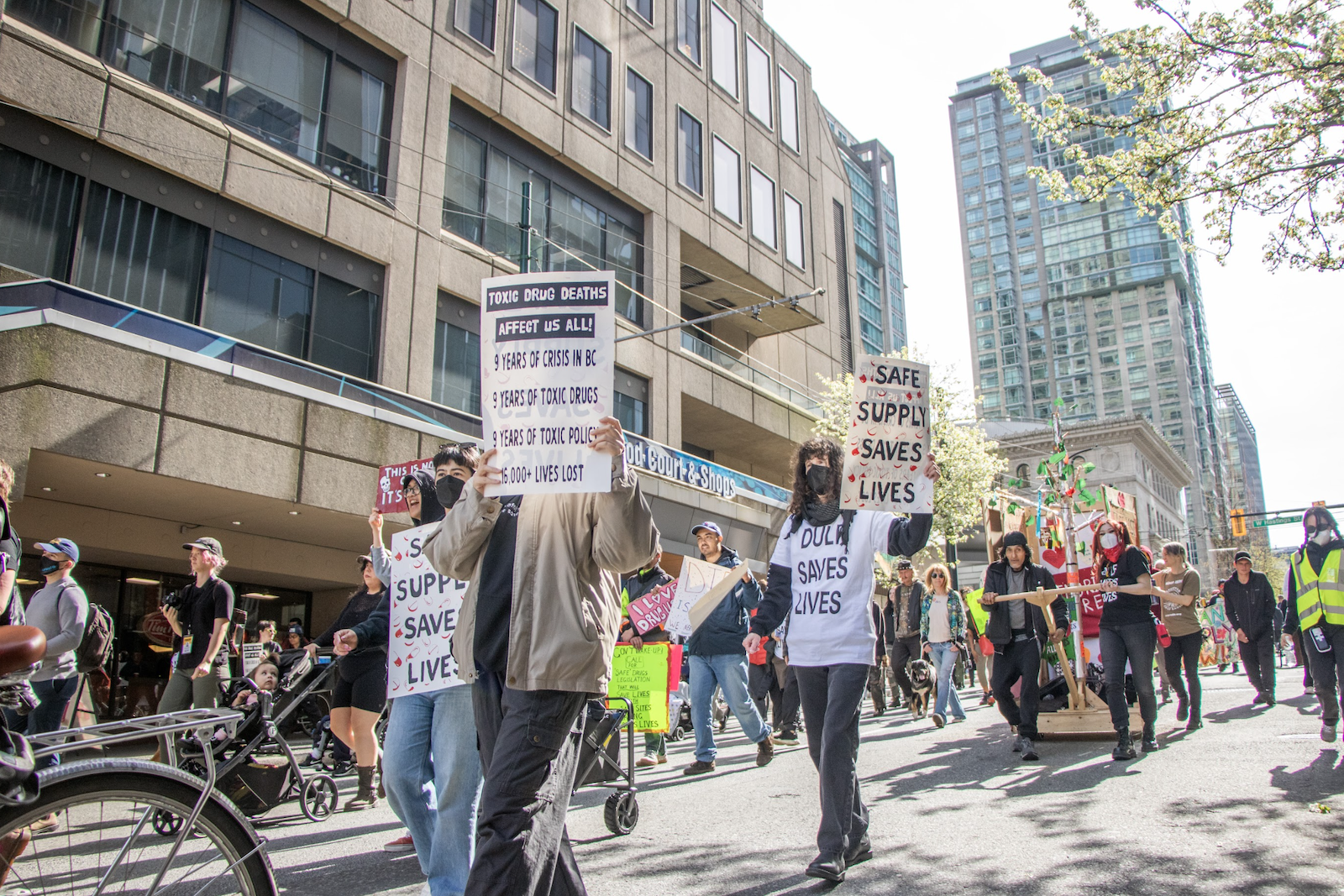
Photograph of a Vancouver rally in April 2025 by Dustin Godfrey