

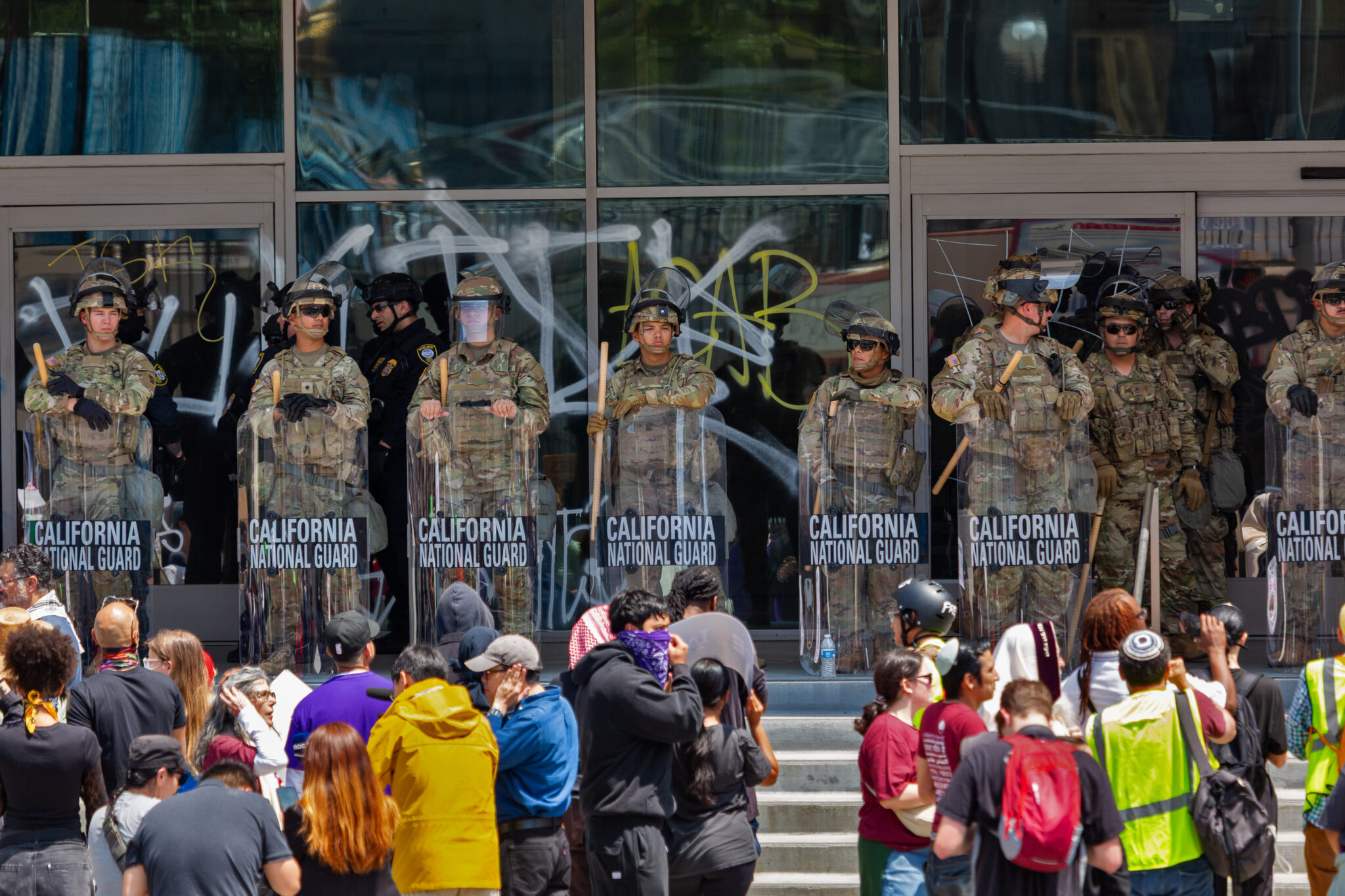
In one week, President Donald Trump’s mass immigration enforcement actions in California drove up the state’s unemployment rate almost as much as the entire first year of the Great Recession, according to a new report from the University of California, Merced. In the 49 years since the Bureau of Labor Statistics (BLS) began making data available, the only other event to have had a more dramatic impact was the COVID-19 pandemic.
The report was published by UC Merced Community and Labor Center on July 15. It appears to be the first analysis of the economic fallout of the immigration crackdowns and protests that followed.
Between May 11 and June 8, California lost 3.1 percent of its private-sector jobs, compared to 3.3 percent between December 2007 and December 2008. The researchers used data from the Current Population Survey, which is administered about once a month by the BLS and the Census Bureau.
During the week of June 8, when Immigrations and Customs Enforcement (ICE) and other federal agencies carried out anti-immigrant actions across the state, the number of undocumented workers reporting employment dropped by 193,428 (7.2 percent). For United States citizens, it dropped 271,541 (2.2 percent). Women, Latino and white workers bore the brunt of the decline.
“[T]he federal administration’s escalating immigration enforcement actions seem to have had profoundly negative consequences for California’s economy,” the researchers wrote. “[E]fforts to protect or enhance immigrant workers’ rights may require policy innovation on behalf of states, municipalities and employers.”
When the pandemic began, the unemployment rate jumped from 6.3 percent in March 2020 to 15.7 percent in April 2020. That and the Great Recession are the only events with comparable impact on California’s economy.
“In the cases of the Great Recession and the COVID-19 8 pandemic, lawmakers invested massive amounts of public resources for one-time stimulus or disaster relief spending,” the researchers wrote. “Similarly, policymakers might examine how to simultaneously protect those workers who must shelter in place during heightened immigration enforcement while infusing massive amounts of cash into the economy.”

In early June, federal immigration agents began raiding California workplaces as well as public parks. Protests were organized in response, and Trump ordered 2,000 California National Guard troops to deploy to the Los Angeles area, over the objections of Governor Gavin Newsom (D). Days later, the Trump administration deployed an additional 2,000 CalGuard and 700 Marine troops, prompting a lawsuit from the state. Newsom stressed that sending CalGuard troops to LA had left state firefighting crews at 40-percent capacity during peak fire season.
Initially this was planned to be a 60-day operation, but the Pentagon announced an early end on July 15.
“The recent workplace raids in California reveal how the state currently lacks an adequate economic safety net system for undocumented immigrant workers, and the downstream effects of escalated immigration enforcement on citizens’ employment,” the UC Merced researchers wrote. “Given the historic magnitude of the effects of recent federal actions on California’s private sector employment, state lawmakers should begin planning and developing a major economic stimulus and disaster package—for all workers.”
Trump’s “Big Beautiful Bill” allocated a historic $160 billion to immigration enforcement. ICE is now the nation’s top-funded agency, and people facing deportation are threatened with harrowing new detention compounds like ”Alligator Alcatraz.” The researchers noted that we can expect immigration enforcement to continue to escalate, in California and around the country.
Top image via WikiMedia Commons/Public Domain. Inset graphic via University of California, Merced.