

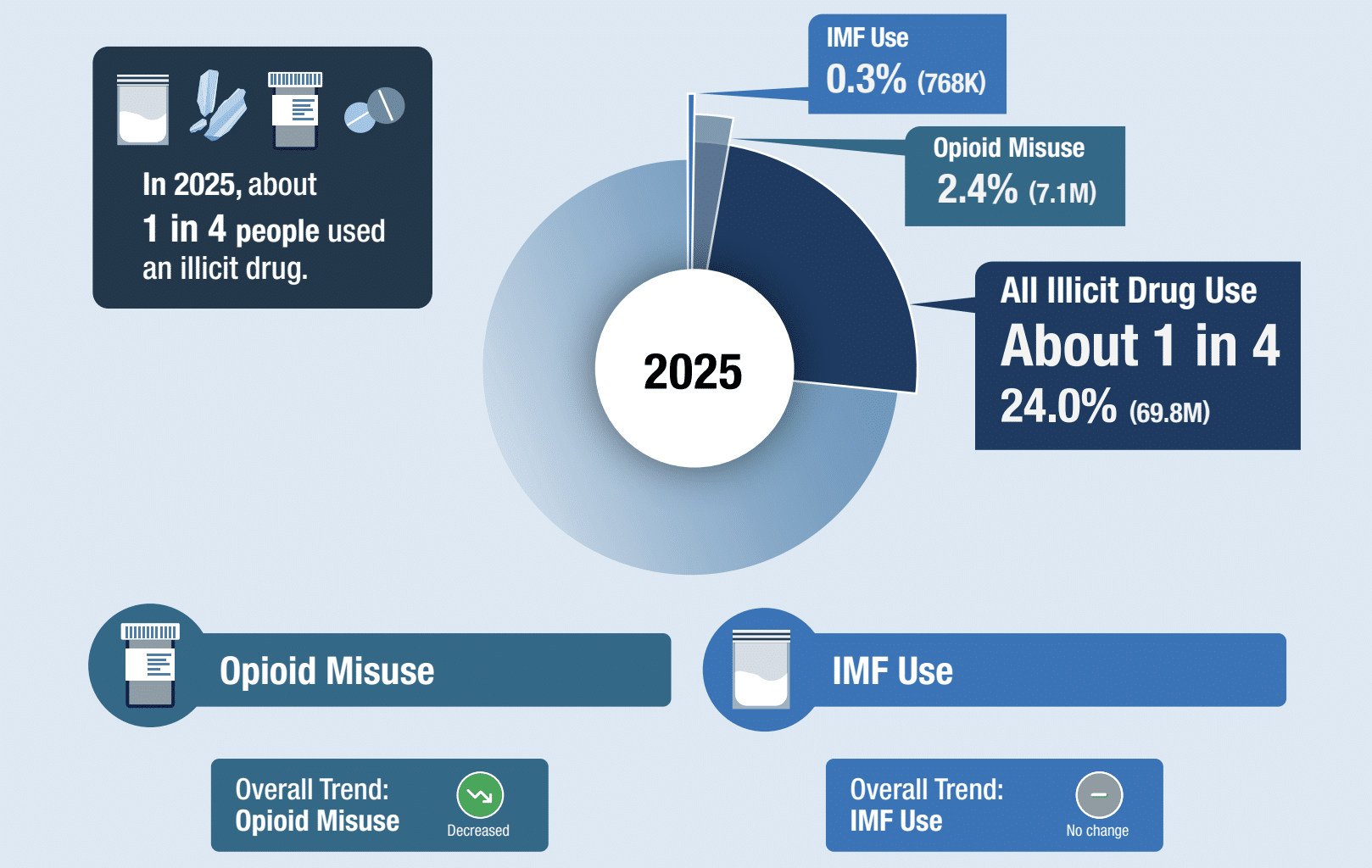
The Substance Abuse and Mental Health Services Administration (SAMHSA) has released the latest edition of its National Survey on Drug Use and Health (NSDUH), which is the source of most national statistics related to drugs, treatment and mental health. This time the annual-ish behavioral health survey is framed as a five-year trend report covering 2021 to 2025, which somewhat compounds the preexisting barriers to gleaning anything useful from it.
The survey covers mental illness, substance use, treatment and recovery for respondents ages 12 and up. The 2025 NSDUH, published in late July, reflects 60,447 completed interviews in person or online; in recent years it’s typically reached around 70,000.
Based on the 2025 respondents, SAMHSA projects that 69.8 million people—around 24 percent of the population over age 12—used at least one unregulated drug at least once within the past year. This refers to marijuana, hallucinogens, cocaine, methamphetamine, heroin, and “misused” prescription opioids, stimulants or tranquilizers/sedatives.
The 2022 NSDUH was the first to include street fentanyl. But it instituted a weirdly nonintuitive format that keeps street fentanyl siloed from the main section on opioids—effectively framing it as an afterthought while keeping the focus on prescription analgesics and heroin.
Respondents aren’t asked about street fentanyl until after they’ve completed the section covering substance use disorder, so the SUD statistics intentionally exclude that data. The same is true of opioid use disorder statistics, which are designed to include “misuse” of prescription fentanyl but nothing about street fentanyl. This format has been repeated in each subsequent NSDUH, including the 2025 edition.
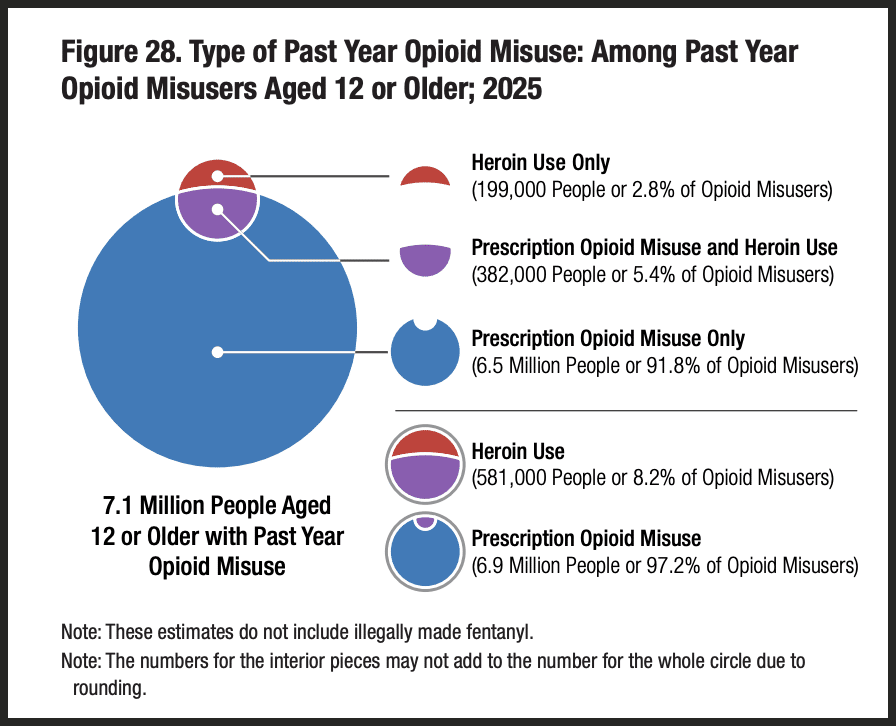
The data show that past-year use of street fentanyl averaged around 660,000 people between 2022 and 2024, then jumped to 768,000 people for 2025. This represents a change from about 0.2 percent of the population over age 12 to 0.3 percent. However, you wouldn’t know that without looking at supplementary materials or data from previous years. The 2025 NSDUH itself simply states that for each year from 2021 to 2025, and across all age demographics, there was no change in the number of people using street fentanyl.
“[Q]uestions about the use of illegally made fentanyl (IMF) have appeared after SUD questions in the NSDUH questionnaire since 2022. For this reason, overall SUD, drug use disorder, and opioid use disorder measures do not capture disorders arising solely from the use of IMF,” the report states. “As discussed in the Illegally Made Fentanyl Use section, however, the estimate of IMF use in the past year among people aged 12 or older was low in 2025 (0.3 percent or 768,000 people).”
The “Illegally Made Fentanyl Use section,” which totals four paragraphs out of the 157-page report, acknowledges that this is “almost certainly an underestimate of true IMF use.” But it discusses street fentanyl almost as a novel opioid emerging in the heroin supply, rather than the one that emerged a decade ago.
In several places, the commitment to the five-year trend framework effectively erases any conclusions one might have otherwise drawn about 2025. For example, take the following graphic illustrating past-year cocaine use:
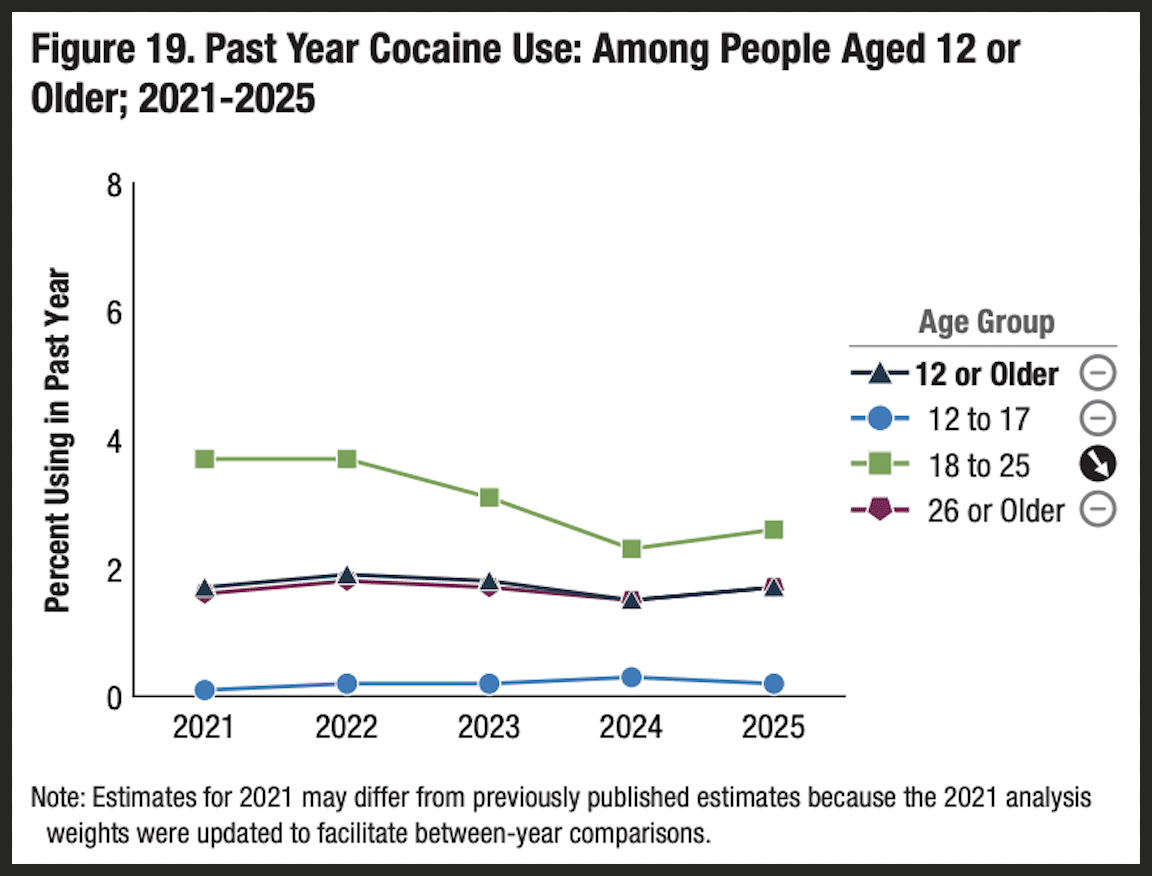
You might say it shows use among the 18-25 demographic decreasing for several years, then in 2025 going back up. SAMHSA’s characterization of the data, however, is that from 2021 to 2025 cocaine use decreased among the 18-25 demographic, and other than that there was no change.
The same thing happened in the broader section on “misuse” of central nervous system stimulants.
The NSDUH is pretty much the gold-standard citation for statistics on SUD and drugs, but the survey has always been marked by awkward data taxonomies that skew the results further away from real life than they would have been already. And by ambiguous language that makes it difficult to interpret even the more straightforward parts. After respondents “who reported ever using heroin or prescription pain relievers” were asked whether they’d been prescribed medication for opioid use disorder (MOUD), for example, and shown a comprehensive and accurate list of different formulations of methadone, buprenorphine and naltrexone, the report proceeds to state that MOUD “do not include the use of medications that are prescribed to manage withdrawal symptoms.”
The survey purports to represent the national scope of drug use and mental illness, but barely acknowledges that it isn’t offered to the populations most impacted by those things. It isn’t offered to people living outside or in their cars, for example, or in jail or prison.
The 2025 NSDUH does include data on whether people received treatment while in prison, jail or juvenile detention, though it doesn’t say what kind.
Top and inset images (cropped) via Substance Abuse and Mental Health Services Administration