
On January 19, Senator Tim Kaine (D-Va) vowed to pass a war powers resolution curbing the Trump administration’s military actions in Venezuela. One such measure narrowly failed to pass the Senate on January 14, after Vice President JD Vance’s vote broke a 50-50 tie. Kaine, who sponsored it along with Sen. Rand Paul (R-Ky), promised to remain resolute. We’re going to be filing a whole lot more war powers resolutions,” he said.
But Kaine’s efforts seem unlikely to do much to rein in an administration that’s bent on pursuing its goals regardless of legal constraints. Emerging details about United States attacks continue to underline this reality.
The military aircraft used in the very first boat strike near Venezuela in September was disguised as a civilian plane, the New York Times reported on January 12. Experts say that’s a war crime. The same would apply to previous reports that the plane fired a second time, killing two survivors who were clinging to the wreckage.
Then there are the civilian casualties inflicted by the January 3 operation to kidnap then-President Nicolás Maduro, who has since appeared in US court charged with “narcoterrorism.” An independent watchdog group tried to submit a report on the casualties to SOUTHCOM, which oversees US military actions in the region, only to learn it had no mechanism to accept the numbers, as the Intercept reported—an issue likely linked to “Secretary of War” Pete Hegseth’s efforts to gut military infrastructure tied to reducing civilian casualties.
“At the highest level the Trump administration has used drugs as an excuse to justify these foreign policy actions … Drugs really are a cover.”
Since “Operation Southern Spear” began in September, at least 123 people are believed to have been killed by at least 35 boat strikes, without any evidence being produced that the victims were trafficking drugs as the administration claims.
Experts have insisted all along that this was never about drugs or related harms in the US. There is no evidence that Venezuela produces fentanyl, which has been involved in the largest number of US deaths. While the country does produce some cocaine, it’s mostly been a transit hub for that drug—with Europe, not the US, the primary destination.
“At the highest level the Trump administration has used drugs as an excuse to justify these foreign policy actions,” Theshia Naidoo, legal director of criminal justice with the Drug Policy Alliance, told Filter. “The unauthorized strikes … have nothing to do with addressing the overdose crisis. Drugs really are a cover.”
The administration’s differing attitudes to regional figures back this up. While Maduro faces drug charges, AP revealed on January 17 that his Trump-approved successor, Delcy Rodriguez —“She’s a terrific person,” the US president gushed—had for years been tracked by the Drug Enforcement Administration, which in 2022 labeled her a “priority target.” In December, Trump also pardoned Juan Orlando Hernández, the former president of Honduras, who was serving a 40-year-sentence for drug trafficking.
“Narcoterrorism is a made-up term. Terrorism groups are driven by political motives, drug cartels by profit motive,” Naidoo said. “At the same time you’ve got cuts to Medicaid [and] state grants that help people with substance use problems.”
“I guess we only care about addiction when we’re bombing people,” Sanho Tree, a fellow at the Institute for Policy Studies think tank and director of its Drug Policy Project, told Filter regarding the massive cuts to US harm reduction and treatment services.
“He couldn’t resist. Had to say the quiet part out loud: ‘We’re here to steal oil.”
The administration is sticking to its drug story. Sort of. A January 9 executive order paid lip service to Trump’s initial justification, claiming that military action against Maduro was about “ending the dangerous influx of illegal immigrants and the flood of illicit narcotics.” But the headline—“SAFEGUARDING VENEZUELAN OIL REVENUE FOR THE GOOD OF THE AMERICAN AND VENEZUELAN PEOPLE”—spoke louder.
Trump mentioned the country’s oil no fewer than 23 times at a press conference on the day of Maduro’s capture, notes a report from the Institute for Policy Studies, and admitted to speaking with US oil executives prior to the operation.
Tree said the administration’s actions have instigated a regional nightmare that will impact the US—and not in the way of wildly affordable oil. Venezuela’s oil is very difficult to refine, he said—the texture “of peanut butter or honey.”
Oil executives have also voiced concerns about investing in a country with a tumultuous political future. “If we look at the commercial constructs and frameworks in place today in Venezuela, today it’s uninvestable,” said Darren Woods, the CEO of ExxonMobil, after a meeting with Trump.
“I didn’t like Exxon’s response,” Trump told reporters on Air Force One on January 11. “They’re playing too cute.”
Tree pointed out that the US could have grabbed Maduro without mentioning the oil. “But he couldn’t resist. Had to say the quiet part out loud: ‘We’re here to steal oil.”
“Stephen Miller’s worst nightmare.”
That naked motive, Tree observed, is far more likely to inspire an insurgency and fuel instability than the ouster of an unpopular dictator. “And what oil executive or staffer is going to risk getting kidnapped?” he wondered. “Plus oil equipment is really easy to blow up.”
Cuba’s already-shattered economy relies on Venezuelan oil. The toppling of its Communist-Party regime is an obsession for Secretary of State Marco Rubio, as the Institute for Policy Studies noted. The ensuing chaos would probably lead to a new flood of refugees.
“Marco Rubio’s wet dream, Stephen Miller’s worst nightmare,” Tree quipped of the far-right, anti-immigrant homeland security advisor, noting that unlike departing Venezuelans, Cubans are a short boat ride away from US shores.
“It’s the ‘Crate & Barrel rule,’” Tree said of the administration’s actions in the region. “If you break it, you own it.”
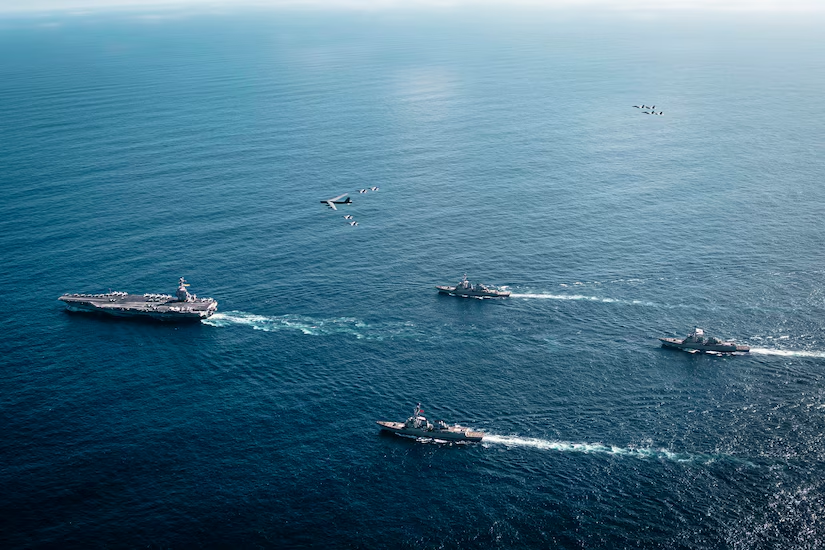
Photograph via United States Department of Justice/War
The Influence Foundation, which operates Filter, previously received a restricted grant from the Drug Policy Alliance. Filter‘s Editorial Independence Policy applies.