
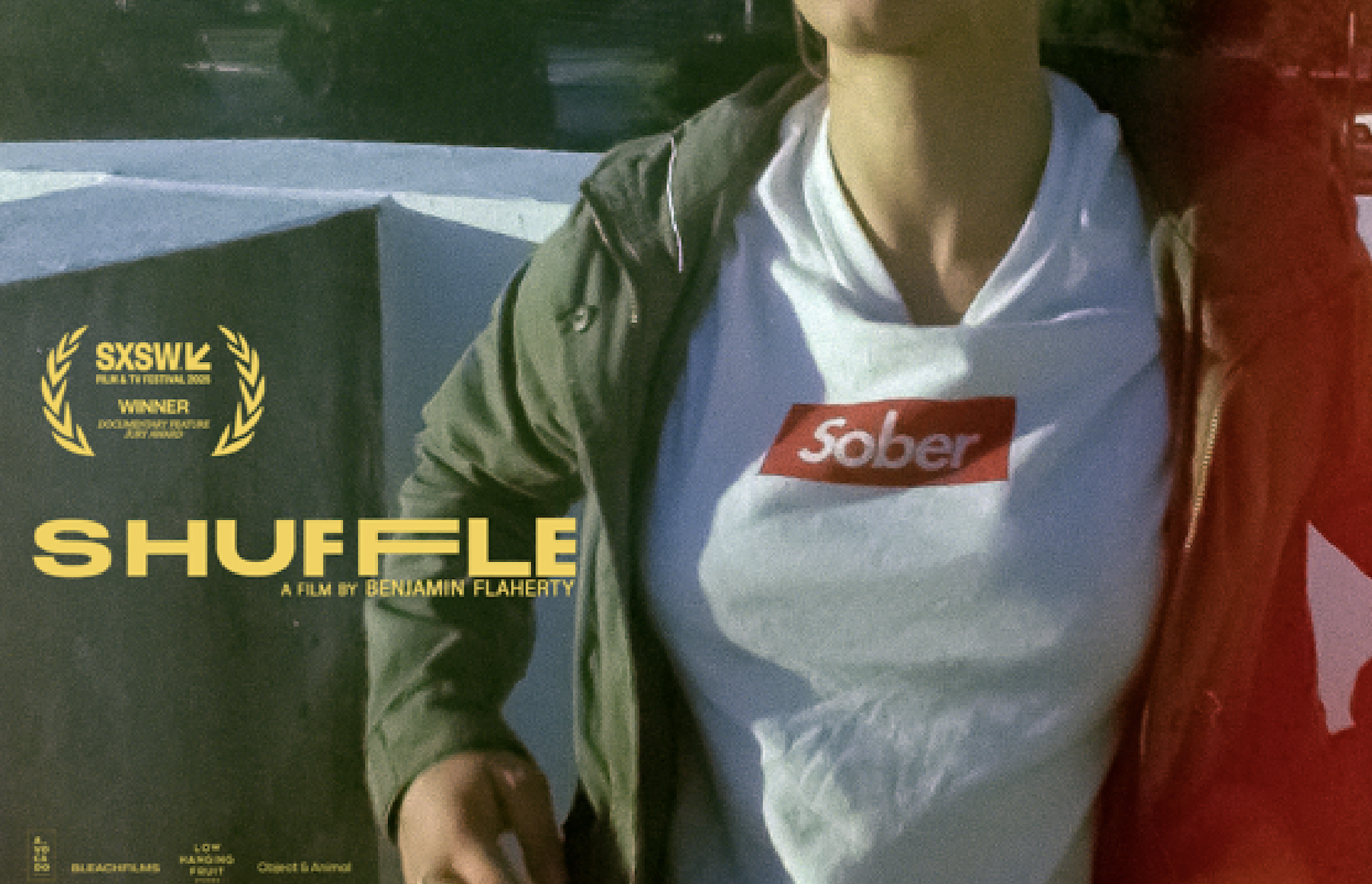
Shuffle is that rare documentary about drug use and rehab that doesn’t offer a pastel, happily-ever-after ending and doesn’t engage in drug porn—something its director, Benjamin Flaherty, calls a “conscious decision.” Through meticulous investigations and interviews, the film illustrates how the unregulated sober home industry is a dangerous scam that views people with addiction as lucrative and ultimately disposable commodities.
The documentary is narrated by Flaherty, who identifies as in recovery from alcohol addiction and attends AA meetings. He captures on film what the writer Shoshana Walter revealed in her shocking book, Rehab: An American Scandal. Sober homes create an ecosystem of extraction that profits off of vulnerable human beings and if some of them die, that’s just the cost of doing business.
Flaherty profiles three people ensnared in the infamous “Florida shuffle.” Corey, Daniel and Nicole cycle through a series of harrowing events for which they’ve been set up. Nicole—by turns funny, sarcastic, angry and desperately looking for purpose—has been in 36 different sober homes. In a powerful scene, she tells Flaherty how she wrote in a notebook the names of hundreds of people she’s known who overdosed and died. She starts reading them out.
AJ is a conflicted “body broker” whose livelihood depends on convincing people with “good insurance” to go into rehab. He has to meet a quota, and he passes on cash kickbacks.
Cory has become a full-time patient, and we watch as he criss-crosses the country by plane on his way to yet another “destination rehab.” Daniel, a quiet and sensitive young man, gets lost in the shuffle. He’s from rural Kentucky but ends up in a sober home in California. Daniel’s not used to being around a lot of people and the fast pace of urban life.
To understand how the system works, Flaherty interviews AJ, a conflicted “body broker” whose livelihood depends on convincing people with “good insurance” to go into rehab. He has to meet a quota, and he passes on cash kickbacks from facilities to those who enroll to seal the deal. He recruits patients on social media.
Flaherty also interviews Lauren, an insurance claims analyst who discovers massive “urine fraud.” Urine testing, often conducted daily, is a lucrative revenue stream for the owners of sober homes and rehabs.
A smoking gun in Shuffle concerns A. Thomas McLellan, who served as deputy director of the Office of National Drug Control Policy in the Obama administration. McLellan wrote the requirement in the Affordable Care Act for mental health and substance use disorder services to be considered “essential,” with no limits on coverage. These services are essential. The problem is, some greedy investors used the no-coverage-caps to commit fraud and get rich.
Enter McLellan’s son, Andrew. He was part owner and a board member of Liberation Way, a former treatment program in Pennsylvania. A lawsuit accused both men of “earning” millions of dollars from what was called a “criminal, sham” rehab. While the McLellans weren’t criminally charged, the former CEO of Liberation Way was sentenced to three years in federal prison over an illegal patient brokering scheme. Andrew walked away with $5 million.
Despite one big problem, the film shines much-needed light on an inhumane, profit-driven industry.
My one serious criticism of Shuffle is the way it portrays Suboxone (buprenorphine)—something I put to Flaherty in our interview. In part because of McLellan Senior’s association with the medication, through his ties to Indivior and Groups Recover Together, the documentary often makes it seem that it’s just another money-making scam, or another drug to “abuse.”
A newspaper headline flashes on the screen: “Are Suboxone clinics the new pill mills?” Daniel took buprenorphine and his mother wonders why a treatment program would put someone on “an addictive medication.” At the end we learn that Cory, who was on Suboxone for 15 years, has stopped taking it.
Flaherty does include a title card correctly stating that Suboxone is effective and is used safely by many, but it doesn’t balance out all the misleading negativity. Because of massive stigma against medications for opioid use disorder, buprenorphine is underprescribed—and many rehabs and sober homes either don’t allow people to be on it or force them to taper off. There are not enough prescribers, which leaves thousands of people without access to an evidence-based, lifesaving medication.
Despite this big problem, the film shines much-needed light on an inhumane, profit-driven industry. Shuffle premiered in 2025, and is currently screening at venues around the country. Filter’s interview with Benjamin Flaherty has been edited for length and clarity.
Helen Redmond: Could you explain how sober homes make profit? I think it’s confusing by design.
Benjamin Flaherty: It’s one of the things that confused me the most. In South Florida, there were these people, “body brokers,” who were recruiting struggling “addicts” off the streets and then bringing them back to sober homes.
The people that they picked up had good insurance. The owner of that sober home would say, “Okay, you’re going to go to this outpatient treatment center while you live here.” And that sober homeowner is going to get a kickback from the treatment center for sending the person there. I didn’t quite understand that at first, because when I heard this, I was living in a sober home and insurance doesn’t have anything to do with a sober home, those are all cash-pay.
The kickbacks are what this scam all revolves around. The reimbursements for treatment are very lucrative for them. There’s going to be drug tests at the sober home. Those are done through a lab, and that lab will give a kickback. So now a sober home owner is getting kickbacks from the urine test because it’s a billable service. Anything you’re prescribed is a billable service and they really want to exploit that. The owner is getting all these kickbacks and getting rent for the apartment. Now here’s what he’ll do to sweeten the deal. He won’t charge rent and say, you can live here for free because I’m making so much money off the kickbacks.
“Before Corey got any real treatment, he was already being sent out to AA meetings and other treatment centers to recruit people.”
HR: What is “body brokering”?
BF: These guys are called body brokers, brokers or marketers. They are middlemen who are often in recovery themselves. They can speak the language and they serve as middlemen for treatment centers. They want people who have good insurance and they look for them online, like on Facebook, and they offer help. It all looks potentially legitimate to some degree. And that’s the scary part about it, especially when you’re vulnerable. It’s like someone’s offering you help and you assume that that’s well intended. So they bring in an insured, struggling person to a treatment center or to a sober home and that broker might make $3,000. That’s how they make money.
HR: Talk about the hustle culture, because I think it’s related to body brokering?
BF: Corey shows the hustle culture pretty well. He called a one 800 number looking for treatment and was flown to a treatment center. And once he got there, I’m pretty sure they understood that Corey can speak the language, he’s been around the block. He knows how to work the streets and a lot of these places will recruit from within.
And so before Corey got any real treatment, he was already being sent out to AA meetings and other treatment centers to recruit people. And I think that’s another danger of this. It’s a system that can take advantage of people who are vulnerable. It’s a system that allows people to continue to hustle, which is a big part of the life of people who struggle with addiction. I say that as one of them. I had to hustle to get what I needed every day. There’s a lot of chaos and being drawn to chaos. And I think that when you allow that hustle, that chaos to continue, you’re putting a roadblock to recovery in place.
“AJ verified a lot of what I had assumed was happening, like the scale of it. He’s like, ‘You have no idea.'”
HR: How did making this documentary affect you as a person in recovery? At one point you say that you had to put the camera down for a year.
BF: That was due to a lot of things. It affected me differently than I expected that it would. I wasn’t necessarily concerned about my sobriety in the sense of going back to drinking, or using a substance. And I think maybe part of that was because what I was dealing with was not my substance of choice. Watching people stay sick is really hard, watching people struggle, being present for it, you know, sort of bearing witness to it. That’s tough. And, you know, I want to help those people, but at the same time, I’m well aware that that’s not why I was there. And I think I also naively thought maybe the camera would protect me, like because I was looking through a lens I was removed. But that wasn’t true. I went to a lot of meetings while I was on the road shooting.
HR: You had an intense relationship with AJ, and he plays an important role in helping you understand how sober homes work. In the documentary his face and voice are disguised and he ended up working as an informant for the FBI. That was scary!
BF: Our first contact was a phone call. He’s a body broker and he tries to make amends for that. He started as a person who went through recovery and he was speaking at AA meetings and in high schools. He’s a great speaker, and someone saw him and recruited him as a broker. At first, he thought he was helping people get into treatment in a legitimate way. Then he quickly found out it was a scam.
We ended up meeting in public a few weeks later and I didn’t know what this dude was gonna do to me. We chose a street corner in the Boston Commons to meet. and we sat on a brownstone stoop for two hours and he just told me everything. AJ verified a lot of what I had assumed was happening, like the scale of it. He’s like, “You have no idea.”
“I am not advocating for abstinence as the only way. I think medication has been of tremendous use. I think it also has the potential for misuse and manipulation in treatment, because I’ve seen it.”
HR: I thought that Shuffle came down against the use of medication for opioid use disorder. And I think that because of the way people in the film talk about Suboxone—that it’s trading on addiction for another, and if you do take it, you need to get off it at some point. In a way the documentary was saying abstinence is the best way to get “clean.” So I’m wondering how you explain that?
BF: I hear that, and we’ve heard some feedback related to that before. I think the first couple of things I would say is, the film is pretty exclusively based on the experience that I had. It was my experience of this situation and a very specific context. So I didn’t go into this trying to explore harm reduction or Suboxone or medically assisted treatment in any way. In fact, I knew very, very little about any of that. So what is expressed in the film is narrow and through the lens of the experience that I had. So I am not advocating for abstinence as the only way. I found that works for me but I don’t think that that’s the only way. I think medication-assisted treatment has been of tremendous use.
I think it also has the potential for misuse and manipulation when used in treatment, because I’ve seen it. Like with Daniel. He was prescribed Suboxone when he had 90 days clean. He didn’t need the medication. They put him back on Suboxone and then withheld it from him so he would get sick and then relapse. It’s another revenue stream.
I think Suboxone is a tool, and I support the ethical prescribing of any of these medications. We mention Corey at the end of the film. He wanted to get off Suboxone. Corey was someone who didn’t want to have a need for any substance and I think that some people who struggle with addiction feel that way. I know I do.
“When I heard the story of sober homes I was enraged, and I want the documentary to enrage people.”
HR: What are you hoping that the documentary can do? You’ve talked about Shuffle helping to make changes in the drug treatment system.
BF: I want to make a ton of noise. That’s what I want to do. I’m pissed off. When I heard the story of sober homes I was enraged, and I want the documentary to enrage people. We’re trying to get Shuffle into the hands of all state legislators. In Kentucky, we’ve been working with a state rep there. We’ve gotten it into the hands of people at Gavin Newsome’s office in California. We’re trying to create a conversation across specialties.
The team I work with have put a ton of time and effort into our impact campaign. We want to provide information to folks to help them find safe drug treatment. You can go to our website, Stop The Shuffle. There’s a resources link with questions, some things to keep in mind if you’re looking for help.
We have a financial ecosystem hiding behind what we’re calling treatment and recovery and that needs to be addressed, because the current situation creates a lot of wealth and not a lot of recovery.
Top image courtesy of Shuffle