

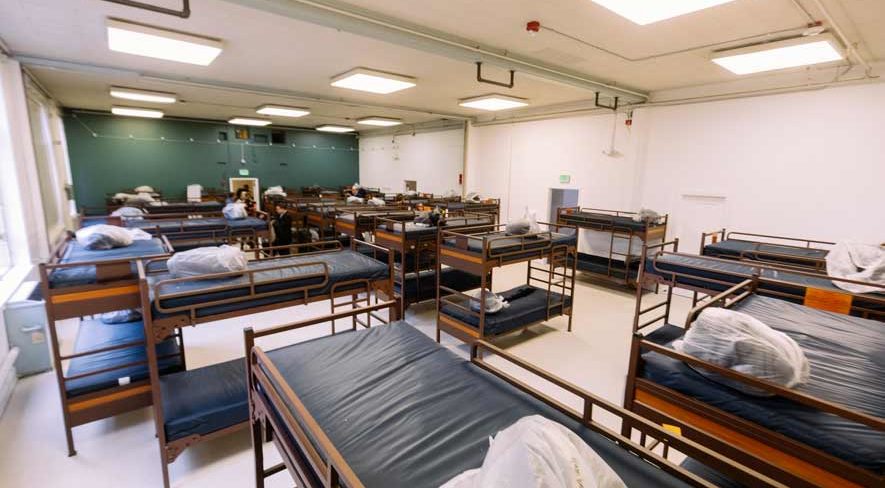
A plan from Mayor Keith Wilson (D) of Portland, Oregon, to build new shelter beds for people experiencing homelessness has drawn fierce backlash from some city residents. Service providers are meanwhile arguing that it does too little to get people into permanent housing, and that treatment provision remains inadequate.
A July 28 public meeting turned hostile, according to a report by Oregon Public Broadcasting (OPB). As Mayor Wilson presented his plan for a new shelter in the city’s Pearl District, to open later this summer, some people in the crowd booed and jeered.
“Lies!” one member of the crowd reportedly shouted, when Wilson noted data showing a fall in crime near city shelters. “How many shelters are going to be near the mayor’s house?”
During his campaign before taking office in January, Wilson promised to build 1,500 new shelter beds. The Pearl District location is slated to be the fifth new shelter opened since then, including two others set to launch in early August. Situated at NW 15th Avenue and NW Northrup Street, it would operate as a night-only shelter, with space for 200 people. It would bring the total of new beds in 2025 up to 630.
“The plan for this shelter is reasonable. We have operated a very similar shelter since 1998. The operation he’s proposing is no different than any other low-barrier shelter in the city.”
Lance Orton is the executive director of CityTeam Portland, an existing shelter provider. He himself was formerly unhoused, and accessed the CityTeam shelter in 2018, before spending a year in residential recovery for opioid use disorder.
Orton, who attended the July 28 meeting, somewhat disputed its characterization in the OPB report, saying the mayor received a mixed reception, including some clapping and support.
“The plan for this shelter is reasonable,” he told Filter, though he has some sympathy for the concerns of residents in the wealthier Pearl District. “We have operated a very similar shelter since 1998 … The operation he’s proposing is no different than any other low-barrier shelter in the city.”
“As an operator, I can tell you it has more safety precautions than we do,” Orton said of the proposed facility, “and we have almost zero problems around us. We have one of the cleanest blocks in our neighborhood, and great relationships with the hotel and restaurant across the street and apartment building next door.”
Shortly after taking office, Wilson met with over 50 local service providers to discuss his plan to end homelessness. He proposed a $28 million package to rapidly expand the system of night shelters to get people off of the streets, as well as day centers and places where people can store their belongings. People would be restricted to no more than 90 days at any 24/7 shelter, and they must remain working with a case manager to find housing or work.
A spokesperson clarified that Wilson believes in arrests only “as a strategy of last resort.”
Wilson’s plan conspicuously lacks money for permanent housing. Yet the expansion of shelter beds is set to be only temporary. Wilson proposes to fund the 1,500 new beds only from December 2025-March 2026, funding just half that amount until June 2027. His plan details a “flex up/flex down” strategy, meaning that after an initial surge, shelter capacity (and city funding) will be decreased with the assumption that fewer people will need it. Noting that 24-hour shelters are expensive, the plan states that the priority should be to “Rapidly stand up a network of nighttime emergency shelters so every unsheltered Portlander can find a safe bed.”
Meanwhile, Portland police will begin enforcing an outdoor camping ban, which city officials approved in May 2024. Anyone sleeping outside and stopped by police who refuses shelter could be charged a fine of $100, or arrested sent to jail for seven days. The city law further prohibits certain activities like using a propane tank or fire, digging, selling bicycle and car parts, or blocking private property.
The mayor’s plan states, “The plan doesn’t require any new laws or ordinances. Existing laws are sufficient. The police should enforce them.” Wilson gave apparently conflicting statements on the camping ban while campaigning, saying, “We cannot arrest our way out of our homelessness crisis, and I do not support jailing individuals for simply refusing shelter”—but also that, “The threat of arrest or actual arrest is an important piece to ensure the community understands our codes are meaningful.”
A spokesperson clarified to OregonLive that Wilson believes in arrests only “as a strategy of last resort.”
It’s a microcosm of battles taking place around the country, which will only be escalated in the wake of President Donald Trump’s July 24 executive order to encourage forced treatment and the criminalization of homelessness.
Orton expressed hope that the mayor’s plan to ramp up immediate shelter capacity will work without excessive enforcement, citing his own experiences.
“As a shelter operator, I’ve seen Portland police drop off in the middle of the night, a guy who was intoxicated and homeless …” he said. “They knocked on the door while I happened to be doing the graveyard shift, and said, ‘Hey can this guy stay in your shelter instead of me taking him to jail?’”
According to OPB, Commander Brian Hughes of Portland Police Bureaus’s Central Precinct told the July 28 meeting that officers would patrol near the Pearl District shelter but that, “my goal and my hope is that we have no involvement at all.”
“We absolutely need to open up more treatment beds and residential facilities, particularly for mental health issues. I think the county will need to invest a lot of money for where we need to be.”
Homelessness is a severe issue in Portland and Multnomah County. A count released by county officials shows that 15,563 people were unhoused in May 2025—of whom nearly half, 7,318 people, were unsheltered. Since 11,000 people were counted in January 2024, the data show, homelessness has increased steadily. Nearly half of the people affected are aged 25-44 (47 percent), while 54 percent are white, 19 percent Black and 15 percent Latino.
Looking beyond immediate shelter, Orton is especially concerned about a lack of capacity to treat substance use disorders and mental health conditions. This has been a serious problem for years in Oregon, which in part led to the passage of the Measure 110 ballot initiative in 2020.
Measure 110 decriminalized low-level drug possession—an element that was repealed in 2024. But it also provides greater funding for harm reduction, and homelessness and other social services.
Yet a study released in December 2023 showed how statewide, people with co-occurring mental health and substance issues continue to face major barriers to getting treatment. As most providers are unable to treat both issues simultaneously, treatment for people with the most severe needs is often found only in hospitals or residential clinics. Many providers won’t accept Medicare or Medicaid coverage.
“We absolutely need to open up more treatment beds and residential facilities, particularly for mental health issues,” Orton said. “We’re expanding our beds from 64 to 110 in October. The area that really needs addressing is mental health—we don’t have enough hospitals for people that cannot navigate a recovery or residential program because the acuity of their mental illness is so severe. We have no place to put individuals … I think the county will need to invest a lot of money for where we need to be with mental health beds.”
Otherwise, he said, the place people with these needs are most likely to be sent is jail.
Photograph via King County, Washington