
Pennsylvania’s governor is increasing pressure on lawmakers to send him a bill to legalize marijuana in the state, saying that doing so would generate new revenue that could be invested in key programs.
“While some in Harrisburg claim we can’t afford to make bigger investments in our kids, public safety, and our economy, know this: If we legalized and regulated adult-use cannabis, we’d bring in $1.3 BILLION in revenue for our Commonwealth over the first five years,” Gov. Josh Shapiro (D) said in a social media post on April 7.
“Those are dollars that can be invested back into our people and our communities,” he said. “Stop with the excuses. Let’s get this done.”
The Democratic-led House in 2025 passed a bill to legalize marijuana, but the Republican Senate majority has criticized that plan while not advancing a model of its own.
Earlier in 2026, the governor again included marijuana legalization in his budget request to lawmakers, but so far the legislature has not enacted the reform.
The Democratic-led House of Representatives in 2025 passed a bill to legalize marijuana and put sales in state-owned dispensaries, but the Republican Senate majority has criticized that plan while also not advancing a cannabis legalization model of its own.
The state’s Independent Fiscal Office (IFO) reported in February that legalizing cannabis in Pennsylvania would generate nearly half a billion dollars in annual revenue by 2028, an estimate that is a significantly larger cash windfall compared to projections from Shapiro’s own office.
With a proposed 20 percent wholesale cannabis excise tax, 6 percent state sales tax for retail and licensing fees, IFO said the governor’s legalization plan would generate $140 million in tax revenue in the first year of implementation from 2027-2028 and increase to $432 million by 2030-2031.
In February, a coalition of drug policy and civil liberties organizations urged Shapiro to play a leadership role to get the job done.
That’s a much higher revenue estimate than what the governor’s office put forward in the latest executive budget. According to his office’s analysis, legalization would generate about $36.9 million in tax dollars in its first year from a 20 percent wholesale tax on marijuana—rising gradually to $223.8 million by 2030-2031.
Meanwhile, a recent Quinnipiac University Poll found that a majority of Pennsylvania voters say they’re ready for the state to legalize adult-use marijuana.
In February, a coalition of drug policy and civil liberties organizations urged Shapiro to play a leadership role in convening legislative leaders to get the job done on cannabis legalization this session.
In March, the Senate Law and Justice Committee amended and approved a bill to create a Cannabis Control Board to oversee the state’s medical marijuana program and intoxicating hemp products, which could eventually regulate adult-use cannabis if it is legalized in the state.
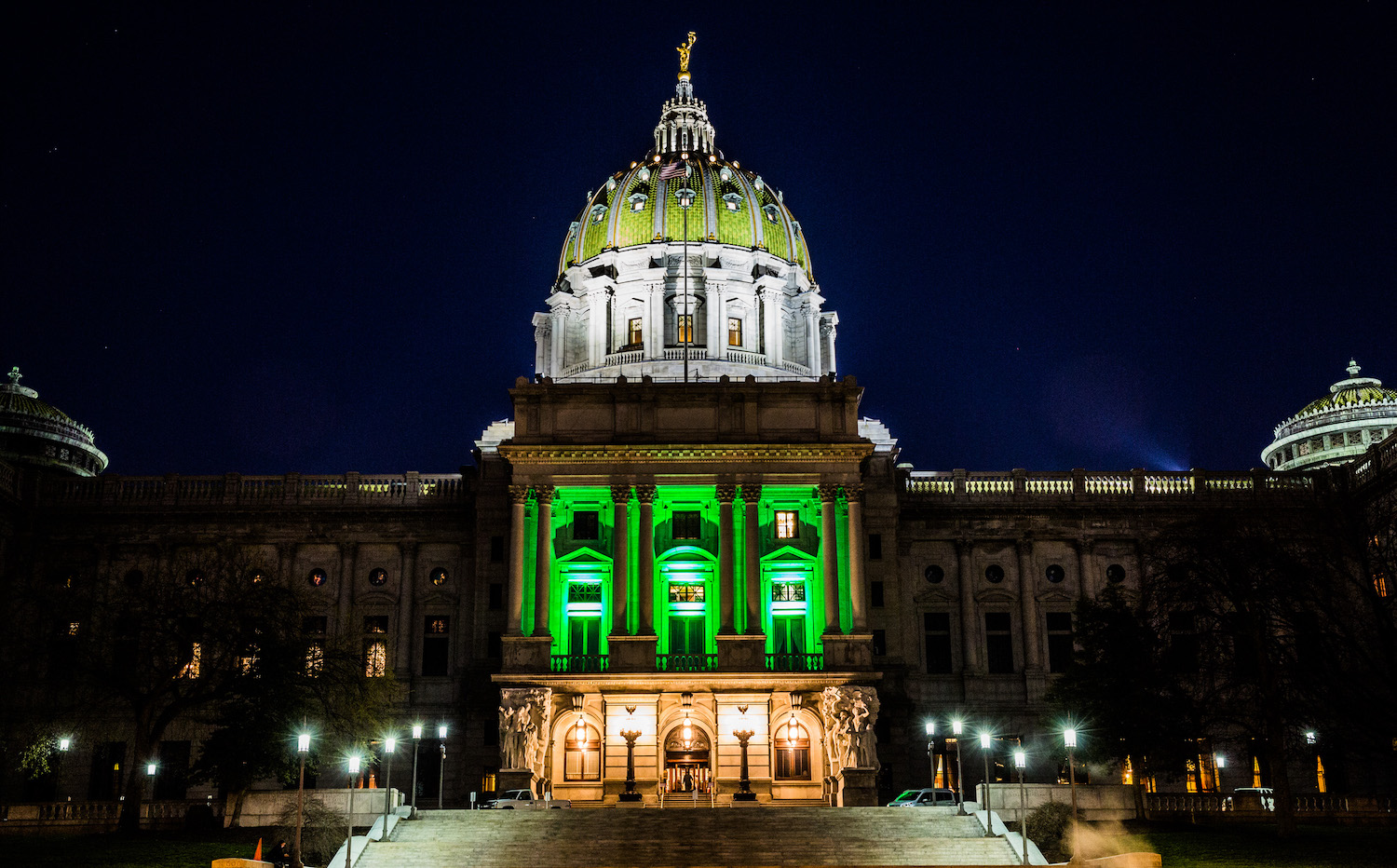
Photograph of Pennsylvania State Capitol, lit up to celebrate the passage of medical marijuana leglislation in 2016, via Governor Tom Wolf/Wikimedia Commons/Creative Commons 2.0
This story was originally published by Marijuana Moment, which tracks the politics and policy of cannabis and drugs. Follow Marijuana Moment on X and Facebook, and sign up for its newsletter.