

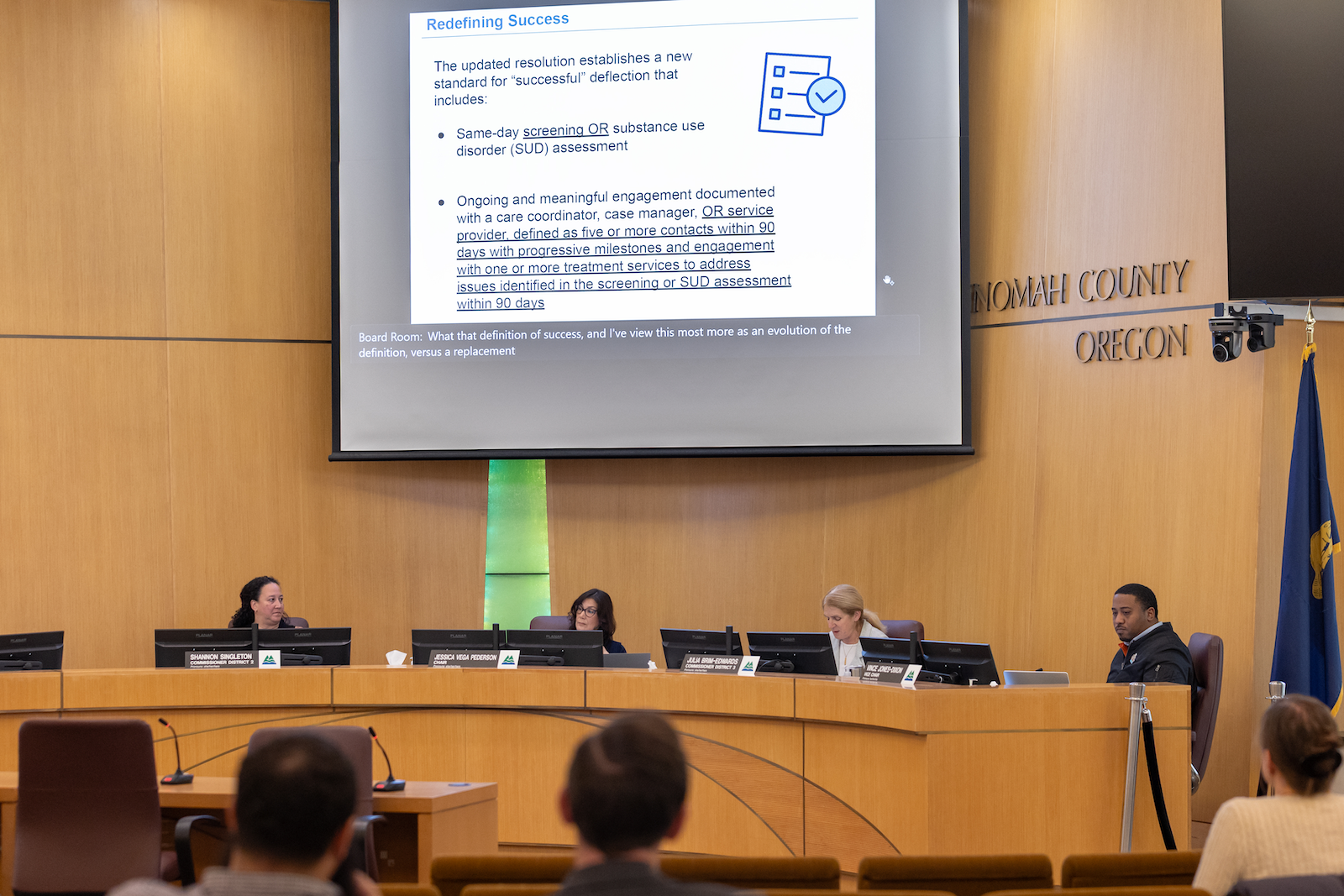
It’s been 18 months since the rollback of Measure 110, Oregon’s landmark bill decriminalizing the possession of small amounts of controlled substances. In its place, a hodgepodge of county-level diversion and deflection programs operate under HB 4002, which recriminalized possession as a misdemeanor punishable by up to six months in jail.
HB 4002 allocated funding for counties to create jail-deflection programs, and encouraged law enforcement to make referrals to such programs as an alternative to arrest. They currently operate in 27 of the state’s 36 counties.
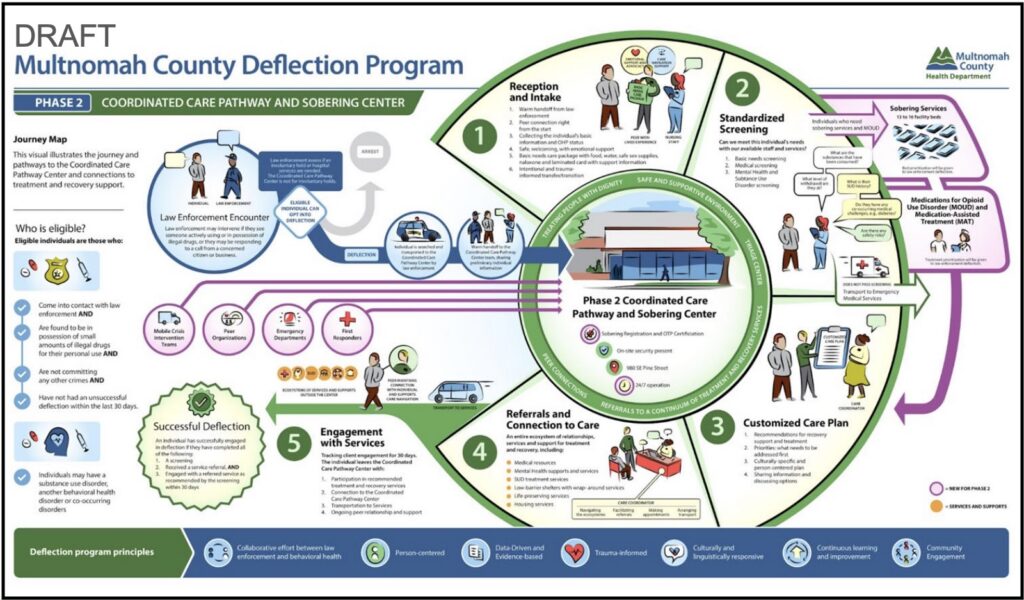
In Multnomah County, Oregon’s most populous, being referred to a jail-deflection program means being transported by an armed police officer through Portland’s bustling Central Eastside to Coordinated Care Pathway Center, operated by Baltimore-based Tuerk House. But only if the quantity of drugs falls under a certain threshold, there are no other charges involved, and the person has no outstanding warrants, is not deemed to be in mental health crisis and has not declined to voluntarily enter treatment within the past 30 days.
In January, District Attorney Nathan Vasquez revealed that his office would begin prosecuting deflection participants who didn’t “meaningfully engage” with the program.
This refers to, at minimum, completing the initial assessment. But it will also target participants who don’t enter treatment with any of the providers they’re referred to.
“[We] have a basic plan now,” Pat Dooris, communications director for the Multnomah County District Attorney’s Office, told Filter. “When we hit early April … we will send the health department a list of names of people who have entered deflection. They will send us back information on how they have engaged with the program and we will then decide if they have successfully completed it or not.”
Dooris said that the DA’s Office will be looking for participants to begin engaging with treatment “right away,” and “will judge how often and how meaningfully” they do so.
Previously, county health officials did not communicate with the district attorney’s office about deflection program participants. While elsewhere in the state participants might face charges depending on the program’s view of their performance, according to Dooris, “there were no consequences for failing deflection in Multnomah County.”
In February, the county enacted a resolution that clarified that Vasquez may file charges “if a deflection participant leaves the Pathway Center before completing a screening or assessment,” which close to one in three participants did in 2025. Though it did not discuss the possibility of criminal charges for participants who enter the program but don’t follow up with at least one treatment provider, it did increase the window to do so from 30 days to 90 days. This mirrors the timeline set by Vasquez: For participants who began the deflection program January 5, their deadline to engage with treatment would be April 5. The State of Oregon’s Criminal Justice Commission also approved “similar” changes “to align the program with policy changes from the District Attorney’s Office.”
More than 50 years since Richard Nixon declared that “America’s public enemy number one in the United States is drug abuse,” this is how one of the nation’s most liberal cities is continuing the War on Drugs.
County Commissioner Shannon Singleton, who co-sponsored the February resolution, told Filter that it is important “providers are defining engagement” because each person’s case is different, and so engagement can’t be defined by policymakers.
“I don’t think we are there yet,” she said, when asked if Multnomah County has a unified strategy on deflection models. She also pointed out that there’s a “disconnect between our behavioral health system and our homeless services system.”
In its first year, the voluntary engagement rate for people referred to the Coordinated Care Pathway Center was 65 percent. Of those who engaged, the “successful” completion rate was 29 percent. Both rates are slightly higher than the state-wide averages (62 percent and 22 percent, respectively).
“Part of the problem with any alternative to prosecution is that they are judged in a vacuum,” Grant Hartley, director of Metropolitan Public Defender, the state’s largest provider of public defense services, told Filter. Hartley believes the deflection model would look like incremental progress, if those numbers were judged against treatment engagement and completion rate through the carceral system. This is why he is against Vasquez’s plan.
“The [criminal-legal] system has failed over and over to address these issues through this type of prosecution,” he said.
He also emphasized that Portland doesn’t have the criminal-legal resources to prosecute its way out of the problem. There aren’t enough public defenders to take on these cases, and there are also not enough probation officers “to really supervise these people meaningfully” once they are presumably jailed and released on probation.
In his view, if a participant is deemed to be “failing” deflection, the situation only becomes more complex, once “the only option for the DA now is to issue an arrest warrant for that person.”
Hartley would also like to see Multnomah County’s deflection program take an approach more like King County’s Law Enforcement Assisted Diversion (LEAD) program, calling it a “very reliable, excellent model [that’s] been proven for decades, and yet we all kind of ignored it.”
“It’s far, far more important to invest in a strong case management team that can stick with people for a long time.”
“It’s important to remember that deflection is not a solution in and of itself,” Shannon Wight, the deputy director of Portland-based nonprofit Partnership for Safety and Justice, told Filter. “It can’t address the underlying lack of affordable housing.”
Wight is a big proponent of the LEAD program in King County, Washington state’s most populous, where Seattle is located—which was born out of racial disparities in the county’s drug possession charges. King County provides intensive case management—not only for the deflection program participants, but for local businesses as well, providing field-based training and support in how to address public disturbances. Wight recently organized a small delegation, including Commissioner Singleton, to travel to Seattle to witness this model in action.
One of the other stark differences between the deflection models in Multnomah County and King County is that the latter does not have a deflection center.
“We’ve operated a deflection framework for 15 years without a deflection center,” Lisa Daugaard, primary architect of Seattle’s LEAD model, told Filter. “It’s far, far more important to invest in a strong case management team that can stick with people for a long time.”
Daugaard stressed that above all, people need stable housing.
“If you have money for capital facilities, a place for people [in recovery] to live is incredibly valuable,” she said.
For Multnomah County, it is hard to ignore this reality—81 percent of deflection program participants were experiencing homelessness when they were referred. This will be the population that bears the brunt of the criminal charges Vasquez is promising to bring after April 5.
Wight, from Partnership for Safety and Justice, emphasized that the point of deflection to the Coordinated Care Pathway Center is to reduce prosecutions.
“If prosecution becomes the default,” she said, “then the program has lost its core purpose.”
Update, March 26: This article has been updated with additional comment from the Multnomah County District Attorney’s Office.
Top image via Multnomah County Communications Office. Inset graphic (cropped) via City of Portland, Oregon.